


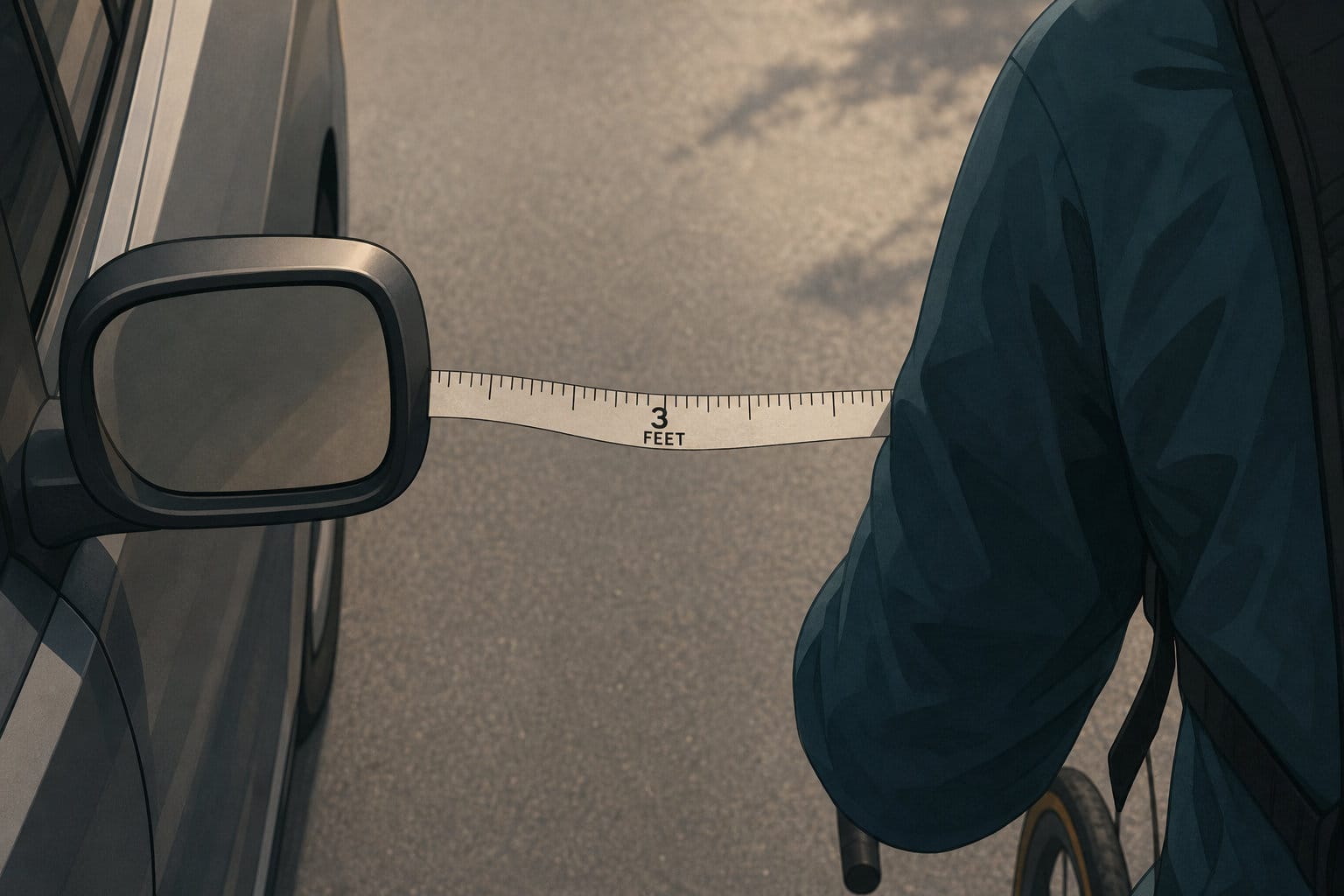
Two weeks ago I wrote (in The Law That Was Supposed to Protect Cyclists) about a flaw in Houston’s safe-passing ordinance: a motorist can satisfy the law simply by staying in their own lane when passing a cyclist riding in an adjacent bike lane, regardless of the actual passing distance, because the ordinance’s “vacate the lane” option and its “pass at a safe distance” option are written as alternatives, not a pair. A driver only has to clear one bar, and staying put clears the easier one.
That flaw led me further than just Houston. Over the past week I read through the actual text of several other safe-passing laws — enacted in Austin, Fort Worth, San Antonio, Dallas, California, and Illinois — along with the model ordinances currently published by BikeTexas and the League of American Bicyclists. Every one of them has some version of the same underlying problem: a distance requirement that’s supposed to function as a fixed minimum, but bends somewhere in the text, in ways ranging from subtle to severe. I don’t know of a jurisdiction that gets all of it right at once — Houston, Austin, Fort Worth, San Antonio, and Dallas mostly avoid one problem but keep another; California and LAB’s model avoid some of that but keep a different one; Illinois solves a piece none of the others do and still shares a gap with California and LAB. I can’t claim to have checked every ordinance in the country, but everywhere I looked, something was missing.
What follows is organized around seven specific flaws, each with its own ordinances to point to. By the end, the case adds up to actual language — not a patch for Houston’s ordinance specifically, but a whole new model any city or state could adopt.
Flaw one: a “vulnerable road user” law that only protects cyclists
Houston, Austin, and San Antonio all define “vulnerable road user” broadly — pedestrians, people on horseback, road workers, scooter and moped riders, and cyclists alike. Most of the laws this essay examines don’t. California’s statute, LAB’s model, Nevada’s, and Delaware’s are all scoped to bicycles specifically, not the broader category their reputations might suggest. Kentucky’s stretches slightly further to include electric scooters. Illinois’s covers “a bicycle or individual,” which reads like it might include pedestrians but was never confirmed as clearly as the others.
Dallas is the sharpest example, because its own ordinance uses the term “vulnerable road user” and still gets this wrong. Its definition covers a person operating “a bicycle, hand cycle, unicycle, or other human-powered wheeled vehicle” — full stop. No pedestrians. No one on horseback. No road worker standing in the shoulder. A law that calls itself a vulnerable-road-user ordinance, in a city that adopted that exact name, protects a narrower group of people than the plain meaning of its own title.
The fix is the broad definition already built into the model language: pedestrians, equestrians, road and utility workers, riders of mopeds and scooters, and cyclists, all covered under the same term and the same protections. Every other flaw in this essay assumes that breadth is already there. It shouldn’t have to be assumed.
Flaw two: a lane change that doesn’t have to produce any distance
Houston’s ordinance lets a motorist satisfy the law by “vacating” a cyclist’s lane, which requires only that the motorist not be in that specific marked lane — no minimum distance is attached to that option at all. A driver who never leaves their own adjacent lane has still, on paper, vacated the cyclist’s.
Houston didn’t invent this structure. It traces back to a bill the Texas Legislature passed in 2009, known as SB 488, which would have imposed a statewide 3-foot passing minimum and introduced the term “vulnerable road user” into Texas law. It passed the House unanimously and the Senate 25–5, but Governor Rick Perry vetoed it — a post-session veto, not subject to override. After that, the advocacy group BikeTexas shifted strategy toward getting cities to adopt local versions of the same model ordinance one at a time. Houston came to this late, the last major Texas city to get one, adopting BikeTexas’s model largely intact in 2013.
I recently asked Robin Stallings, BikeTexas’s executive director since 2003 and one of the people who actually worked on this language, where the lane-change option came from. His answer: it evolved across multiple legislative sessions going back to 2001, and is inspired by Move Over laws — the familiar rules, on the books in some form in all fifty states, requiring a driver to change lanes away from a stopped emergency vehicle or roadside hazard when safe. A plausible, concrete answer: the option almost certainly wasn’t built as a permissive escape hatch. It was borrowed from a framework nobody thought to stress-test against a slower-moving cyclist instead of a stationary hazard.
Austin, Fort Worth, and San Antonio inherited the same basic structure. Dallas took a different path and landed on the same core flaw anyway: it requires a motorist to entirely vacate a cyclist’s lane, and separately prohibits re-entering that lane before passing at a safe distance. That second duty sounds like real protection until you notice it only applies to a motorist who enters the cyclist’s lane in the first place — a driver who stays in their own adjacent lane the whole time never “re-enters” anything, so the distance requirement never triggers. Different wording, same loophole.
The League of American Bicyclists’ own model has a version of it, too. Its rule for multi-lane roads requires a driver to “move the vehicle to the lane to the immediate left, if the lane is available and moving into the lane is reasonably safe” — with no distance requirement attached to that branch at all. “Reasonably safe” is the only qualifier. On any multi-lane road, LAB’s model never actually requires a driver to achieve any specific distance from the cyclist; it only requires changing lanes.
Every one of these instances is solved the same way: make distance the only thing that can satisfy the law, regardless of how many lanes exist or whether one of them happens to be marked for bikes. A lane change is never sufficient on its own under language built that way — only the distance actually achieved matters, whether a driver gets there by changing lanes or not.
Flaw three: a floor that isn’t really a floor
Fort Worth, San Antonio, and Austin all define “safe distance” the same way SB 488 originally did — “when road conditions allow, safe distance is at least” three feet, or six — language still sitting, uncorrected, in BikeTexas’s own current model ordinance.1 Read plainly, that phrasing makes the distance figure itself conditional, not a floor — a driver could argue conditions simply didn’t allow for it. Austin is the sharpest example: it’s the city most Texans would call the state’s cycling capital, home to BikeTexas itself, and it still has this exact soft spot. Houston’s ordinance doesn’t; it defines safe distance as whatever accounts for road, traffic, and weather conditions, “but, in any event, not less than” three feet or six — an unconditional hard minimum. The city with the strongest cycling reputation in Texas kept the softer language. Houston, generally thought of as far more car-centric, is the one that quietly fixed it.
Dallas doesn’t even get that far — nowhere in its ordinance is “safe distance” ever actually defined with a number. The 2009 state bill this whole family of ordinances descends from was written specifically to fix an “inadequately defined ‘safe passing distance’” already sitting in Texas law. Dallas’s version ended up right back there.
California’s law sets a 3-foot default with no lane-change escape hatch, but it isn’t a truly unconditional floor either. Where a driver genuinely can’t achieve 3 feet, the law shifts to a discretionary standard: slow down, and pass only when doing so “would not endanger the safety of the operator of the bicycle.” A pass at less than 3 feet can be legal under this fallback — an honest acknowledgment that literal compliance isn’t always possible, but a vague enough standard that it’s hard to enforce and easy for a defense attorney to argue after a collision. The “slow to a reasonable speed” piece is doing more work than it looks like, too: none of these laws otherwise account for the fact that the same lateral clearance is more dangerous at higher speed, and California’s fallback seems to informally treat reduced speed as compensation for reduced distance without ever saying so. That’s two distinct problems — a road too narrow to comply, and an unaddressed speed differential — solved with one vague mechanism built for neither.
This isn’t a hypothetical problem to solve from scratch, either. Illinois already requires exactly what I’d propose: an unconditional 3-foot minimum, a lane change as a separate additional duty rather than a substitute for it, and a plain instruction to wait if the full distance isn’t achievable. Chicago’s own ordinance just adopts the state standard directly.
The fix gives the answer every other slow-moving obstacle already gets: wait. Nothing about a cyclist makes that principle stop applying, and existing rules on crossing a centerline already provide a real way around a slow vehicle when the road is too narrow to share, without a special exception written just for this.
Flaw four: protection that only runs one way
California’s and Illinois’s laws, and LAB’s model, all condition their core passing-distance duty on the vulnerable road user “proceeding in the same direction” as traffic. Houston’s ordinance, and the Texas cities that share its structure, don’t; their own “same direction” language describes the road’s lane configuration, not which way the vulnerable road user is traveling. That’s a point in Texas’s favor, whether or not anyone drafting these ordinances thought about it in these terms. A same-direction condition is a reasonable assumption for a bicycle-specific law, since cyclists are generally required to ride with traffic. It’s a bad assumption for pedestrians, who are frequently required by law to do the opposite — walk facing oncoming traffic, specifically so they can see it coming, on roads without a sidewalk. A law that only protects same-direction travelers leaves a pedestrian walking exactly as the law tells them to with no protection at all.
“Wait” isn’t a coherent instruction for an oncoming vulnerable road user the way it is for one being overtaken. A driver catching up to a slower cyclist can simply hang back until it’s safe to pass. A driver and an oncoming pedestrian are closing the distance together — there’s nothing to wait out, and reversing away from them isn’t a sensible legal requirement either. That case needs its own remedy: a driver who can’t maintain the same distance while meeting a vulnerable road user coming the other way has to move as far from their path as safely possible and slow down as the gap closes, rather than an instruction that only makes sense if the vulnerable road user is the one being followed.
Flaw five: an assumption about which lane the cyclist is in
LAB’s “move to the lane to the immediate left” instruction assumes the cyclist is always riding in the rightmost lane. It’s not just a model law’s problem, either — LAB says its language is modeled directly on the actual statutes of Nevada, Delaware, and Kentucky, and all three confirm it.2 The assumption is reasonable on an ordinary two-way street. It stops being one on the kind of wide, one-way street that dominates downtown Houston, where a cyclist might legitimately be in a left-side lane — positioning for a left turn, staying visible at cross streets, avoiding a right-hook conflict, or simply keeping pace with slow, congested traffic the same way any other vehicle ends up in whichever lane is moving. A motorist approaching from the right in any of those situations would need to move right to pass safely, not left, and none of this language contemplates it. The fix sidesteps the problem entirely by never specifying a direction at all — a driver changes into whatever lane is actually available and safe.
Flaw six: no way to make an unwitnessed violation count
None of the enacted ordinances reviewed here give a collision itself any evidentiary weight. That matters because of a problem my previous essay documented directly: officers describing this exact kind of violation as “very difficult” to observe and cite in the moment, since it requires catching a driver mid-pass rather than investigating something after the fact. A collision is the one piece of evidence that always exists after a close pass goes wrong, and none of these laws use it. LAB’s model does — treating a collision between a motor vehicle and a cyclist as prima facie evidence of a violation. It doesn’t prove a violation on its own, but it shifts the burden onto the driver to show the collision wasn’t the result of one, giving officers and courts something to work with after the fact instead of only in the moment.
Flaw seven: an affirmative defense with no causation requirement
Houston, San Antonio, and Austin all give a driver the same broad way out: an affirmative defense if the vulnerable road user was, at the time, violating any traffic law at all — with no requirement that the violation have anything to do with the encounter. An unrelated infraction from three blocks earlier is enough, on this language, to hand a driver’s attorney something to work with. Tying the defense to proximate causation instead keeps the fairness underneath it intact — a driver genuinely shouldn’t be liable for a collision the vulnerable road user’s own illegal conduct actually caused — without leaving the door open that wide.
Putting all the fixes together
Six clauses, each answering a specific failure in a law already on the books somewhere:
(a) In this section, “vulnerable road user” means a pedestrian, including a runner, physically disabled person, child, skater, highway construction or maintenance worker, tow truck operator, utility worker, other worker with legitimate business in or near the road or right-of-way, or stranded motorist or passenger; a person on horseback; a person operating a bicycle, handcycle, micro-mobility device, or other human-powered wheeled vehicle or conveyance; a person operating equipment other than a motor vehicle, including unprotected farm equipment; or a person operating a motorcycle, moped, motor-driven cycle, or motor-assisted scooter.
(b) A driver of a motor vehicle overtaking a vulnerable road user proceeding in the same direction, or a stationary vulnerable road user, shall, regardless of the number of marked lanes available or whether a marked bicycle lane is present, maintain a distance of not less than three feet between any part of the vehicle and the vulnerable road user, or not less than six feet if the vehicle is a bus, heavy truck, or other commercial motor vehicle. A driver who cannot maintain this distance shall not pass, and shall wait until the required distance can be achieved.
(c) A driver of a motor vehicle meeting a vulnerable road user proceeding in the opposite direction shall maintain the same distance required by subsection (b). A driver who cannot maintain this distance shall move as far from the vulnerable road user’s path as can be done safely, and reduce speed as necessary to do so.
(d) If a vulnerable road user is proceeding in the same lane of travel as the motor vehicle, and another lane proceeding in the same direction is available, the driver shall change into that lane before passing, if it is safe and practicable to do so.
(e) A collision between a motor vehicle and a vulnerable road user is prima facie evidence of a violation of this section.
(f) It is an affirmative defense to prosecution under this section that the vulnerable road user’s own violation of a traffic law proximately caused the driver’s inability to comply with this section.
This is a textual model any city or state could use.
Even the best-written law isn’t enough on its own
California’s penalty is a genuine weakness on its own terms: $35 for a basic violation, $220 even with bodily injury. But laid against the rest of the field, California turns out to be the outlier on the low end, not the norm. Houston and Austin both cap out at $500. Dallas goes up to $500 for injury. Fort Worth splits its violations into a three-tier schedule topping out at $500. Illinois — the same state whose distance requirement and “wait” mechanism this essay has already held up as the closest thing to a working model — caps its penalty at $1,000, nearly triple Houston’s and close to thirty times California’s base fine. Good drafting and a real deterrent aren’t in tension with each other; a state has already managed both at once.
Only one example in this whole comparison ever created a criminal offense for the worst case: SB 488, which classified a bodily-injury violation as a Class B misdemeanor, carrying up to $2,000 and 180 days in jail. It’s also the one example that never became law. Everything that actually got enacted, in Texas and California and Illinois alike, tops out at a fine — real money, in some cases a fair amount of it, but never anything a court could actually put someone behind bars for, however badly a pass went.
None of this changes what Houston’s own numbers show: only 27% of the fines assessed on the citations Municipal Courts could actually account for were ever actually collected. Closing the textual loopholes would mean a cyclist riding in a marked bike lane actually has an enforceable distance protection, which right now they mostly don’t. But fixing the words on the page doesn’t fix everything else my previous essay documented: sporadic enforcement, dismissals running two-to-one against convictions, fines that go mostly uncollected. A better-written law still needs someone willing to write the citation, and a court system willing to make the fine mean something once it’s written. Getting the text right just means the rest of the system finally has something real to enforce.
Fort Worth Code of Ordinances § 22-95; San Antonio Code of Ordinances § 19-9(c) (adopted Feb. 4, 2010); Austin Code of Ordinances § 12-1-35(C) (adopted Oct. 22, 2009, amended May 3, 2019). All three use the same “when road conditions allow” language.
NRS 484B.270(2)(a), KRS 189.340(2)(a), and Del. Code tit. 21, § 4116(1) all require a driver, on a multi-lane road, to move into the lane to the immediate left, with no distance requirement attached to that branch — the same shape as Flaw Two, live in three states’ actual law.