


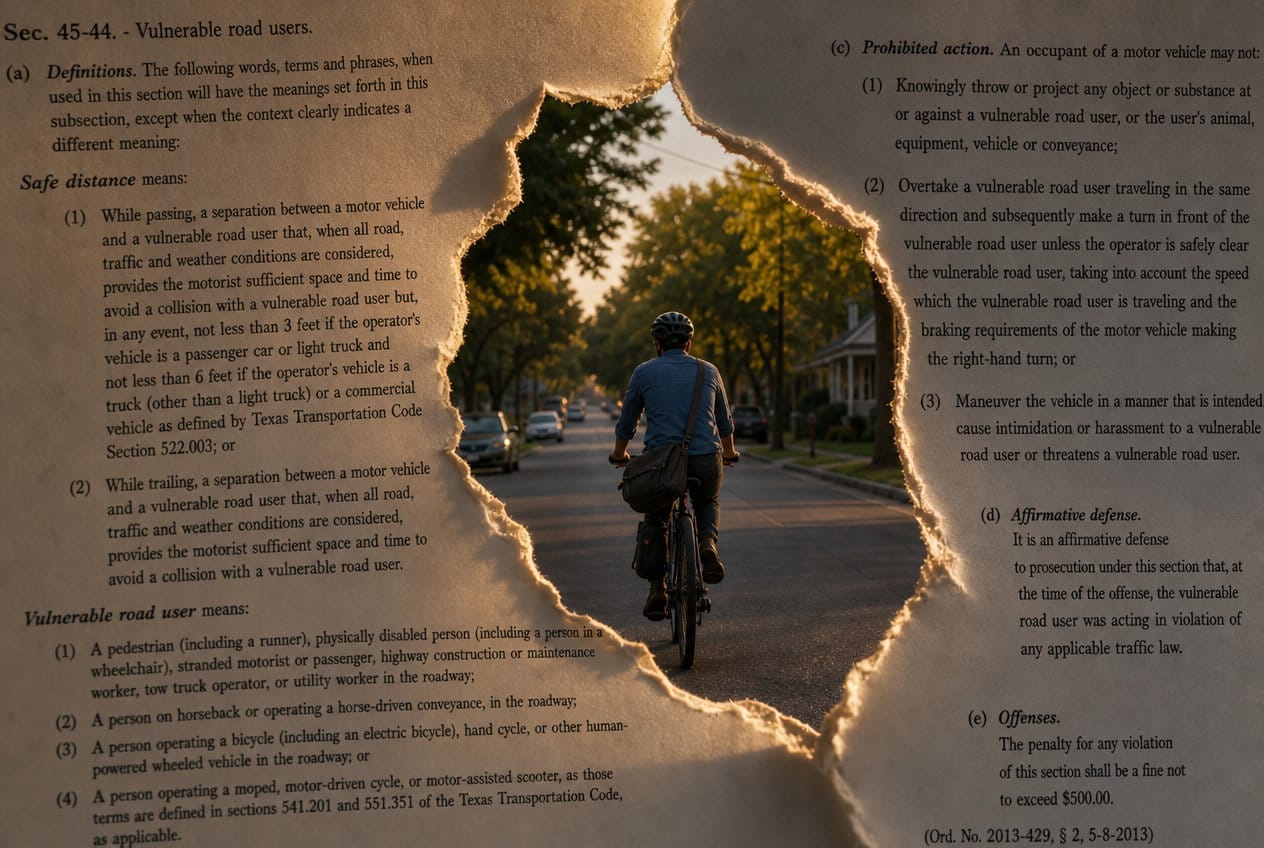
Chelsea Norman was 24 years old, riding south on Waugh Drive just past West Gray Street, when a hit-and-run driver fatally struck her in the early hours of December 1, 2013. Ten days later, Houston Police wrote the first citation under the city’s seven-month-old Vulnerable Road User ordinance1 — the first time officers had used a law meant to protect exactly the kind of rider Norman had been.
Houston had passed that ordinance in May 2013. Then-Mayor Annise Parker, signing it, put its purpose plainly: “As a city, we need to protect everyone and anyone who uses our roads.”2 Even so, that first citation came slowly, and only after a death made the shortfall impossible to ignore. A year and a half after the ordinance passed, a Houston Chronicle editorial made the point plainly: “Like many well-intentioned laws, this one is seldom enforced.”3 Real enforcement wouldn’t begin until a sting operation the following summer, and even that effort produced only 10 citations over a seven-week span. The irony is sharper than it first appears: in the two years immediately before this ordinance passed, Houston police had issued to cyclists 788 citations in 2011 and 688 in 2012, for their own traffic violations.4 Whatever else was true about enforcement priorities, ticketing cyclists themselves was never the problem.
The ordinance itself — Houston Code of Ordinances Sec. 45-44, commonly called the “safe passing” ordinance — requires a motorist passing a lawfully-operating cyclist to do one of two things: vacate the cyclist’s lane entirely, or pass at a safe distance — at least 3 feet for a passenger car or light truck, at least 6 feet for a bus or other heavy commercial vehicle.
That sounds like real protection. But it has a hole in it the size of a bike lane.
The loophole, in the ordinance’s own words
The two requirements are written as alternatives, not as a pair. A motorist has satisfied the ordinance the moment either condition is met, not both. And that creates an odd asymmetry for exactly the riders the ordinance’s supporters probably pictured it protecting most: cyclists riding in a marked bike lane.
If a cyclist is in a bike lane and a motorist stays entirely within their own adjacent travel lane, the motorist has satisfied the “vacate the lane” condition by simply never being in the bike lane. Nothing about that condition actually requires distance; it only requires absence from the cyclist’s specific marked space. Once that’s true, the passing-distance requirement in the second condition is rendered moot.
A cyclist “taking the lane” — riding in a general travel lane rather than a marked bike lane — keeps the ordinance’s full protection. A cyclist doing exactly what a painted bike lane invites them to do may have no enforceable minimum passing distance whatsoever. The ordinance, read on its own terms, structurally favors the riding position it presumably wasn’t written to contemplate.
A similar gap on the state level
Texas state law has a related wrinkle. Texas Transportation Code §551.103(a)(4) gives cyclists two separate paths to legally use a full travel lane rather than hugging the right edge: subsection (A), a bright-line rule available whenever the lane is under 14 feet wide and has no adjacent bike lane; and subsection (B), available whenever a lane is “too narrow for a bicycle and a motor vehicle to safely travel side by side,” regardless of its width or whether a bike lane exists nearby.
The moment a bike lane is painted next to a narrow travel lane, subsection (A)’s automatic, no-argument-required entitlement disappears — even if that bike lane is unusable, blocked, or too narrow to actually ride in safely. Subsection (B) remains available, but it isn’t automatic; in court, a cyclist would have to affirmatively show the lane is genuinely unsafe to share. The bike lane’s mere presence doesn’t eliminate a cyclist’s right to take the lane — but it downgrades that right from a free entitlement to something that has to be argued and proven. (This is one reason why converting a wide outside lane into a narrow lane plus a traditional unbuffered bike lane is counterproductive.)
The unlawful-cyclist exception
Sec. 45-44 has one more quirk worth naming. Subsection (d) provides an affirmative defense: a motorist can’t be convicted if the cyclist was, at the time, violating any traffic law themselves. Combine that with the state-law problem above, and a motorist’s attorney has a ready-made argument sitting in plain sight: point to the nearby bike lane, argue the cyclist should have been riding in it, and force the cyclist to prove after the fact that the narrow-lane exception actually applied to them. The cyclist doesn’t necessarily lose that fight. But they have to have it, in a courtroom, after the collision that already happened.
None of this shows up as a line item in any dataset — citation records don’t track which defenses were actually raised in a given case. What they do show is how the ordinance functions overall, once you look past its text and into its record.
Thirteen years of citations
I requested Houston Municipal Courts' complete Sec. 45-44 citation record through a public information request: every citation issued under the ordinance, 2013 through 2025, with outcomes and violation subsections broken out. That record showed 50 citations. But cross-referencing it against a separate, independently-obtained dataset — this one shared with me by Houston Chronicle reporter Dug Begley, who'd pulled his own records on this ordinance back in 2022 — turned up a fuller, more reliable total: 72 citations over thirteen years.5
That overall rate of roughly five and a half citations per year seems strikingly low — but the distribution across those thirteen years tells a sharper story. Forty of the 72 citations (55.6%) were issued in just three years: 2015, 2016, and 2017. A separate, earlier burst in 2014 (10 citations) suggests the ordinance saw real, if inconsistent, use through its first five years — 57 of the 72 citations, nearly 80% of the entire thirteen-year total, were issued by the end of 2018. From 2019 onward, enforcement settled into a genuine, sustained quiet: an average of two citations per year for seven straight years.
Contemporaneous reporting fills in why the mid-2010s look the way they do. A sting operation that ran from late July through mid-September 2015 produced 10 citations on its own — nearly 14% of every citation issued under the ordinance across its entire thirteen-year history, packed into a seven-week window. Most of those citations were issued between roughly 8 and 10 in the morning, consistent with a deliberate effort to catch drivers during the actual commute hours cyclists share the road with them. It was, by any reasonable reading, a real operation — and also, per the record, one that was never repeated at that scale again.
There’s a real practical reason enforcement was so sparse in those early years, not just neglect. HPD Assistant Chief Mark Eisenman told the Houston Chronicle in December 2013 that citations “for riding too close to a bicyclist are very difficult to issue because an officer has to observe the violation while not en route to another call for service.”6 HPD Captain Larry Satterwhite, whose team conducted the department’s early stings, made much the same point three months later: “Judging what’s three feet and what’s not is very difficult to do.”7
What happened to the citations that were written
Full case-outcome detail — whether a citation was dismissed, resulted in a conviction, or simply went unresolved — is only available for the 50 citations in my original Municipal Courts dataset; the 22 additional citations found through the comparison above don’t come with that same level of detail. For the 50 citations where the outcome is known, 33 — two out of every three — were dismissed. Only 13 of them, just over a quarter, resulted in an actual finding of guilt, a fine, or a paid judgment. Four more remain outstanding failure-to-appear warrants, never resolved at all.
The single largest reason for dismissal wasn’t a judge finding the driver not guilty on the facts. It was “Officer Not Present” — the citing officer simply didn’t show up to court — accounting for 11 of the 50 (22%). Combined with insufficient-evidence and defective-complaint dismissals, the clear majority of these dismissals reflect process failures, not the underlying facts being contested.
Of the $17,611.50 nominally owed across these 50 citations, only $4,748.80 (27%) was ever actually collected.
The violation that matters most, cited least
The combined citation data break down by specific violation subsection. Two categories dominate the numbers: failing to vacate the lane or pass at a safe distance (28 citations across 13 years), and failing to yield right-of-way on a left turn — the “left-cross” hazard, a motorist turning left across a cyclist’s path (25 citations).
But two smaller categories are the most telling. Only four citations, in 13 years, were issued for overtaking and turning right in front of a vulnerable road user — the “right-hook” maneuver responsible for some of the most severe cyclist injuries and deaths nationally. And only four citations, in 13 years, were issued under the ordinance’s most serious provision:8 maneuvering a vehicle to intimidate, harass, or threaten a vulnerable road user. Of the three in each category with known outcomes, all three were dismissed — the fourth, found through the newer dataset, doesn’t come with outcome detail, but there’s no reason to think it fared any better. In over a decade on the books, the single most aggressive violation category the ordinance recognizes has, as best I can tell, never once produced a conviction.
This isn’t a retrospective complaint
The concerns above aren’t just visible in hindsight. A Houston cyclist rigged his bike with a 3-foot pole extending sideways just weeks after the ordinance’s first citation was written, specifically to test its buffer requirement, and began forwarding video of cars striking it to city prosecutors. Even Captain Satterwhite, while expressing concern for the man’s own safety, acknowledged on the record: “We definitely have a real issue that we need to address.”9 No follow-up on those forwarded videos appears anywhere in subsequent reporting. Coverage in the Chronicle from 2015 through 2018 raised nearly identical questions in real time, again and again. A March 9, 2017 editorial put it as plainly as the “seldom enforced” line from over two years earlier, saying that enforcement of the ordinance “has been almost nonexistent.”10 Then–Police Chief Art Acevedo pledged that same year, “We will be writing tickets.”11 A year later, the paper reported 23 cyclists had been killed in Houston in the five years since the ordinance passed — against roughly 53 citations and 33 warnings issued over that same period. BikeHouston’s then–executive director John Long publicly criticized a July 2017 incident in which a driver was found at fault for striking a cyclist at Heights Boulevard and I-10, yet no citation was issued at all. A Rice University cycling club president, quoted in the same reporting, named the mechanism directly: officers investigating crashes “either are not aware of the law or do not think of it.”
None of this required thirteen years of hindsight to see. People were saying it as it happened.
What the law promises, and what it delivers
Put the legal analysis and the enforcement data side by side, and a single picture emerges. Houston’s VRU ordinance, read carefully, contains a structural flaw that leaves cyclists riding in marked bike lanes without an enforceable passing-distance protection at all. And the ordinance that exists has been enforced sporadically, in short campaigns that faded almost as soon as they started, resolved in the driver’s favor two-thirds of the time, and apparently has never secured a conviction for its most serious violation.
A law that reads as protective on paper isn’t the same thing as a law that functions as protective in practice. For a cyclist deciding how to ride today, that distinction isn’t academic. Knowing precisely where the ordinance’s protection actually reaches — and where it quietly doesn’t — is itself a piece of knowledge worth having, regardless of what the next legislative session or the next enforcement campaign eventually does about it.
By 2022, city officials had settled on a different explanation for the thin numbers: the ordinance, they said, was never really meant to be enforced this way at all. “We are not going to ticket our way out of turning those drivers around,” HPD Commander Kristine Anthony-Miller told the Chronicle that October, describing the department’s preference for “awareness and signs” over citations.12 It’s a hard claim to square with the historical record above — Chief Acevedo’s own 2017 pledge was specifically about writing more tickets, not fewer — but it’s a useful admission in its own right: nine years in, the people responsible for enforcing the ordinance had stopped pretending its original purpose was enforcement.
Its practical legacy today is more a memorable slogan than a functioning law. “Three feet, it’s the law” has outlived the follow-through that was supposed to give it teeth. A billboard campaign bearing that message four years after the ordinance’s passage probably did much more to fix the phrase in public memory than the courts have ever done to fix it in practice.
I am not an attorney, and nothing in this essay should be construed as legal advice. The above is a lay reading of public statutory text and public records; anyone with legal questions about a specific situation should consult a licensed attorney.
Houston Chronicle, “Law to help cyclists spurs few citations,” January 7, 2015.
CultureMap Houston, “Safe passing ordinance goes into effect immediately: New rules to protect pedestrians, bicyclists,” May 8, 2013.
Houston Chronicle, “Pedal forward,” December 19, 2014.
Houston Chronicle, “Cyclists, walkers get room on roads with law,” May 9, 2013, citing figures given by Mayor Parker.
Comparing the two datasets by case number turned up 22 real, dated citations present in his file that don't appear in the record Municipal Courts sent me in 2026 — including the December 11, 2013 citation discussed in the opening footnote, confirming Lt. Chavez's account. It's a real, unexplained discrepancy in what should be a single, consistent public record; I've asked Municipal Courts directly about it and will update this piece if I learn more. One limitation worth flagging: Begley's dataset doesn't include the same case-outcome detail (dismissed, convicted, fine paid) that my own dataset does, so anywhere this piece discusses what happened after a citation was issued, it's necessarily working from a smaller, though still substantial, subset of the full total.
Houston Chronicle, “Cyclists say police not enforcing ordinance,” December 11, 2013.
Houston Chronicle, “City launches plan to keep cyclists safer,” March 26, 2014.
Subsection (c) actually contains three separate prohibited actions: (c)(1) knowingly throwing or projecting an object at a vulnerable road user; (c)(2) the right-hook maneuver; and (c)(3) maneuvering a vehicle to intimidate, harass, or threaten a vulnerable road user. This section of the essay is specifically about the third of these.
Houston Chronicle, “Bicyclist makes his point with 3-foot pole,” April 28, 2014.
Houston Chronicle, “Pedaling forward,” March 9, 2017.
Houston Chronicle, “A pledge to shift gears on cycling safety,” August 7, 2017. (The rest of this paragraph, through the Rice University cycling club president’s quote, comes from the same article.)
Houston Chronicle, “Drivers passing unsafely rarely cited,” October 10, 2022.
I was right hooked in Tucson, AZ a little over 10 years ago by a car that overtook me and turned right into a parking lot. Presumably the driver thought he would pass in front of me and misjudged. There was nothing other than me between the entrance to the parking lot and the driver and I was traveling in a wide non-buffered bike lane on a major arterial street (two lanes each direction). The driver was cited for driving closer than three feet to a cyclist but I do not know exactly how that law reads in AZ. The police officer who cited the driver had the advantage of a video shared with him by the manager of the computer store that the driver was going to that clearly showed the entire incident. The officer did not have to guess at what took place The driver had to enter the cycle lane in order to hit my front wheel with his rear fender (my last recollection before launching forward over my handlebars and sustaining a brain contusion with subarachnoid hemorrhage). My attorney (I was forced to sue as the driver's insurance company refused to negotiate in good faith) said it was the first time he had heard of that citation being issued in Tucson.