


Anyone who rides a bicycle on Houston’s streets knows the feeling. You’re riding where you should, far enough from the curb to stay out of the debris and visible to the drivers behind you, and a pickup roars past with its horn blaring, its driver plainly convinced that you are hogging the road. On some streets this happens far more often than on others, and the difference often comes down to a single number: the width of the lane.
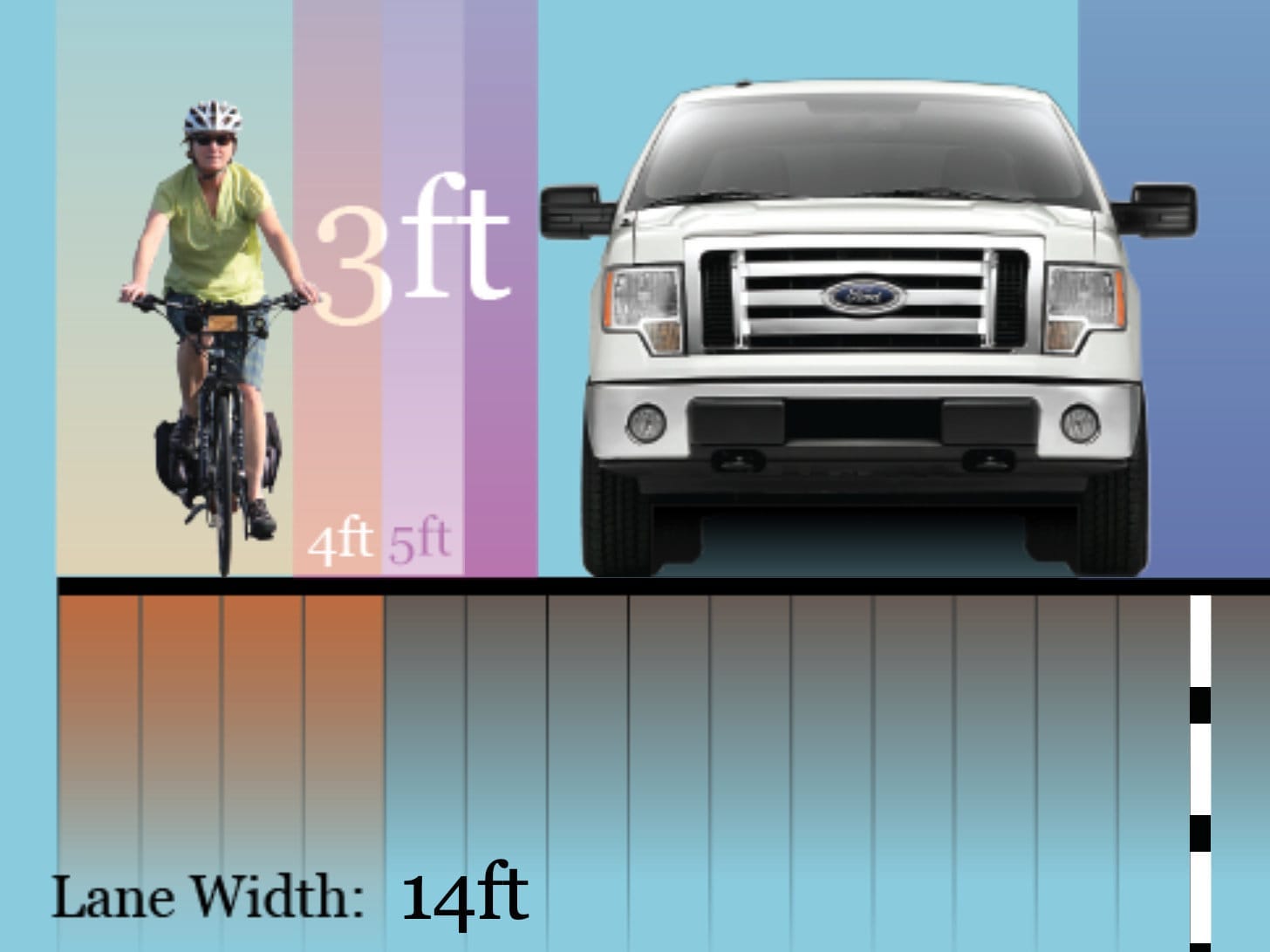
Diagram by Keri Caffrey, used with permission.
The number that causes the most trouble is 14 feet. For decades, planners have treated a 14-foot outside lane as a bicycle accommodation: wide enough, the theory went, for a car and a bicycle to share it side by side. Houston’s 1993 Comprehensive Bikeway Plan leaned on that idea, and the city is still striping 14-foot lanes today. But 14 feet is the worst possible width for a lane shared by bicycles and cars. It is too narrow for a driver to pass a cyclist safely within it, and too wide for a cyclist to claim it without looking unreasonable.
The arithmetic of sharing a lane
Start with the vehicles. A full-size pickup like the one in the diagram is nearly 7 feet wide before you count its mirrors. A cyclist needs 4 to 5 feet of operating space: the width of the handlebars, plus room to wobble, plus enough distance from the curb to avoid the gutter seam, the storm drains, and the broken glass that collects at the edge of the road. Between the two, the law in Houston requires at least 3 feet of clearance when a driver passes a cyclist.1
Add those up and a driver passing a cyclist within the same lane needs roughly 14 or 15 feet with no margin at all, before allowing any space between the truck and the next lane over. A lane that comfortably accommodates side-by-side travel needs to be about 17 feet wide. Fourteen feet is at least 3 feet short.
Drivers seem to know it. A 1999 federal study of streets with wide curb lanes found that motorists passing cyclists moved partly into the next lane 17% of the time, more than twice as often as on streets with bike lanes. The study also found that how much room cyclists got depended mainly on the total width available.2
What Texas law says about 14 feet
Texas law draws its own line at the same number. Like most states, Texas generally requires a cyclist moving slower than traffic to ride “as near as practicable to the right curb or edge of the roadway.” But the law gives cyclists two separate ways to use the full lane instead. One is a bright-line rule: the lane is less than 14 feet wide and has no bike lane next to it. The other applies to any lane “too narrow for a bicycle and a motor vehicle to safely travel side by side,” whatever its width.3
At 14 feet, the bright-line rule no longer applies. A cyclist who takes the lane loses the automatic, no-argument entitlement and has to rely on the second path, which, as I wrote in an earlier essay, has to be argued and proven if anyone challenges it.4 The arithmetic says a 14-foot lane is too narrow to share. The law treats it as shareable until a cyclist proves otherwise. The law and the geometry part ways at exactly the width planners chose.
Why 10 feet works better than 14
The surprising part is that a narrower lane is often better for a cyclist than a 14-foot one. Sometimes less really is more.
In a 10-foot lane, a cyclist riding in the correct position, near the center of the lane, plainly occupies a lane that can’t be shared. No driver needs that explained. Drivers see a lane that’s full, and they change lanes to pass, the same way they would pass a slow-moving truck.
In a 14-foot lane, the same cyclist in the same position seems to be leaving several feet of empty pavement to the right while holding everyone up. The lane looks wide enough to share, so a driver who has to wait or change lanes concludes that the cyclist is being unreasonable. The cyclist is doing exactly what the situation requires, and the street makes it look wrong.
That makes 14 feet a teaching problem as well as an engineering one. As a cycling instructor, I teach students to control the lane when it’s too narrow to share, because that position makes them visible and prevents unsafe passes. A 14-foot lane contradicts the lesson every time they use it. The alternative it invites, riding at the far right edge so drivers can squeeze by, is exactly the position that produces close passes, and it puts the cyclist in the gutter, where the hazards are.
How 14 feet became the standard
The idea of the wide curb lane had respectable origins. For years, the main national guide to bicycle facilities, published by the American Association of State Highway and Transportation Officials, recommended 14 feet of usable width as the standard for a shared lane.5 As recently as 2012, a Federal Highway Administration safety guide still defined a “wide curb lane” as one at least 14 feet wide, “which allows bicyclists and motorists to travel side-by-side within the same traffic lane.”6 Building a wider outside lane was cheaper and less contentious than building bike lanes, and it seemed to serve everyone.
Houston’s 1993 Comprehensive Bikeway Plan, adopted in the wake of a federal law that for the first time made serious money available for bicycle projects, embraced the approach. “The standard width considered desirable for an outside lane to safely accommodate a bicycle and motor vehicle is 14 feet, with an optimum width of 15 feet,” the plan declared, and it recommended that “a wide right-hand lane of 14 to 15 feet width should be adopted as a standard design section for non-residential streets.” The plan even acknowledged the problem at the edge of the road: the lane, it said, “should be wide enough to allow safe passage for the cyclist around obstacles such as drainage grates, parking, and longitudinal ridges between paving and curb and gutter.” It just didn’t account for how much room that takes.7
The plan also offered a recipe for adding wide curb lanes to existing four-lane divided roads without widening them: restripe each side as a 10-foot inside lane and a 14-foot outside lane. It recommended that approach for the “initial implementation” of bikeways in speed zones of 35 mph or less, which covered nearly all of them, because it would “allow more miles of bikeways to be implemented with much less impact on the travelling public.” As proof that it worked, it pointed to Ella Boulevard between 11th and 18th Streets, which was already striped that way and, the plan said, “has not resulted in any unusual traffic accident patterns or complaints.”8 Today, that stretch of Ella has been restriped again, this time with 4-foot bike lanes along the gutter, the plan’s other option for the same road.
I’ll have much more to say about that plan, and the people who made it, in a future essay. Its authors meant well, and they were following the best national guidance of the time. In hindsight, its reliance on 14-foot lanes was a mistake.
Still being striped today
What makes this more than a history lesson is that Houston is still doing it.
On T.C. Jester Boulevard south of West 11th Street, each direction has 24 feet of pavement. It used to be divided into two 12-foot lanes. Not long ago it was restriped as a 10-foot inside lane and a 14-foot outside lane. The old center line was scraped off, but its ghost is still visible on the pavement, next to the new one.
So the 14-foot lane didn’t come from finding new space. It came from taking 2 feet away from the inside lane. The corridor gave up a comfortable travel lane to create an outside lane that still can’t be shared safely, and that makes cyclists who ride correctly in it look like they’re in the way. It is, almost exactly, the 1993 plan’s recipe for retrofitting a four-lane divided road, applied three decades later. This isn’t a leftover from 1993 that nobody got around to fixing. Someone chose 14 feet recently, and on purpose.
Where sharing does work
None of this means that shared lanes can’t work. Houston has a lot of neighborhood collector streets that are 34 feet wide, split into two lanes of about 17 feet each. Dunlavy Street between West Alabama and Westheimer is a good example. Where nobody is parked, those lanes are wide enough for a driver to pass a cyclist with room to spare, and they generally work well.
Parked cars change the picture. A parked car takes up about 7 feet, plus the zone where its door might swing open, and a 17-foot lane with cars parked along it is effectively a narrow lane. That may be fine: a narrow lane, as I said, is easy for a cyclist to control. But it means the same street can be shareable on one block and not on the next, depending on whether anyone is parked there.
Choose a width that tells the truth
The lesson isn’t that every lane should be 17 feet wide, or that every lane should be 10. It’s that a lane should be honest about what it is. A lane narrow enough that it plainly can’t be shared tells drivers to change lanes to pass. A lane wide enough to share, 17 feet or more, lets them pass safely without changing lanes. And a separate space for bicycles removes the question altogether.
Fourteen feet does none of these things. It looks shareable but isn’t, and it makes a cyclist who rides correctly look as if they’re doing something wrong. Of all the widths a city could choose, it’s the one to stop striping.
“The Law That Was Supposed to Protect Cyclists”, On Further Reflection, August 4, 2026.
William W. Hunter et al., “Bicycle Lanes Versus Wide Curb Lanes: Operational and Safety Findings and Countermeasure Recommendations”, Federal Highway Administration, report FHWA-RD-99-035, 1999.
Texas Department of Transportation, “Laws and regulations FAQ”, citing Texas Transportation Code § 551.103(a)(4).
“The Law That Was Supposed to Protect Cyclists”, as in note 1.
American Association of State Highway and Transportation Officials, Guide for the Development of Bicycle Facilities (1999), p. 17: “In general, 4.2 m (14 feet) of usable lane width is the recommended width for shared use in a wide curb lane.”
Federal Highway Administration, “Bicycle Road Safety Audit Guidelines and Prompt Lists”, May 2012 (archived copy).
City of Houston, Comprehensive Bikeway Plan (1993), p. 6-2.
City of Houston, Comprehensive Bikeway Plan (1993), pp. 6-8 to 6-9.