


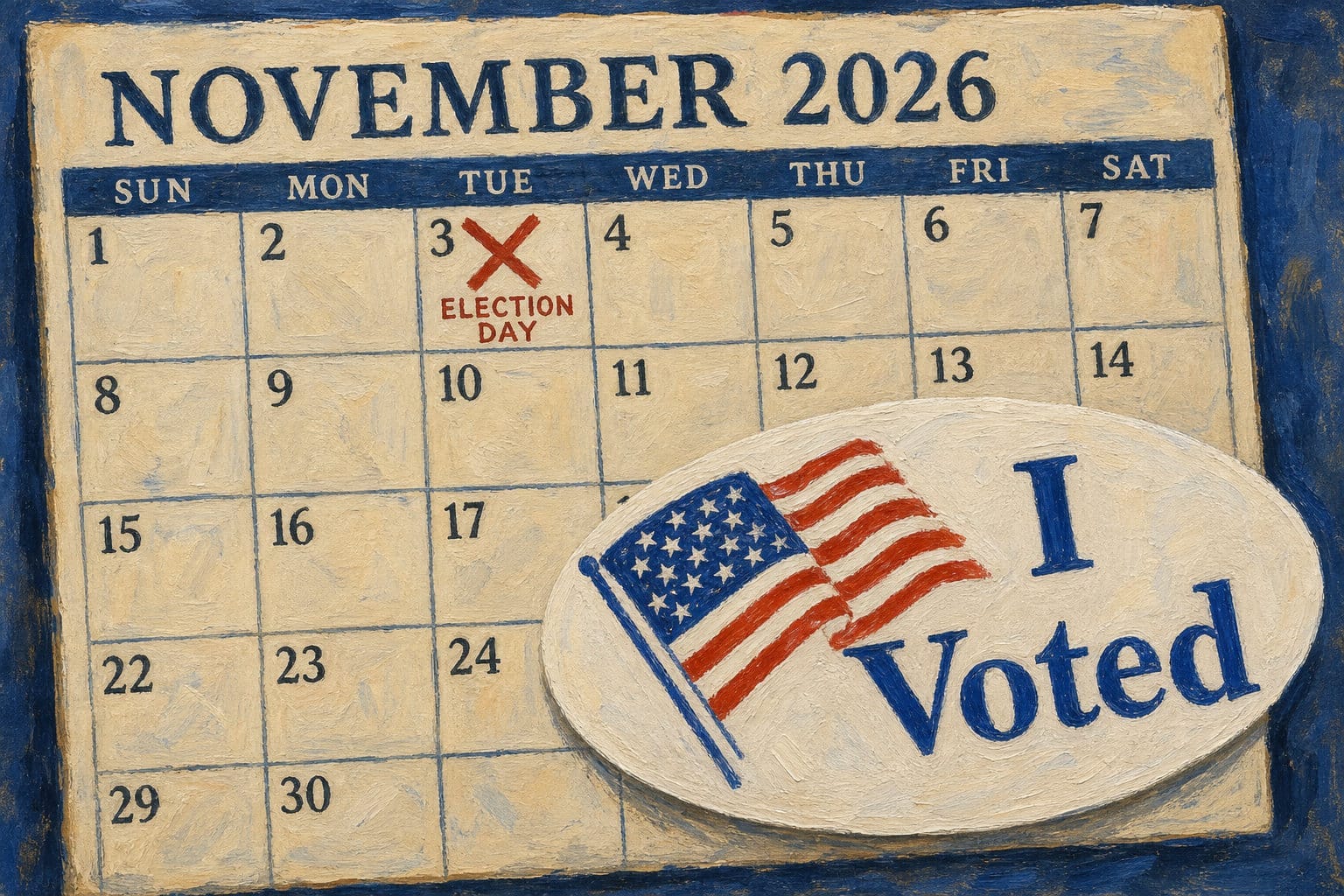
Today is Election Day. Federal law sets it as “the Tuesday next after the first Monday in November” in every even-numbered year, which is a strangely specific way to pick a date.1 Ask why, and you’ll probably hear a story about farmers. November came after the harvest and before the worst of winter. Sunday was for church, and Monday was for traveling by horse to the county seat, so Tuesday was the first day a farmer could vote without breaking the Sabbath or missing Wednesday’s market.
It’s a good story, and it may even describe the world the lawmakers lived in. But most of it isn’t in the record. The reasons Congress actually gave had more to do with fraud, an old deadline, and a new invention.
Before there was an Election Day
For the nation’s first half-century, there was no single Election Day. A 1792 law let each state choose its presidential electors at any time during the 34 days before the first Wednesday in December, when the electors met to cast their votes.2 States held their elections on different days, and some let their legislatures choose the electors with no popular vote at all.
That arrangement followed the Constitution’s own design. Under Article II, the presidential election is the one held by the electors, who must cast their votes on the same day throughout the United States. How each state chooses its electors is left to its legislature, “in such Manner as the Legislature thereof may direct.”3 In 1792, that might mean a popular vote, a vote of the legislature, or something in between, and a single national day for so varied a process would have made little sense. A national Election Day became plausible only after half a century in which, one by one, the states moved to choosing electors by popular vote. By 1844, South Carolina was the only state whose legislature still chose them.4
In a formal sense, the real election is still the one in December. The electors still meet in their states, now on the first Tuesday after the second Wednesday in December, and it is their votes, counted by Congress on January 6, that elect the president.5
The result was an election that could sprawl across a month, and 1844 was the last time it did.6 That created two problems. The first was that results from early states could influence voters in later ones, a problem that was about to get worse: Samuel Morse tested his telegraph that same year, and news that once took days to travel would soon arrive in minutes.
The second was outright fraud. Partisans of the era had a name for one kind of it: “pipe-laying,” the practice of bringing in voters from elsewhere to cast illegal votes. In 1840, a Michigan correspondent complained that “thirty or forty strangers, unknown to any of us,” had voted in his town. With elections spread across different days, the same men could be moved from one state to vote in another. A labor newspaper argued in 1841 that a single national election day would put a stop to it.7
What Congress actually said
In December 1844, the House took up a bill to set one day for the whole country. Its stated purpose, as recorded in the Congressional Globe, was “to guard against frauds in the elections of President and Vice President.”8 The Library of Congress summarizes the 1845 law the same way, as an effort “to address the problem of voter fraud in presidential elections.”9 President John Tyler signed it on January 23, 1845, and the first presidential election held on a single national day took place on November 7, 1848.10
That explains a single day. It doesn’t explain the odd formula. Why not simply the first Tuesday in November?
The answer lies in the old deadline. The electors still met on the first Wednesday in December, and the 1792 law still required them to be chosen within the 34 days before that. The Tuesday after the first Monday in November always falls exactly 29 days before the first Wednesday in December, safely inside the window. Rep. Alexander Duncan of Ohio, the bill’s sponsor, said so on the House floor: his object in proposing that wording, he explained, was “to avoid the necessity of changing the laws in relation to the day on which the electoral colleges now meet.” The first Tuesday in November wouldn’t always work: in a year when November 1 fell on a Tuesday, it would have come 36 days before the electors met, outside the window.11 The strange wording wasn’t about farmers or bookkeeping; it was about fitting a new rule inside an old one.
The story everyone tells
So where does the farmer story come from? It appears in encyclopedias, news explainers, and classroom lessons, often in the same order: the harvest, the Sabbath, the journey to the polls, the market day. Some versions add that Congress avoided November 1 because it was All Saints’ Day, or because merchants did their monthly books on the first of the month.
None of it is unreasonable. America in 1845 was overwhelmingly rural, many voters did have a long trip to the polls, and Congress surely knew that. Some historians accept the agricultural explanation. But when the Congressional Research Service, which writes nonpartisan reports for members of Congress, lists these reasons, it cites modern scholars and reference works, not the congressional debates of 1844 and 1845.12 They may be a fair description of the world Congress was legislating for. They aren’t what Congress said.
From presidents to everything else
The 1845 law applied only to presidential electors. Congress extended the same date to elections for the House of Representatives in 1872, effective in 1876, and to the Senate in 1914, after the Seventeenth Amendment gave voters the power to elect senators directly.13 Most states followed, holding their own elections on the same day for convenience, though some still hold state and local elections at other times.
Election Day is not a federal holiday. A number of states make it a state holiday, but for most Americans it is an ordinary workday.
Elections are no longer one day
For most of its history, the Tuesday rule meant what it said: if you wanted to vote, you voted on Tuesday. That is no longer true. In the 2024 general election, according to a federal report, about 30% of voters cast their ballots by mail and another 35% voted early in person, leaving fewer than 4 in 10 who voted in person on Election Day itself.14 In Texas this year, early voting ran from October 19 to October 30, and over seven million Texans voted that way.15 For most Americans, Election Day is now less the day they vote than the deadline for voting.
I’m one of them. I voted early this year, as I almost always do when I have the option. Partly it’s to avoid the longer lines typical of Election Day, and partly it’s a safety valve, in case something happens that would keep me from getting to the polls on the day itself. Still, something is lost: there is something healthfully communal about standing in a substantial line with your fellow citizens, waiting together to do your civic duty.
Many democracies hold national elections on a weekend or make Election Day a holiday, and proposals to do the same in the United States come up regularly. In 2012, for example, two members of Congress introduced a Weekend Voting Act that would have moved federal elections from Tuesday to a Saturday and Sunday.16 None of these proposals has passed, and arguments about them tend to split along familiar lines. Some see a weekend election as more convenient for workers; others worry about cost, staffing, and conflicts with religious observance.
A rule outliving its reasons
The Tuesday after the first Monday in November was a practical fix for the problems of 1845: fraud, slow news, and an electoral deadline that Congress wasn’t ready to change. The farmer story grew up around it afterward, perhaps because it made an arbitrary-looking date seem sensible.
The electors no longer meet on the first Wednesday in December, the telegraph is long gone, and most voters no longer cast their ballots on Tuesday at all. But the date remains, because changing it would take an act of Congress, and no Congress has seen enough reason to try. It is one of the oldest rules in American elections, and like many old rules, it has outlived the reasons for it.
2 U.S.C. § 7; 3 U.S.C. § 1. See Congressional Research Service, “Election Day: Frequently Asked Questions”, R46413.
Act of March 1, 1792, 1 Stat. 239; Congressional Research Service, as in note 1.
U.S. Constitution, art. II, § 1, “The Constitution of the United States: A Transcription”, National Archives.
Congressional Globe, 28th Congress, 2nd Session, p. 14 (remarks of Rep. Alexander Duncan), December 1844.
Michael T. Morley, “Postponing Federal Elections Due to Election Emergencies”, Washington and Lee Law Review Online 77 (2020), p. 184; “1844 Presidential Election”, 270toWin.
Barry Popik, “Pipe Layer”, The Big Apple, quoting the Detroit Daily Free Press (reprinted Dec. 15, 1840) and The Radical, in Continuation of the Working Man’s Advocate (March 1841).
Congressional Globe, December 13, 1844, as quoted by the Congressional Research Service, as in note 1.
Library of Congress, “Today in History: November 4”.
Act of January 23, 1845, 5 Stat. 721; Congressional Research Service, as in note 1.
Congressional Globe, 28th Congress, 2nd Session, p. 14 (remarks of Rep. Alexander Duncan), December 1844.
Congressional Research Service, as in note 1.
Act of February 2, 1872, 17 Stat. 28; 38 Stat. 384 (1914); Congressional Research Service, as in note 1.
Ashley Lopez, “Mail-in voting rates dropped but early in-person voting is a hit, federal report shows”, NPR, July 1, 2025.
“Texas voter guide 2026: What to know before the Nov. 3 election”, KPRC, October 2, 2026; Colleen DeGuzman, “More than 7.7 million Texans voted early in 2026 election, surpassing 2018 record”, The Texas Tribune, October 31, 2026.
“Legislation Introduced to Move Election Day to Weekend”, FedSmith, March 10, 2012.