


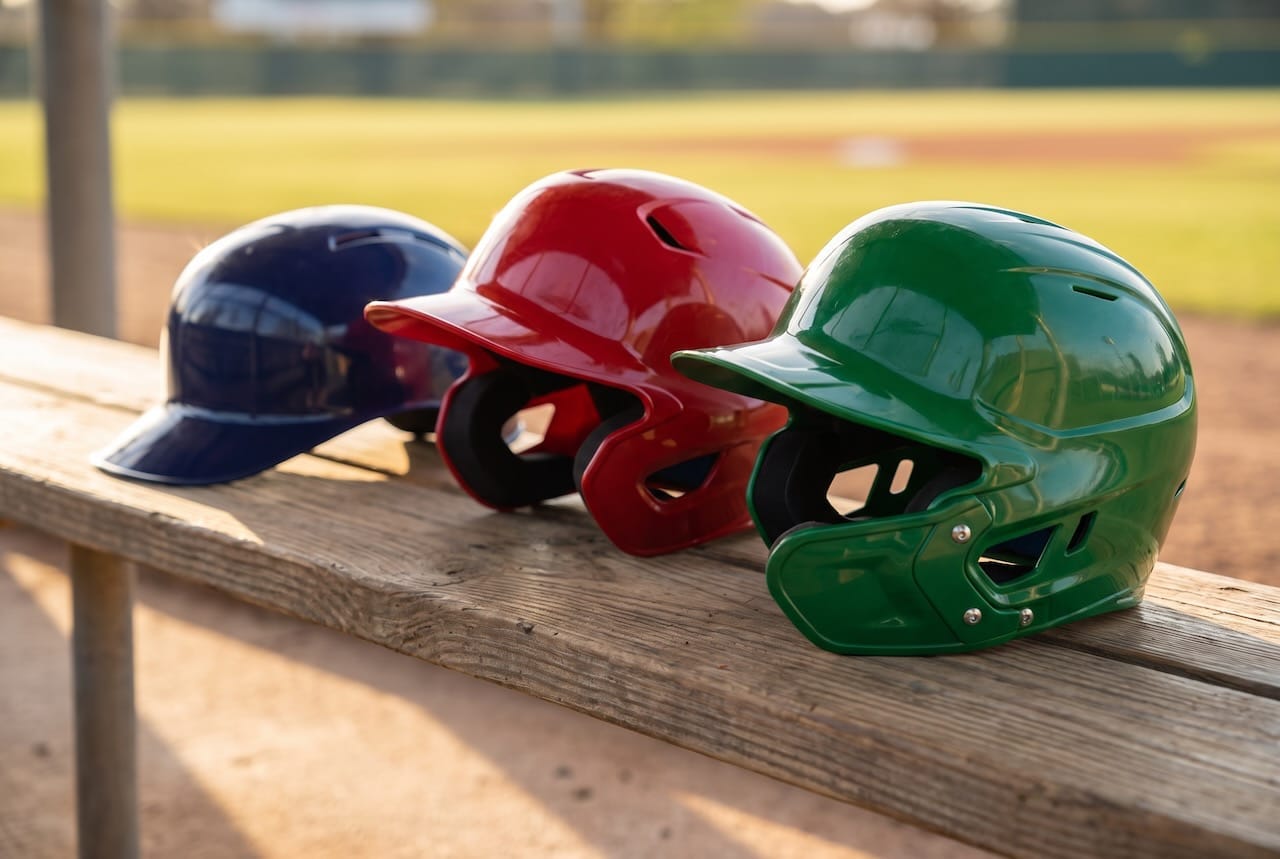
I was at an Astros game a few nights ago, watching batter after batter step in against a lineup of upper-90s fastballs, when it occurred to me that I had no idea where the helmets came from. I don’t mean the specific model, or the manufacturer — I mean the whole idea of them. Batting helmets haven’t been around forever. Somebody, at some point, had to be the first person to decide a batter needed a hard shell over his skull, and somebody after that had to convince an entire sport to go along with it. They feel so obviously necessary now that it’s easy to forget they were ever a new idea at all, let alone a contested one.
So I went looking for where they actually came from, and when. It turns out that a piece of equipment we now take for granted took over fifty years to be adopted, and in some sense that process continues even today.
It arguably all started back on August 16, 1920, when Cleveland Indians shortstop Ray Chapman stepped into the batter’s box against New York Yankees pitcher Carl Mays and never left it. The pitch struck him in the head; he died the next morning. Chapman remains the only player in Major League Baseball history to die from an injury sustained during a game. But despite the fatality, it wouldn’t be until 1971 that the sport required every batter to wear a hard-shell helmet. That 51-year delay looks, at first glance, like one long, unbroken failure of institutional will, but in fact it splits into two distinct periods.
A real technology gap, 1920 to 1952
In 1920, the specific material that eventually solved this problem didn’t exist. Fiberglass-reinforced composite — the substance that made the first genuinely good batting helmet possible — wasn’t even discovered until 1932, and it wasn’t commercialized until 1938, with its earliest real applications in building insulation, nowhere near a molded protective shell. A form strong enough for something like a helmet developed only through military use during the Second World War, decades after Chapman’s death.
That doesn’t mean nothing was possible in 1920. Simpler alternatives existed, each with a real limitation. Padded leather caps offered cushioning but no true hard shell. Vulcanized rubber, an industrial technology going back to the 1830s, could be molded rigid, but nobody had yet applied real engineering to how such a shell would actually disperse impact energy. Bakelite, the first true synthetic plastic, was hard, moldable, and in wide commercial use throughout the 1920s — in radios, telephones, and countless household goods — but too brittle to absorb a hard impact. Steel military helmets were widely available after the First World War, but too heavy, and built for a soldier holding a position, not a batter needing to repeatedly turn his head quickly to track a pitch.
So this period wasn’t simple institutional failure. The materials genuinely weren’t there yet, even though a partial effort using what did exist remained possible and mostly wasn’t made. In 1907, Giants catcher Roger Bresnahan had improvised a crude leather protective cap — the first recorded head protection in the sport’s history, over a decade before Chapman’s death. In 1939, Negro Leagues star hitter Willie Wells, who was often thrown at, began wearing a repurposed coal miner’s hard hat with the headlamp stripped off, the first thing at hand that offered any real protection at all. In 1941, the Brooklyn Dodgers became the first team with any organized policy at all, after Joe Medwick and Pee Wee Reese were both beaned within the same season. What players wore, at general manager Larry MacPhail’s order, wasn’t a helmet in any modern sense — it was a thin plastic liner, made from a DuPont material called Plastacel, slipped inside an ordinary cloth cap. These were isolated, makeshift responses, none of which amounted to a good solution, because the truly good solution hadn’t been invented yet.
The hinge: Branch Rickey, 1951 to 1952
Branch Rickey — the same executive who’d broken baseball’s color line by signing Jackie Robinson four years earlier — became general manager of the Pittsburgh Pirates in 1950. Concerned about player safety, he joined with engineers Ralph Davis and Ed Crick, and longtime Pirates executive Charlie Muse, to develop a real, impact-engineered protective shell: compression-molded, glass-fiber-reinforced polyester, about 8.5 ounces. Late in the 1952 season, Rickey made it mandatory for his entire team, both at bat and in the field.
The reception was not warm. Players complained the helmets were too heavy, and that the foam lining soaked up sweat that dripped into their eyes innings later. Former Pirates catcher Joe Garagiola, recalling having to wear one even in the field, put it plainly: “You could have put a light on the front and gone into a cave.” Around the league, the Pirates — a struggling team at the time — became a running joke, mocked for supposedly needing head protection because they were bad enough to get beaned constantly. In Brooklyn, kids in the stands at Ebbets Field threw marbles at the helmeted players’ heads. None of this was really about the engineering. As USA Today’s Jorge Ortiz wrote in 2018, decisions like this one have always come down to “issues of style, image and function,” with “exposure to razzing and the game’s macho culture” adding real pressure to stick with the status quo — a dynamic that would resurface, nearly identically, decades later around further helmet innovations.
Then, late in that same 1952 season, Pirates outfielder Paul Pettit was pinch-running toward second base on a potential double play when the shortstop’s hard relay throw caught him square in the head. The ball dented the helmet. Pettit stayed in the game. “Made believers out of everybody,” Garagiola later recalled.
That’s the story’s real hinge. Everything before it is about missing technology. Everything after it is about missing will.
A proven solution, and twenty more years anyway, 1952 to 1971
Word spread fast after that. On August 1, 1954, Braves outfielder Joe Adcock, who was wearing a reinforced-polyester helmet, was struck in the head by a pitch from Brooklyn’s Clem Labine and knocked unconscious for roughly fifteen minutes; he later said the helmet probably saved his life. The Dodgers ordered every player on their roster to start wearing one the very next day, and other teams quickly followed. By 1955, fourteen of the sixteen major league teams were offering helmets to their players.
But “offering” isn’t the same as requiring. In 1956, the National League finally mandated a protective cap or insert — with a grandfather clause letting established veterans opt out if they didn’t want one. The American League followed the same structure in 1958. Even after the technology had been proven twice over, in front of the whole league, the sport still built in an exception for anyone who’d rather not bother.
The risk stayed real the entire time this played out slowly. In 1953 — one year after the Pirates’ helmets debuted — a minor-league player named Don Zimmer was hit in the head by a pitch and spent two weeks in a semi-coma with a fractured skull, in a game where the fix that might have prevented it already existed and simply wasn’t yet universal.
It took until 1971 for Major League Baseball to require a hard-shell helmet for every batter — though even this rule kept the same grandfather clause as before, letting established veterans keep going bare-headed if they chose, with a plastic liner inside their cap as the only concession. One did: Boston Red Sox catcher Bob Montgomery, grandfathered in as an active player when the rule changed, kept batting helmetless for eight more years, becoming the last player in MLB history to do so in his final career game, September 9, 1979.
The same shortfall, recurring in miniature
The pattern didn’t fully end in 1971 — it just got narrower. On August 18, 1967, Boston Red Sox outfielder Tony Conigliaro, a rising young star, was struck in the face by a pitch. He was wearing a helmet, but as was standard practice at the time, it had no earflap. He suffered a fractured cheekbone, a dislocated jaw, and permanent retina damage that derailed what had been a very promising career. Earflaps had actually been available for years by then, but players resisted them anyway — Oakland’s longtime equipment manager, Steve Vucinich, later recalled it took roughly five years of slow, reluctant, voluntary adoption before a majority of players agreed to wear one at all. It wasn’t until 1983 that baseball finally made earflaps mandatory — and even then, only for new players entering the league, not retroactively for anyone already established. Sixteen years after Conigliaro’s own injury went unanswered, the sport reached for the same grandfather-clause half-measure it had already used with the original helmet mandates in 1956 and 1958. Montreal Expos outfielder Tim Raines took that exemption the longest, wearing a flapless helmet until his final game, September 29, 2002 — nearly two decades after the rule changed.
What still isn’t required
On April 8, 1984, Houston Astros shortstop Dickie Thon — an All-Star the year before, a player whom renowned baseball statistician Bill James later suggested might have had a real Hall of Fame trajectory ahead of him — was struck in the face by a Mike Torrez fastball at the Astrodome. Unlike Conigliaro, Thon was wearing a helmet with an earflap; by most accounts, the earflap absorbed some of the impact. It still wasn’t enough. He suffered a fractured orbital bone and permanent vision damage that ended his career’s potential arc. In 1991, he received the Tony Conigliaro Award, given to a player who overcomes adversity through spirit and determination — named for the same player, hit the same way, seventeen years earlier.
This is a different kind of evidence than Chapman’s or Zimmer’s. Thon didn’t have missing equipment; he had equipment that offered incomplete protection, just as Conigliaro had. It’s a story about equipment that protects some of the head and not all of it — a hard shell and an earflap guard the skull and the ear, not the eye socket and the rest of the face. And that shortfall, in smaller form, is still open today: full face protection in MLB remains optional. The jaw and cheek guard some players now wear voluntarily — the C-Flap, patented in 1987 by team doctor Robert Crow but worn by only a handful of players for decades afterward — became more common only after Miami Marlins outfielder Giancarlo Stanton suffered his own severe facial injury in 2014.
The hard shell itself, meanwhile, has continued to advance. Modern MLB helmets are tested to withstand a 100 mph fastball, more than 30 mph faster than the standard used as recently as the early 2010s. In 2013, the leagues adopted as standard the Rawlings S100 Pro Comp, an aerospace-grade carbon fiber composite; in 2024, MLB switched manufacturers again, partnering with the German protective-equipment company Strauss.
It’s worth knowing the guard actually works when it’s tested. On April 6, 2017, Milwaukee outfielder Keon Broxton was struck in the face by a 92.6 mph fastball while wearing one. The flap kept the ball from striking his left eye directly; he suffered only a small nasal fracture and a few stitches, and didn’t miss a game. “That C-flap, man,” Broxton said afterward, “that thing just saved my life.” It’s the clearest documented case of the guard actually being tested by a real pitch and doing its job — not a player switching to it after an injury, the way Stanton and most other adopters did, but proof arriving in real time. It’s still a choice, not a requirement, four decades after Thon and over a century after Ray Chapman.
The same institutional pattern from 1956 and 1983 has already shown up again around this exact piece of equipment — not as a league-wide rule this time, but as one team’s own internal policy. In 2018, the Brewers organization, still riding the wave of Broxton’s incident, mandated the C-Flap for every player in their minor-league system who’d finished the 2017 season below Double-A, with the requirement following those players for the rest of their minor-league careers. Nobody already established above that level was required to start. Rather than require the newer, better piece of equipment of everyone at once, the Brewers applied it only to whoever hadn’t been grandfathered in yet, letting the rest of the roster simply age out over time.
One more example, from this year
On May 2, 2026, Astros first baseman Christian Walker, wearing a C-Flap, stepped in against Boston rookie left-hander Tyler Samaniego at Fenway Park. A 93.3 mph fastball caught him over the left eye. By his own account afterward, it struck the C-Flap first — the piece appeared to fly off entirely — and the ball then struck his head.
Walker passed concussion testing. He started the next game.
A century after Ray Chapman died from a pitch nobody was equipped to survive, a piece of equipment nobody’s required to wear took a 93 mph fastball meant for a batter’s skull — and the player walked away fine. The flap came apart doing exactly what it was built to do, saving its wearer from likely severe injury.
That’s really the whole distinction this history keeps drawing, over and over, in different forms: a real limit versus a choice. In 1920, nobody had the materials to protect Ray Chapman; that was a technological constraint, and it took real invention to overcome it. By 1952, the invention existed, and it still took 19 more years and a fair number of injured players to make it universal; that was a choice, dressed up for two decades as something harder than it was. Every version of this story since — the earflap, the C-Flap, the jump to carbon fiber — has been some version of the same two questions asked again: what can’t be done yet, and what simply hasn’t been required yet. More than a century after Chapman’s death, Walker’s game the day after being struck suggests the first question has mostly been answered. The second one, judging by how many players still step into the batter’s box bare-faced, evidently hasn’t.