


Watching a challenged pitch get reviewed this season, I noticed a number. The replay graphic showed the ball as a small circle, the edge of the strike zone as a line, and between them a measured gap: less than a tenth of an inch. The umpire’s call was upheld, the stadium cheered or groaned depending on its loyalties, and the game moved on.
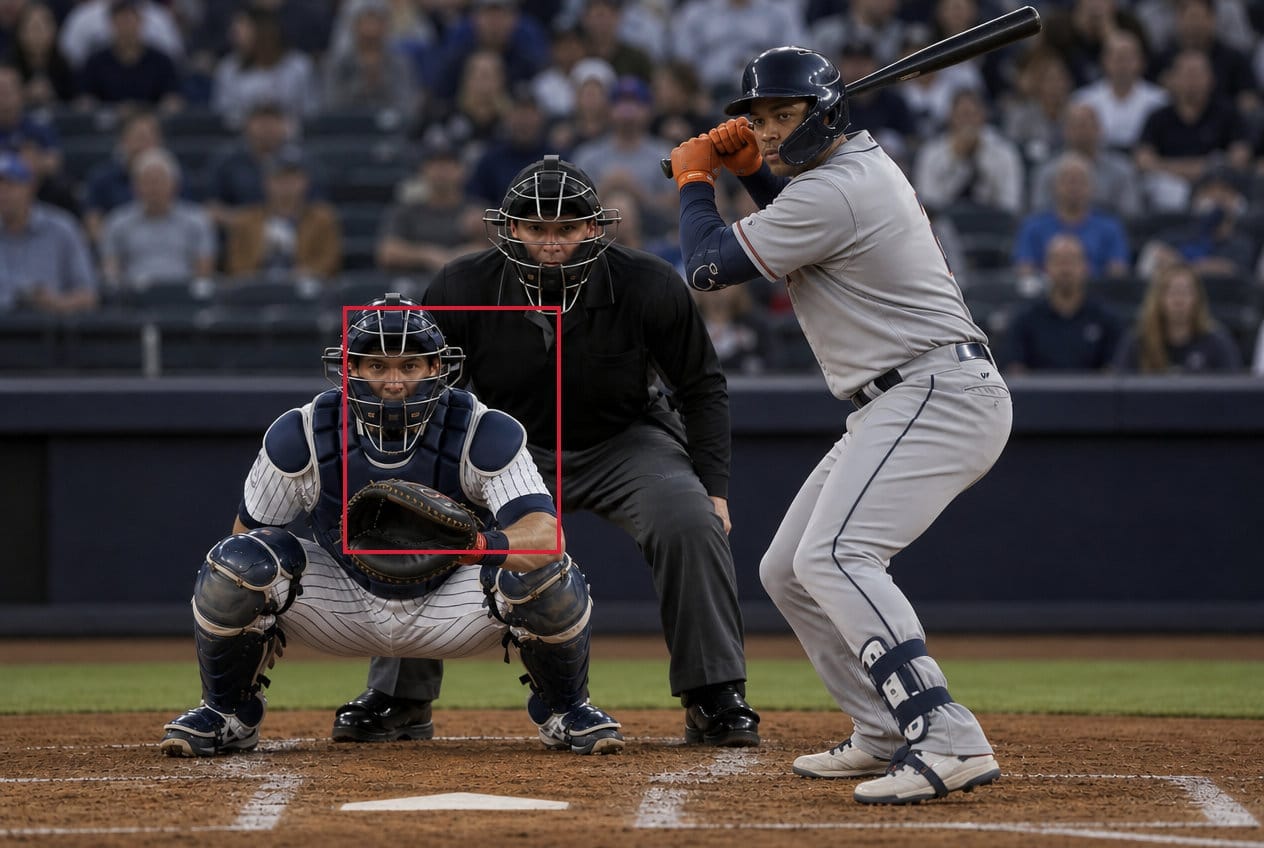
The strike zone, drawn to the ABS rule for a 6′1″ batter. (Illustration generated with AI tools.)
A number like that makes a quiet promise: the machine knows where the ball was, knows it to within a thirtieth of the ball’s width, and the argument baseball has been having with its umpires for 150 years has finally been settled by something that cannot be argued with.
Before taking that promise at face value, it’s worth knowing what the machine is actually doing when it produces that number — how it sees the ball, where it looks, and what it’s measuring against. None of this is secret; MLB has published most of it, and the rest has been reported in detail. It’s simply that almost nobody watching the graphic knows any of it.
What the system is, and isn’t
The Automated Ball-Strike system, or ABS, doesn’t replace the umpire. A human being still stands behind home plate and calls every pitch. The machine decides only when someone disputes a call.
Each team gets two challenges per game, and keeps a challenge when it succeeds, so a team that challenges well can challenge all night. Only three people are allowed to challenge: the pitcher, the catcher, or the batter, and they must do it themselves, immediately, by tapping their cap or helmet. No signals from the dugout. A team that has used up its challenges is awarded a fresh one for each extra inning.
The system was approved for the major leagues on September 23, 2025, by the Joint Competition Committee — the body, created under the players’ collective bargaining agreement, that votes on rule changes, made up of six owners, four active players, and one umpire.1 It took effect this year for spring training, the regular season, and the postseason, everywhere except the occasional neutral-site game played in a park that lacks the necessary camera installations.
It’s worth keeping in mind what it’s correcting. By the most widely cited independent count, human umpires already call about 94% of pitches correctly.2 The system exists for the other 6% — and, as it turns out, for the moments when a single borderline pitch decides a game.
How the cameras see a pitch
The tracking is done by Hawk-Eye, the Sony-owned system behind line calls in tennis and ball-tracking in cricket. Twelve cameras are mounted around each ballpark, five of them dedicated to following the pitch.3 Since 2023, those five have run at 300 frames per second.
At that rate, a 95-mph fastball is photographed roughly every 5.6 inches of its flight — about 120 snapshots between the pitcher’s hand and the plate. In each one, the system finds the ball, and by comparing where it appears in cameras viewing it from different angles, works out where it was in three-dimensional space at that instant. String the snapshots together and you have the pitch’s path. MLB states the system’s margin of error as about one-sixth of an inch.
Where the zone sits
Once the system knows where the ball went, it needs something to measure it against. That something is a rectangle.
The zone ABS uses is flat — a two-dimensional plane, standing upright over home plate like a pane of glass. It sits at one particular depth: the midpoint of the plate, 8.5 inches from the front edge and 8.5 inches from the back. The system asks a single question about each pitch: where was the ball at the moment it passed through that plane? Nothing that happens before or after matters.
The rectangle is 17 inches wide, exactly the width of home plate. But a pitch doesn’t have to pass through the rectangle to be a strike. The system models the ball as a circle with a radius of 1.45 inches — the regulation size — and calls a strike if any part of that circle touches the rectangle, however slightly.4 So the ball’s center can be as much as 1.45 inches beyond either edge and still count. The effective target, measured by where the center of the ball may pass, is about 19.9 inches wide.
That’s the zone’s width. Its height is where things get more particular.
How tall the zone is
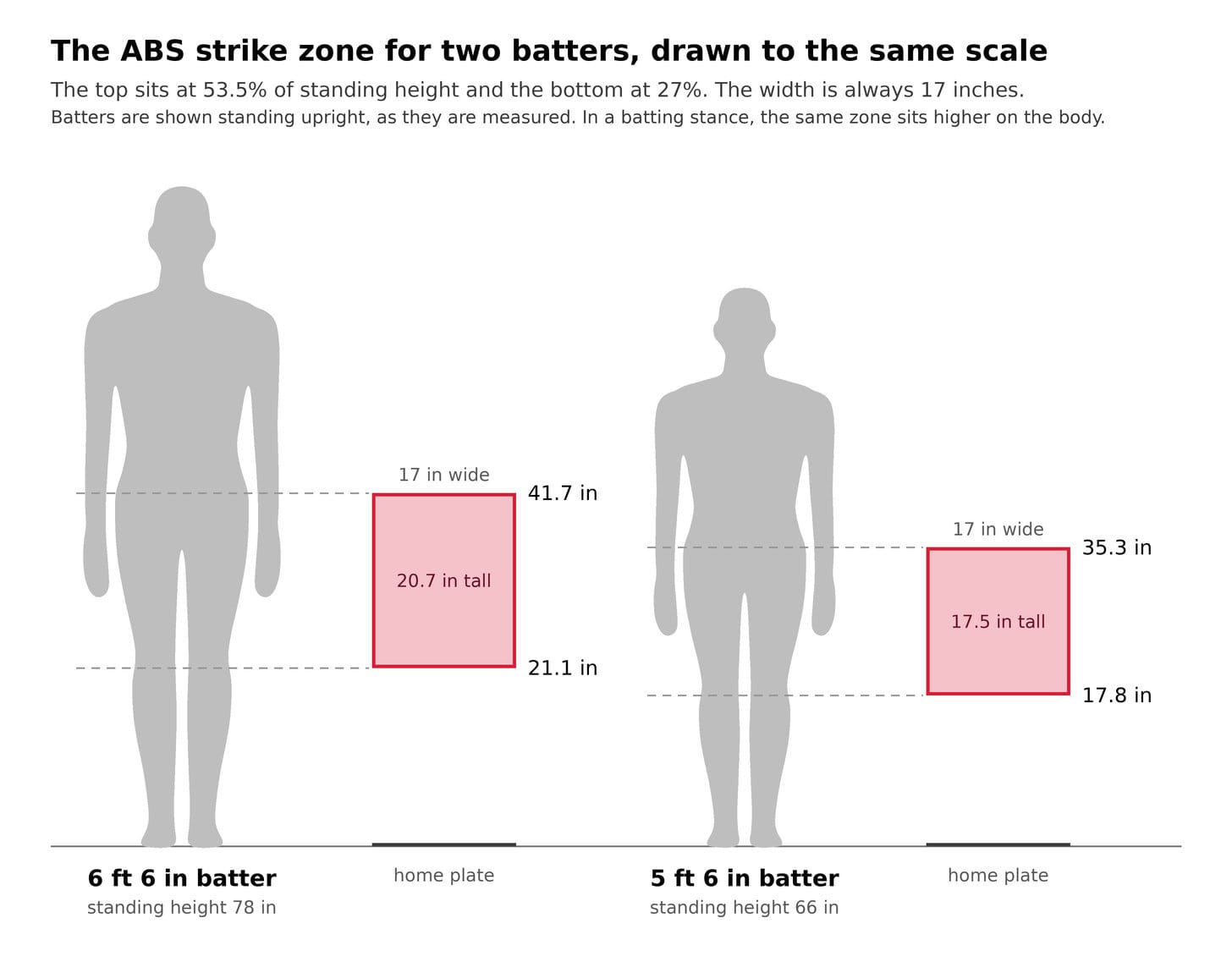
The top of the ABS zone sits at 53.5% of the batter’s height. The bottom sits at 27%.
Which means the zone is different for every hitter, and MLB has to know every hitter’s height precisely. So each player is measured in spring training, under conditions that sound more like a physical than a baseball practice: no shoes, no hat, heels together, back flat against a wall, standing fully upright.5 The measurement is taken to the millimeter, and a player has to be measured and certified before he can appear in a game.
That number then sets his zone for the season. A 6-foot-6 slugger’s zone runs 20.7 inches from top to bottom; a 5-foot-6 infielder’s, 17.5. Both are exactly 17 inches wide, because the width is set by the plate, not by the player. How a batter actually stands when a pitch arrives — crouched low, upright, leaning over the plate — plays no part. His zone is determined by how tall he is, not by how he is standing.
How a challenge works
When a player taps his helmet or cap, the review is almost instant. The stadium screen shows the pitch’s path, the rectangle, and the ball’s position as it crossed, and the call either stands or flips. The whole exchange takes about 15 seconds.
Over the regular season, players made more than 10,500 challenges — a little over four per game — and won 54% of them. Catchers challenged most and won most — 59% of more than 5,500 challenges; batters won 49% of theirs; and pitchers, who seldom challenge, won 40% of fewer than 200. In the ninth inning, teams still holding both of their challenges won just over a third of them — not because judgment falters late, but because a challenge left unused at the final out is worth nothing, so players spend them on long shots.6
Early in the season the numbers were already striking. In the first 47 games, 94 calls were overturned.7 On April 1, the Twins challenged nine calls in a single game against the Royals, and eight went their way. That mark didn’t last: on June 8, the Brewers and Athletics combined for 16 challenges in a 12-inning game, and 11 of the home-plate umpire’s calls were reversed. Each of those reversals played out in front of the crowd, with the pitch’s tracked path shown on the ballpark’s video board. The system doesn’t only second-guess umpires — it corrects them, in public, sometimes several times a night.
It has also changed what a catcher is worth. For years the most prized defensive catchers were the ones who could frame — receive a borderline pitch so quietly and so centrally that the umpire called it a strike. Framing still works, because a human still makes the first call. But now its best work can be undone: a stolen strike that the batter challenges goes back where it belongs. And catchers have picked up a second, newer skill: the judgment to know which borderline pitches called balls were truly strikes, and to spend a challenge only on those.
The zone has already moved
The rectangle hasn’t always looked like this. Before reaching the majors, ABS was tested for years in the minor leagues, and it changed along the way.
In 2022 the testing zone was 19 inches wide. The following year it was narrowed to 17, after games called by the machine produced more strikeouts than games called by people.8 It wasn’t a cosmetic change. Since the ball-radius rule applies to whatever the nominal width is, the effective target shrank from about 21.9 inches to 19.9, and walks rose. One pitching prospect remarked that the wider zone had given him strikes he hadn’t gotten in college.9
The top of the zone moved too. It was set at 51% of the batter’s height until 2024, when it was raised to 53.5%: the lower top had been meant to cut strikeouts on high fastballs, and it drove up walks instead.10
Each of these adjustments was made the same way: someone looked at the results, didn’t like them, and changed the number.
What the number actually tells you
Go back to the graphic from the beginning: the ball, the line, and a gap of less than a tenth of an inch.
The system’s stated margin of error is about a sixth of an inch — roughly a seventeenth of the ball’s width, where the screen implied a thirtieth. The number on the screen is precise, but it isn't accurate to anything like that degree.
This is the distinction between precision and accuracy: precision is how finely a number is expressed; accuracy is how close it is to the truth.11 A bathroom scale that reads 172.4 pounds is precise to a tenth of a pound; if the scale is off by three pounds, it’s accurate only to three. The display can show as many decimal places as its designers like. The measurement behind it doesn’t improve.
And there’s a further reason for caution in the details of how the cameras work. At 300 frames per second, the ball is photographed about every 5.6 inches of its flight. The plane where the call is decided is essentially never captured at the instant the ball crosses it. The system works out where the ball must have been from the snapshots on either side. The gap on the screen is a calculation, not a photograph.
None of this makes the system bad. Early in the season, ESPN’s Jeff Passan found 42 challenges that had been decided by less than half an inch, and a dozen that fell inside the system’s own margin of error. For most pitches, a sixth of an inch doesn’t matter at all. For those dozen, the machine’s verdict was, strictly, a guess — a very well-informed guess, but one it presented with a confidence it couldn’t back.
But the margin of error turns out to be the smaller surprise. The larger one is the rectangle itself.
What the rulebook says
Here is how Major League Baseball’s official rules define the strike zone. The wording has stood essentially unchanged since 1996:
The STRIKE ZONE is that area over home plate the upper limit of which is a horizontal line at the midpoint between the top of the shoulders and the top of the uniform pants, and the lower level is a line at the hollow beneath the kneecap. The Strike Zone shall be determined from the batter’s stance as the batter is prepared to swing at a pitched ball.12
So the rulebook’s zone is not a flat rectangle, but a three-dimensional volume, shaped as a seven-sided prism: home plate’s outline, extended upward, with a flat top and bottom. And where the rulebook sets that top and bottom by the batter’s posture as each pitch is delivered, the machine sets them by percentages of his barefoot height, standing straight against a wall, measured once a year.
MLB’s own announcement describes the operational zone — the rectangle and the percentages — without mentioning that it differs from the rule. Baseball America, reviewing the rules in May, put it plainly: the zone in the rulebook and the zone MLB actually uses are “completely different.”13 The rulebook has not been amended. Both definitions are currently in force.
Why the engineers broke the rule
It would be easy to read this as carelessness, but it wasn’t. The departures from the written rule were tried, tested, and chosen.
MLB first built the system to follow the rulebook literally, as a three-dimensional volume. It didn’t work, for a reason that becomes obvious once you picture it. A curveball can clip the front of that volume at the knees and then drop well below them by the time it reaches the catcher's mitt. Under the literal rule, that pitch touched the strike zone, so it’s a strike. To everyone watching — the batter, the catcher, the umpire, the fans — it looks like a ball. The literal rule, faithfully implemented, produced calls that nobody would accept.
Tracking each batter’s stance was tried too, in Triple-A, and dropped. Testing found that human umpires had never adjusted much for stance anyway, and players, asked what they preferred, chose a fixed zone they could learn over one that moved with their own posture.
So the engineers did what engineers do when a specification turns out to be unworkable: they wrote a better one. Researchers at Cornell have studied ABS as a case of exactly this — a rule everyone assumed was clearly defined, which turned out to need a series of substantial, non-obvious judgment calls before a machine could apply it.14
What nobody did was go back and change the rulebook.
Two strike zones
It’s tempting to treat the rulebook zone as the real one and the machine’s as a compromise. But the rulebook zone was never as fixed as that makes it sound.
Organized baseball has redefined its strike zone at least six times since adopting one in 1887. Shoulders to knees; then armpits to the top of the knees; then shoulders to knees again; then back to the armpits in 1969, alongside a lowered pitcher’s mound, after pitchers had dominated the 1968 season so thoroughly that the league felt it had to intervene; then the current language, settled in stages by 1996.15 Anyone who remembers the zone as “the numbers to the knees” is remembering a real era, one of several. Every one of those definitions was a policy choice, made because someone looked at the results and didn’t like them.
The machine hasn’t changed that. It has adjusted its own zone twice already, for the same reason and in the same way. What it changed is that the choice is now written down in decimals — 53.5%, 27%, 8.5 inches, 1.45 — and executed identically in every ballpark, which is a real improvement over a zone that used to vary with the umpire and the inning.
But it left the old definition standing beside the new one, unrevised. Baseball now has two official strike zones: the one in the rulebook and the one the machine calls.
The postseason begins today. Every challenged pitch in it will be judged against the second.
Major League Baseball, “MLB announces ABS Challenge System coming to the Major Leagues beginning in the 2026 season”, September 23, 2025. The release is also the source for the 15-second review time and the zone’s dimensions.
Umpire Scorecards, which grades every major-league home-plate umpire’s calls against pitch-tracking data.
The technology deserves an essay of its own, and I expect to write one.
Perry Pierce, Matthew Whitrock, and Stuart Cheshire, “Developing MLB’s Automated Ball/Strike System (ABS)”, MLB Technology Blog.
“Brewers get measured for ABS Challenge System”, MLB.com.
“2026 MLB Automated Ball-Strike (ABS) Challenge Analysis”, Baseball-Reference. Figures cover the full regular season.
Jeff Passan, “The best — and worst — automated balls-and-strikes challenges of MLB opening weekend”, ESPN, March 30, 2026.
“The Automated Strike Zone Is Slightly Different At Triple-A in 2023”, Baseball America, 2023.
Ronald Blum, “What is a strike in baseball? Robots, rule book and umpires view it differently”, Associated Press, July 10, 2023.
“2024 MiLB Rule Changes: New Triple-A Strike Zone, Pitch Clock Tweaks And More”, Baseball America, 2024.
John H. Lienhard, “Accuracy and Precision”, The Engines of Our Ingenuity, episode 1742.
Major League Baseball, Official Baseball Rules, 2026 edition, “Definitions of Terms”.
J.J. Cooper, “MLB’s Official Rules Don’t Reflect The New Strike Zone”, Baseball America, May 1, 2026.
Andrea Wen-Yi Wang, Waki Kamino, David Mimno, Karen Levy, and Malte F. Jung, “Inside Baseball: The Automated Ball-Strike System as an Object Lesson in Technological Rule Enforcement”, Cornell University.
Major League Baseball, “Strike Zone”, and Baseball Almanac, “The Strike Zone: A History of Official Strike Zone Rules”.