


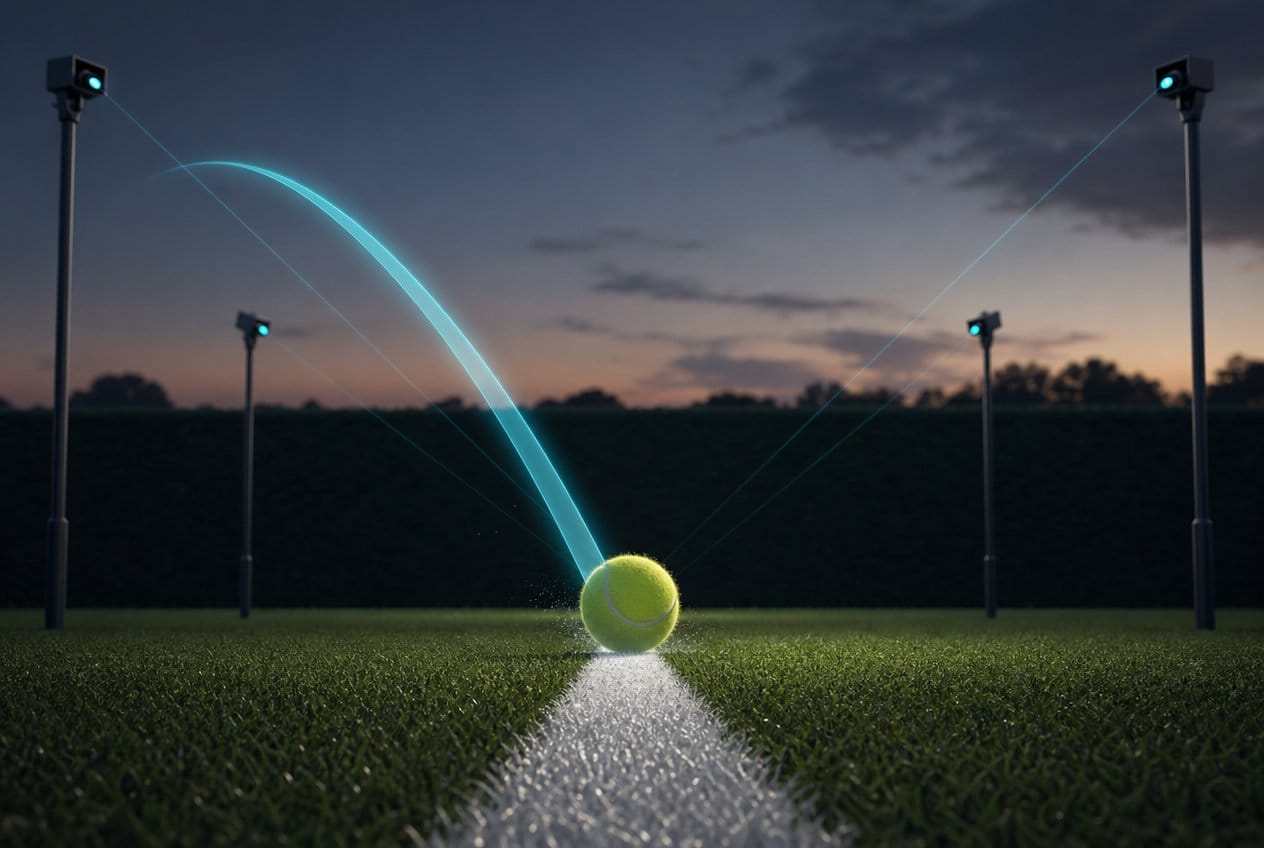
On December 30, 2005, at the Hopman Cup in Perth, Australia, a 16-year-old Dutch tennis player named Michaëlla Krajicek disagreed with a line call in the third game of her match against China’s Peng Shuai. Instead of arguing with the chair umpire, she asked a machine. A replay of the ball’s flight appeared on a big screen, the call was overturned, and Krajicek became the first player to win a Hawk-Eye challenge in an official competition. She went on to lose the match, which almost nobody remembers.1
Five years earlier, the same machine had no official standing anywhere. Its inventor, a cricketer, had been frustrated by bad umpiring, but the machine’s first job was to make the game more interesting to watch on television. Today, in one form or another, it calls lines at Wimbledon, confirms goals in the Premier League, measures first downs in the NFL, and calls balls and strikes in Major League Baseball. Its path from broadcast graphic to referee says a lot about what machines are good at judging, and what they aren’t.
A graphic for cricket fans
Hawk-Eye began with a frustrated cricketer. Paul Hawkins had hoped to play professionally and had watched, as he later put it, “the frustrations in the game due to poor decision-making by officials.” After finishing a PhD in artificial intelligence at Durham University in 1999, he joined Roke Manor Research, a Siemens-owned research company in Hampshire, because he felt it had “the infrastructure to develop what I had in mind.”2
What he and his colleague David Sherry had in mind, at least on paper, was a television product. Their 1999 patent application was titled “Ball tracking and trajectory prediction,” and the system they built was designed to show viewers where a cricket ball had gone and where it would have gone next.3 Its debut came on Britain’s Channel 4, during the England–Pakistan Test at Lord’s in May 2001, where it served as an aid to the commentators. In 2002, Roke Manor spun it off as Hawk-Eye Innovations, a joint venture with Sunset + Vine, the company that produced Channel 4’s cricket coverage.
That origin matters, because the hardest question in cricket is hypothetical. In a leg-before-wicket decision, the umpire must judge whether a ball that struck the batter’s leg would have gone on to hit the stumps. Nobody can see the answer, because the leg got in the way. A broadcast graphic that drew the ball’s likely path past the leg gave viewers something no umpire had: a confident picture of what would have happened. It was a wonderful thing to show on television. Whether it was good enough to decide a match was a separate question, and it took years to answer.
What the machine actually sees
The principle is simple. Several cameras placed around the field, six in the original cricket setup, record the ball from different angles. Software finds the ball in each frame, combines the views to fix its position in three dimensions, and fits a smooth path through the points.
What appears on screen is not a recording. It is a reconstruction: the most likely path, drawn from measurements, rendered as a clean animation of a ball and a line. When the question is where a tennis ball landed, the reconstruction sits close to the measurements, because the cameras watched the ball land. When the question is where a cricket ball would have gone, the system must extend its path beyond what any camera saw, and the uncertainty grows.
Tennis’s governing body tested Hawk-Eye in a laboratory in Hampshire in December 2004, comparing it against a reference camera that shot 2,000 frames a second, and certified it for officiating on October 14, 2005.4 Cricket took longer, and when it adopted the system for its Decision Review System in 2009, it built in a margin for error. Under the rule known as “umpire’s call,” the on-field decision stands unless the machine shows more than half the ball hitting the stumps. A ball that merely clips them is left to the umpire. The International Cricket Council reconsidered the rule in 2021 and kept it, adjusting only the target area. The committee’s chairman, the former Indian bowler Anil Kumble, explained that the system exists to correct clear errors while keeping the umpire as the decision maker, given the prediction involved.5
That is an unusual admission for a sport to write into its rules: the machine is precise, but not precise enough to overrule a person on a close call.
Tennis lets the machine in
Tennis needed a scandal. In the 2004 U.S. Open quarterfinal between Serena Williams and Jennifer Capriati, the chair umpire overruled a line judge’s correct call on a Williams backhand, and television replays showed millions of viewers that the ball had been clearly in. The tournament kept the umpire off its courts for the rest of the event, and within about 18 months tennis had a challenge system.6
The professional tour followed. At the Miami tournament on March 22, 2006, Jamea Jackson made the first Hawk-Eye challenge on the tour, and lost it.7 The U.S. Open adopted the system that August, the first Grand Slam to do so, and the others followed.
Not everyone was won over. In the 2007 Wimbledon final, after Rafael Nadal successfully challenged a ball called long, an angry Roger Federer told the chair umpire that the machine was “killing me today” and asked him to switch it off.8 The umpire declined, and Federer won anyway.
Over time the machine stopped merely reviewing calls and began making them. During the pandemic, in 2020, the U.S. Open replaced line judges with automated calling on most of its courts, and on all of them the following year. Wimbledon followed in 2025, ending the use of line judges for the first time in the tournament’s 147-year history. With every call made by the machine, players could no longer challenge anything, so the challenge system that Krajicek had first used disappeared there.9 Of the four Grand Slams, only the French Open, played on clay where the ball leaves a visible mark, still uses human line judges.
Soccer’s long refusal
Soccer held out longer. The Premier League began working with Hawk-Eye in 2006, testing a camera system at Fulham’s Craven Cottage and then at Reading’s training ground. But in March 2008, the International Football Association Board, which writes the game’s laws, ruled out goal-line technology altogether.
Then came the 2010 World Cup. In a knockout match against Germany, England’s Frank Lampard hit a shot that bounced off the crossbar and well over the goal line. The officials didn’t see it, the goal wasn’t given, and FIFA’s president, Sepp Blatter, who had opposed the technology, changed his mind. On July 5, 2012, the board approved two goal-line systems, Hawk-Eye and a magnetic system called GoalRef.10 The Premier League installed Hawk-Eye for the 2013–14 season, with seven cameras watching each goal and a signal to the referee’s watch within a second.
For seven years it worked without a public failure. Then, on June 17, 2020, in the first match after the pandemic shutdown, Aston Villa’s goalkeeper caught a Sheffield United free kick and backpedaled over his own goal line, carrying the ball clearly across it. The referee’s watch stayed silent, play went on, and the video assistant referee didn’t intervene. Hawk-Eye apologized: from every one of its camera angles, the ball had been hidden by the goalkeeper, a defender, or the post. It was the system’s first failure in more than 9,000 matches.11 Cameras can only judge what they can see.
Hawk-Eye did not win every contract, either. For the 2014 World Cup, FIFA chose a German competitor, GoalControl. But by 2022, Hawk-Eye was back at soccer’s biggest event in a more ambitious form. The semi-automated offside system at the World Cup in Qatar used 12 cameras under the stadium roof to track up to 29 points on each player’s body, 50 times a second, built on Hawk-Eye’s limb tracking. A sensor inside the ball reported 500 times a second, to pin down the instant it was kicked.
Offside, unlike a goal, depends on the exact position of a shoulder or a toe at that instant, so the system tracks bodies, not just a ball. Even so, FIFA did not let it decide on its own. The system alerts the video officials, who check the kick point and the offside line it has chosen before passing the decision to the referee. And one part of the rule stays entirely human: a player in an offside position is penalized only if he is involved in the play, and whether he was, FIFA says, is up to the referee.12
Hockey, basketball, and football
Hawk-Eye has reached all three of the other major American leagues, but not by tracking a ball’s flight, and mostly not by making calls.
In hockey, Hawk-Eye’s replay system has been in every NHL arena since 2015, supplying the synchronized camera angles that officials use for video reviews and coaches’ challenges. Every arena now also has optical tracking that follows 29 points on each player and three on each stick, 60 times a second. The league is evaluating whether that tracking could eventually call offside automatically. For now, it doesn’t.13
In basketball, the NBA began using Hawk-Eye’s optical tracking with the 2023–24 season, following every player and the ball in three dimensions. The league said the data would help officials improve the accuracy of their calls.14 It supplies data, angles, and evidence. It does not call fouls.
In American football, Hawk-Eye has assisted the NFL’s replay officials since 2021, and since the 2025 season it has been the primary way of measuring first downs, using six 8K cameras in each stadium. The chains, carried by the familiar crew on the sideline, survive as a backup. But the new system measures from the spot where an official places the ball, and that spot is still chosen by hand, by a person who had to judge where a runner’s knee went down in a pile of bodies.15 The machine can measure to a fraction of an inch from a starting point that may be off by a foot.
Baseball, the subject of my essay “Two Different Strike Zones,” fits the same pattern: Hawk-Eye cameras already supported its replay reviews and pitch tracking, and this season they began calling challenged balls and strikes, against a zone the league defined for the machine.
The list goes on. Badminton adopted Hawk-Eye for line calls in 2014. Hurling and Gaelic football began using it at Croke Park in Dublin in 2013, to decide whether a high shot passed between the posts. Snooker uses it on television. I looked for uses outside sport and found none: whatever the technology’s potential, its entire market so far is games.
Where the cameras stop
Set side by side, the sports show a pattern. Hawk-Eye takes over completely where the question is geometric. Did the ball land inside the line? Did it cross the goal line? Did it pass between the posts? Those are questions about a ball and a boundary, and a set of cameras can answer them better than any human eye.
Even there, the machine has limits, and they are physical rather than philosophical. The cameras must actually see the ball, which is why a goalkeeper’s body was enough to defeat the system at Villa Park. And the less of the ball’s flight the cameras see, the more the system has to guess. A tennis ball is watched all the way to the court. A cricket ball that hits a batter’s pad a few inches after bouncing gives the cameras almost nothing to work with, and Hawkins himself has said the system needs roughly a foot of travel after the bounce to predict a ball’s line with confidence. Cricket’s “umpire’s call” exists for exactly those cases.
Where the question involves bodies and judgment, the machine becomes an assistant instead. Whether a hockey stick was too high, whether a defender fouled a shooter, whether a runner was down before the ball came loose: the cameras supply the evidence, and a person still decides.
Soccer’s offside rule shows both sides of that line inside a single call. Where each player stood at the moment of the pass is geometry, and the cameras now measure it to the width of a shoulder. Whether the player who stood offside was actually involved in the play is judgment, and it still belongs to the referee. The machine answered the half of the question that has an answer, and left the other half where it was.
And even in the sports the machine dominates, the human judgment hasn’t disappeared. It has moved upstream. Cricket had to decide how much of the ball must hit the stumps before the machine could overrule an umpire. The NFL still needs an official to choose the spot before the cameras can measure from it. Baseball had to decide what its strike zone means before a machine could call it, and decided it differently from its own rulebook. Every sport that hands a call to Hawk-Eye has first had to answer a question no camera can: what, exactly, the rule is.
What the cameras will try next
The same pattern is shaping what comes next. At this summer’s World Cup, FIFA’s offside system went a step beyond the one used in Qatar. For clear offsides, it now alerted the assistant referees on the field directly, so they could raise their flags at once, and every player was scanned in three dimensions to make the tracking more exact. But FIFA was explicit that the system is limited to an attacker’s position and will not decide whether he interfered with play.16
The NFL may face the hardest case. Its cameras already measure first downs, and the league has tested a system that tracks more than two dozen points on each player’s body, combined with chips inside the footballs, that might someday locate the ball in a pile of bodies. Commissioner Roger Goodell has called the problem “complicated” and said the league won’t adopt anything until “you think you have it right.”17
Tennis still has one holdout. At this year’s French Open, Casper Ruud was leading 8–7 in a tiebreak, one point from winning the set, when the chair umpire, inspecting the ball’s mark in the clay, ruled in a shot that electronic line calling, shown on television, had called out. The point went against Ruud, and so did the match. The tournament’s director, Amélie Mauresmo, stood by her officials: “As of today, the machine is not 100 percent reliable, so we continue to place our confidence in human officials.” As for 2027, she said, “we’ll see.”18
Meanwhile, Sony, which owns Hawk-Eye, is steering the same tracking data back toward the audience, turning NHL games into live animated recreations for fans.19 The technology that began as a television graphic is finding its way back to television. In every sport, the cameras are being asked to take over more of the geometry, and the people who run the sport are deciding how much of the rest to keep.
The harder problem
The name itself has drifted. Sony bought Hawk-Eye Innovations in 2011, and “Hawk-Eye” now covers ball tracking, video replay, and body tracking in sports that have little in common. The four major American leagues all buy from the same company.
Through all of it, Hawkins has understood that the technology’s biggest obstacle was never precision. In 2010, defending his system against cricket critics who doubted it could predict the bounce of a ball on a worn pitch, he put it this way: “We score very high on our accuracy but our believability is what is harder because we use a virtual world.”20
That is the trade Hawk-Eye has offered every sport since Krajicek’s challenge in Perth. It replaces a person’s view of what happened with a machine’s reconstruction of it, more accurate than any eye, and drawn so cleanly that it looks like the truth itself. The sports that accepted the trade did so because a reconstruction is easier to believe than an umpire. Where they drew the line, they drew it at the part of the game the cameras can’t see.
AFP, “Netherlands oust China to claim Hopman Cup berth”, ABC News (Australia), December 30, 2005. A month earlier, Hawk-Eye had been announced for a seniors’ event, the Masters Tennis at London’s Royal Albert Hall, the finale of the ATP’s tour for retired champions: “Tennis to get a boost with Hawkeye technology”, Indian Television, November 7, 2005.
Vaughan Willmore, “The Man Who Saved Tennis”, Tomorrow, May 1, 2023.
World Intellectual Property Organization, “Game-changing technologies”.
International Tennis Federation, “Line Calling”, November 2021.
“ICC cricket committee makes key change to lbw reviews in DRS”, ESPNcricinfo, April 1, 2021.
“Umpire ruled out after Serena row”, CNN, September 2004.
Alexandre Sokolowski, “March 22, 2006: The day of the first Hawk-eye challenge”, Tennis Majors.
AFP, “Federer beats Nadal to equal Borg record”, Mail & Guardian, July 8, 2007.
“Wimbledon to replace tennis line judges with electronic system from 2025”, Al Jazeera, October 9, 2024.
“IFAB approve goal-line technology”, Al Jazeera, July 5, 2012; “Premier League unveils Goal Decision System”, NBC Sports, August 8, 2013.
“Goal-line technology fail! Hawk-Eye apologise after stunning incident denies Sheffield United”, TNT Sports, June 17, 2020.
FIFA, “Semi-automated offside technology”.
NHL Public Relations, “NHL, Sony announce multiyear global technology partnership”, NHL.com, June 4, 2025; Jacob Feldman, “NHL Mulls Call Automation Options via Hawk-Eye Tech Expansion”, Sportico, June 4, 2025.
Becky Sullivan, “Say goodbye to chain crews: The NFL will use camera technology to measure 1st downs”, NPR, April 1, 2025; Hawk-Eye Innovations, “Sony’s Hawk-Eye Innovations Selected by the NFL to Revolutionize Line to Gain Measurements”, April 1, 2025.
Jonathan Jones, “NFL testing state-of-the-art technology to help spot football, but when could it be implemented?”, CBS Sports, February 5, 2025.
AP, “French Open chief Mauresmo backs human judgment after Ruud line-call controversy”, WTOP, June 2026.
NHL Public Relations, “NHL, Sony announce multiyear global technology partnership”, NHL.com, June 4, 2025.
John Mehaffey (Reuters), “Inventor of Hawk-Eye defends technology”, Mail & Guardian, January 20, 2010.