


Suppose someone asks you: what number, multiplied by itself, gives you negative one? The honest answer, for a very long time, was that no such number exists. Multiply any positive number by itself and you get something positive. Multiply any negative number by itself and you also get something positive — a negative times a negative is a positive. There’s no number left over to produce a negative square. The question isn’t hard. It’s malformed.
Except mathematicians kept running into it anyway, and not because they went looking for trouble.
In the 1500s, Italian mathematicians were racing to solve cubic equations — equations of the form x³ = px + q — using a general formula, the cubic equivalent of the quadratic formula you probably learned in school. Gerolamo Cardano published one such formula in 1545, in his book Ars Magna. It worked. But it had a strange defect: for certain cubics, ones with perfectly ordinary, real, verifiable solutions, the formula insisted on routing you through the square root of a negative number to get there. Not sometimes producing a nonsensical answer — reliably producing the correct answer, but only if you were willing to carry an apparently meaningless expression through the middle of the calculation and trust that it would resolve itself by the end.
Cardano found the whole business distasteful. Working through one such case in Ars Magna, he described the manipulation as subtle to the point of being useless. He wasn’t wrong to be suspicious. He just didn’t yet have a reason to trust the thing he’d stumbled into.
The proof that nobody wanted to believe
That reason came a few decades later, from Rafael Bombelli. In his 1572 Algebra, Bombelli took on the cubic x³ = 15x + 4 — an equation with an obvious, easily checked real solution, x = 4. Cardano’s formula, run on this equation, produced an expression built from the square root of negative 121. By any standard notion of what square roots were allowed to be, this shouldn’t have meant anything at all.
Bombelli didn’t dismiss it. He invented his own notation for it — he called the square root of negative one più di meno, “plus of minus” — and started treating it as a number he could actually calculate with, following the same algebraic rules as everything else, just provisionally, to see where it led. Where it led was back to 4. Two expressions, each involving this supposedly meaningless quantity, added together and the impossible part cancelled out exactly, leaving the correct, ordinary, real answer waiting on the other side.
Bombelli’s reaction, by his own account, was that the whole thing seemed built on sophistry rather than truth — right up until he’d worked through the proof enough times to convince himself it wasn’t. That’s a genuinely strange position for a mathematician to be in: distrusting your own result even as you keep verifying that it works.
This is worth sitting with for a moment, because it’s not the origin story most people expect. Imaginary numbers weren’t invented because someone wanted to solve x² = −1 for its own sake — that’s an easy equation to just declare unsolvable and walk away from. They forced their way into mathematics as a side effect of solving equations that were never in question in the first place, real equations with real answers, discovered by people who initially wanted nothing to do with them.
From a trick to a place
For roughly two hundred years afterward, that’s about all these numbers were: a useful trick, tolerated because it produced correct answers, not because anyone had a clear account of what it actually meant to have a “number” whose square was negative. That changed only once someone found a way to make the number visible.
The idea, when it finally arrived, was almost embarrassingly simple: if an ordinary number can be marked as a point on a line, a number with both a real and an “imaginary” component can be marked as a point on a plane — one axis for the familiar numbers, a second axis, at a right angle, for multiples of this new quantity. Suddenly i, the imaginary unit, wasn’t a suspicious algebraic residue anymore. It was a location: one step straight up from zero.
The idea surfaced three separate times before it stuck. Caspar Wessel, a Danish-Norwegian surveyor, worked it out in 1797 and published it two years later — in Danish, aimed at cartographers, and it went almost entirely unread by the wider mathematical world for a full century. Jean-Robert Argand arrived at essentially the same picture in 1806, self-published, with his own name left off the pamphlet; it reached the mathematical mainstream mostly by accident, after a copy passed anonymously into the hands of a well-connected mathematician who happened to pass it along. And Carl Friedrich Gauss, by some accounts, had been sitting on a similar picture privately for years before Wessel or Argand ever published anything — reportedly wary of exposing an idea this strange to a mathematical establishment he expected would laugh at it. It was only once Gauss finally attached his own considerable reputation to the idea, in 1831, that it stopped being a curiosity three different people had each stumbled into and started being an accepted part of mathematics.
There’s something worth noticing in that pattern. The idea itself wasn’t the hard part — three people found essentially the same picture independently, without knowing about each other’s work. What took two hundred years was permission: someone credible enough willing to say, in public, that this is a real thing.
What e is actually about
Set that aside for a moment, because the other half of this story starts somewhere that looks completely unrelated: not geometry, but growth.
The number e shows up wherever something grows continuously in proportion to its own size — compounding interest, radioactive decay, population growth. It has a specific, almost self-referential property: the function eˣ is its own derivative. Its rate of change, at any point, is exactly equal to its own current value. Nothing else does this. It’s the number that makes continuous growth mathematically well-behaved.
There’s nothing here, on the face of it, that has anything to do with circles, angles, or the geometry that eventually gave imaginary numbers a home. e is about accumulation over time. π is the ratio of a circle’s circumference to its diameter — a fact about shape, fixed and static, with no reference to change or growth at all. There’s no obvious reason these two constants, arising from entirely different domains, should have anything to say to each other.
What happens when you raise growth to an imaginary power
Here’s where the two threads actually meet, and it’s worth working through slowly rather than treating it as a trick.
Raising e to an ordinary power, like e², means growth: the value gets larger, moving further out along the number line. But what does it mean to raise e to an imaginary power — to ask for e to the power of i times some number? There’s no literal “growing” happening, since i isn’t a quantity you can meaningfully compound. What it actually does, once you have the complex plane to picture it on, is different in kind: it rotates.
Specifically, e^(ix) doesn’t move a point further from the origin at all — it keeps it at a constant distance of exactly 1, and instead sweeps it around in a circle as x increases, rotating counterclockwise by x radians. This isn’t a coincidence dressed up as a definition; it falls directly out of how exponential growth and circular motion turn out to obey the same underlying differential relationship once you allow the exponent to be imaginary. Growth, pointed sideways into the imaginary direction instead of straight out along the real line, becomes rotation.
And rotation, run continuously, traces a circle. Which means π — the constant that governs circles — has to show up eventually, because a half-turn around that circle, by definition, covers a distance of exactly π radians.
The equation itself
Put x = π into e^(ix), and you’re asking: what do you get after rotating exactly half a turn around that unit circle? You end up exactly opposite where you started — at −1.
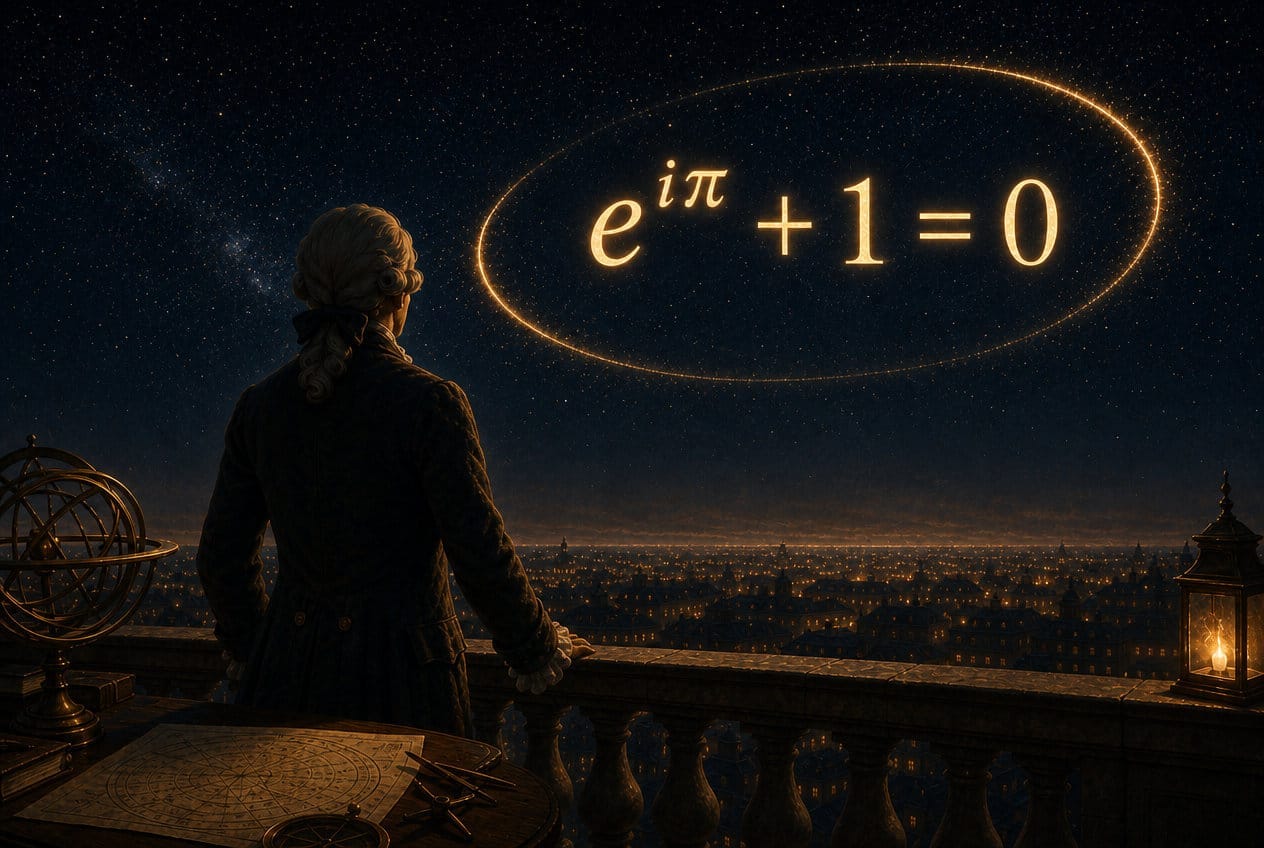
That’s Euler’s identity: e^(iπ) = −1, or, written the way it’s more often quoted, e^(iπ) + 1 = 0. It gets celebrated as the most beautiful equation in mathematics, and it’s easy to see why people reach for that word — five of the most important constants in all of mathematics, sitting in one short line. But I think the beauty is easier to actually feel once you’ve followed the argument that gets you there, rather than just being handed the result. It isn’t a coincidence that a growth constant and a circle constant turn out to be related. It’s what happens, necessarily, once you take seriously a number that centuries of mathematicians tried not to believe in.
A number that had to be found before it could be used
There’s a pattern worth pulling out of all of this. Imaginary numbers weren’t accepted because someone decided they’d be convenient. They were accepted, slowly and reluctantly, because they turned out to be necessary — the only route through to answers that were never in dispute, verified again and again by people who initially wanted nothing to do with the method that produced them. Bombelli didn’t invent √−1 because he liked the idea. He invented it because a real equation, with a real, checkable answer, left him no other choice.
That’s not quite how a fiction usually behaves. Fictions can be discarded once they’ve served their purpose. This one kept showing up in more places, doing more work, connecting things — growth and rotation, algebra and geometry — that had no obvious business being connected at all. At some point, “useful trick we don’t quite believe in” stops being a stable description of something. Either it’s the most persistent, productive coincidence in the entire history of the subject, or it’s telling you about the structure of mathematics itself.
I don’t think that’s a live question anymore. But it’s worth remembering that it took the best mathematicians in Europe the better part of three centuries to admit they’d found something real, and not a mistake.
A charming footnote to this story: in 2021, one correspondent petitioned Unicode’s mailing list for a dedicated superscript π character, citing Euler’s identity by name. A Unicode contributor’s reply noted that the Technical Committee has repeatedly declined to add superscript/subscript letters outside of natural-language use, and — perhaps more pointedly — that “no character will be added based solely on a public mailing-list thread.” The most beautiful equation in all mathematics still can’t get its own code point.