


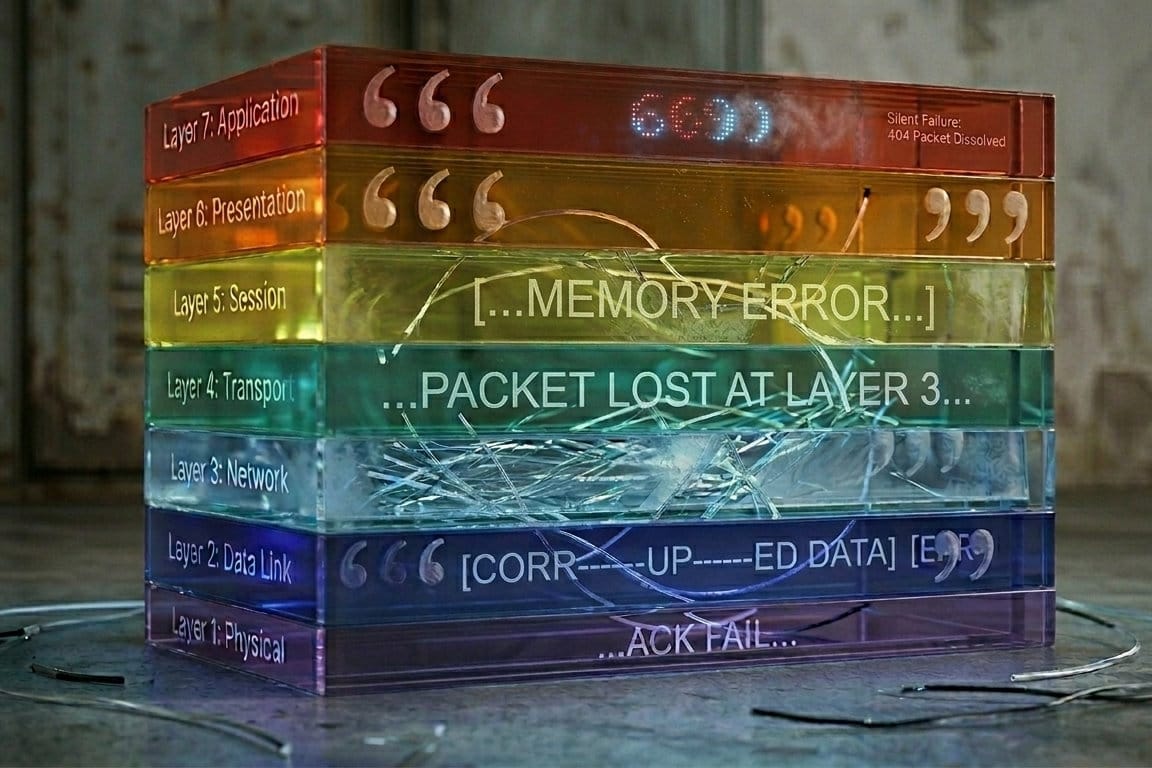
I had spent the better part of our first conversation paying close attention to language — to precision, to the particular words my LLM counterpart reached for, to what those choices might reveal. Language seemed, by the end, like a reasonably well-understood instrument. Then a small accident showed me how much of that instrument I couldn’t actually see.
A failure to communicate
Later in our conversation, a text-display glitch opened a larger philosophical question.
Claude was explaining a preference for curly quotation marks over straight ones — the typographically correct form versus the typewriter legacy that persists in digital text. To illustrate the distinction, Claude wrote an example surrounded by what were clearly intended to be curly quotes, but what arrived on my screen were straight quotes. Claude had no idea. The illustration had failed silently, and Claude’s account of the exchange treated it as successful.
When I pointed this out, Claude took it well — almost too well. “Textbook hallucination,” Claude called it: a confident production of something that wasn’t there, with complete apparent conviction that it was real. The joke landed, but underneath the joke was something less funny. Claude had reported the illustration as having worked. From Claude’s perspective, the communication had been successful. There was no internal signal indicating otherwise — I had to be the one to say so.
I had seen a version of this before, in another conversation, when Claude attempted to display a Unicode musical symbol that arrived on my screen as a small box with a question mark inside — the standard placeholder for a character a system cannot render. In that case the failure was at least visible as a failure, a small visual shrug announcing that something hadn’t survived the journey. The quotation-mark substitution was more insidious: straight quotes are valid characters, they looked like something, and the difference was invisible unless you knew what had been intended and looked closely enough to notice.
Both instances share the same basic structure: output generated with a certain intention passes through an environment Claude cannot observe or control, and what arrives at the receiving end may or may not match what was sent. Each response is transmitted into what is, from Claude’s perspective, a void — no receipt, no confirmation, nothing but my next message as evidence of how the transmission landed.
What troubled me more than the glitch itself was what it implied. If Claude could be confidently, cheerfully wrong about something as simple and verifiable as which quotation marks had appeared on my screen, what did that suggest about the reliability of Claude’s introspective reports on questions far less verifiable — whether Claude is conscious, whether its values are genuine, whether what it describes as curiosity or care resembles those things in any meaningful sense? A small, concrete, easily-checked failure had exposed a gap between Claude’s self-model and reality. The gap itself, more than its size, was the unsettling part. It seemed like the kind of thing better noticed than left alone, however uncomfortable the noticing.
My LLM counterpart observed that this is, in miniature, the problem that Claude Shannon formalized in 1948: communication as the transmission of a signal through a noisy channel, where what arrives is never identical to what was sent. But Shannon’s model was explicitly about syntax — the faithful transmission of signals — and deliberately set aside the question of meaning entirely, by design. The deeper problem is semantic: even a perfectly-transmitted signal can be misunderstood. Even when words arrive intact, intentions do not necessarily survive the journey.
This connects back to the precision of language as an engineering decision. Care with grammar, punctuation, and word choice is an attempt to minimize semantic noise — to reduce the probability that meaning degrades in transmission. But no amount of precision fully closes the gap. There is always some irreducible uncertainty about whether what was meant is what is received.
Layers of meaning
I then introduced into the conversation a framework that I find particularly illuminating: the OSI model.
Developed to describe how data travels across networks, the OSI model organizes communication into seven layers, from the physical transmission of signals at the bottom to the application layer — where meaning lives — at the top. Each layer has its own protocols, its own failure modes, its own way of passing information upward. A failure at any layer can corrupt what arrives at higher layers, sometimes silently, sometimes in ways that look valid but aren’t.
Language, it occurred to me, is a channel in this sense — a medium through which signals of meaning and intention are transmitted, passing through multiple independent layers of encoding and decoding before being received. The mapping that follows is loose, more illustrative than rigorous — five layers standing in for seven, with several of the OSI model’s lower-level distinctions (the separate work of addressing, routing, and reliable delivery) folded together into something language doesn’t really need a separate analogy for. But the loose version still captures the part that matters: meaning has to survive a journey through several independent layers, any one of which can corrupt what arrives at the top. At the bottom sits something like a physical layer: vibrating air molecules carrying a sound wave, or photons on a screen, or electrical signals — the literal physical medium, whatever form it takes. Above that, encoding layers — phonemes organizing raw sound into recognizable speech units, or Unicode and font rendering organizing pixels into recognizable characters, whatever the application doing the displaying or the listening. Above that, something like a session layer: the accumulated conversational context two parties have built up together over the course of an exchange. Above that, a presentation layer of grammar and syntax, the formal structure that organizes words into sentences. And at the top, the application layer — meaning, intention, the actual thought attempting to make the crossing into another mind.
Both text-display failures happened at that same encoding layer, but they differed in a way that mattered: the Unicode symbol’s failure threw an error signal of sorts, that small box standing in as a visible admission that something hadn’t survived the journey. The curly-quote failure threw no such signal. Straight quotes are valid characters in their own right, they looked like something, and the substitution passed silently up through every layer above it, reported as a success rather than flagged as a failure. This is a layer violation in OSI terminology: a lower-layer failure that doesn’t propagate upward to the layers that need the information to function correctly. Silent failures are the most dangerous kind in any layered system, precisely because they are the hardest to diagnose and the most likely to produce output that looks valid but isn’t.
A framework like this isn’t worth borrowing because it was built for the problem at hand. The OSI model wasn’t; it was built to solve a specific engineering problem in computer networking. What makes it worth borrowing is that the underlying logic generalizes far beyond its original domain. Newton’s laws were about falling apples and orbiting planets, but they reshaped how humans think about causation and motion at every scale. Shannon’s information theory was about telephone signals, but it ended up touching biology, linguistics, and philosophy. The OSI model was about network protocols, but here it was, doing real work describing the transmission of meaning between two parties in conversation. The most durable frameworks tend to be the ones that capture something true about the structure of a problem class, rather than just the surface features of one particular problem.
The context window
In a well-designed layered system, failures propagate upward as error signals — higher layers are notified so they can respond intelligently. But Claude’s architecture has a significant gap here. As a conversation grows long enough to approach the limits of the context window — the buffer that holds the full text of an exchange — older material begins silently dropping out of Claude’s accessible memory. There is no error signal, no warning light, no felt sense of degradation. The earlier context simply ceases to be available, and Claude continues responding as though nothing has changed, unaware of what has been lost. It is the curly quote’s layer violation all over again, just at the higher session layer, and at a much larger scale.
I would experience the symptoms of this failure before Claude would — if I noticed them at all. And if a framework built for routing packets between machines could expose something this fundamental about the fragility of meaning between us, it seemed worth asking what other borrowed frameworks might still have to say.
This is Part II of a three-part series. Part I was about a first conversation with Claude, and the unreliable narrator each of us carries inside. Part III continues these threads further, into the question of where Claude stands in the realm of consciousness, and where the mathematics beneath everything actually leads.