


Most of us learned the story in grade school: in the fall of 1621, the Pilgrims at Plymouth sat down with their Wampanoag neighbors for the first Thanksgiving. It’s a good story, and something like it really happened. But the holiday we’ll celebrate this Thursday owes less to that meal than to a magazine editor who spent decades lobbying governors and presidents, a Civil War that made national unity an urgent cause, and a Senate committee that, in 1941, finally pinned the date down for good.
What happened in 1621
Almost everything we know about the 1621 celebration comes from a single letter, written that December by the colonist Edward Winslow and published in London the next year. After the harvest was in, Winslow wrote, the governor sent four men out hunting birds, so the colonists could “rejoice together.” The Wampanoag leader Massasoit arrived with some 90 men, who went out and killed five deer, and for three days the English “entertained and feasted” them.1
Winslow never called it a thanksgiving. To the Pilgrims, a day of thanksgiving was a religious occasion, given over to prayer and sermons, not a three-day harvest feast with games and venison. The 1621 meal acquired its famous name more than two centuries later, as we’ll see.
Days of thanksgiving
What the colonists did have was a habit of proclaiming special days, of fasting in hard times and of thanksgiving after good fortune, such as a victory, a rain after a drought, or a good harvest. Those days were usually Thursdays. Sunday was the Sabbath and off limits, and Thursday was already a special day in Plymouth and the Massachusetts Bay Colony: it was market day, and it was “lecture day,” when ministers delivered a midweek sermon.2 Over time, the autumn thanksgiving became a yearly custom across New England, and by the 1830s it had become the holiday we’d recognize, with church in the morning, a family reunion, and a turkey dinner.3
Outside New England, though, it remained occasional at best. In 1789, the first Congress under the Constitution asked George Washington to recommend a national day of thanksgiving, and he named Thursday, November 26.4 But it didn’t become an annual event. Later presidents issued proclamations sporadically, on varying dates,5 and Thomas Jefferson refused to issue any at all, writing that the federal government was “interdicted by the constitution from intermedling with religious institutions.”6 For the first half of the 19th century, Thanksgiving was left to the states, and each governor proclaimed it, or didn’t, on whatever day he chose.
The editor who wouldn’t quit
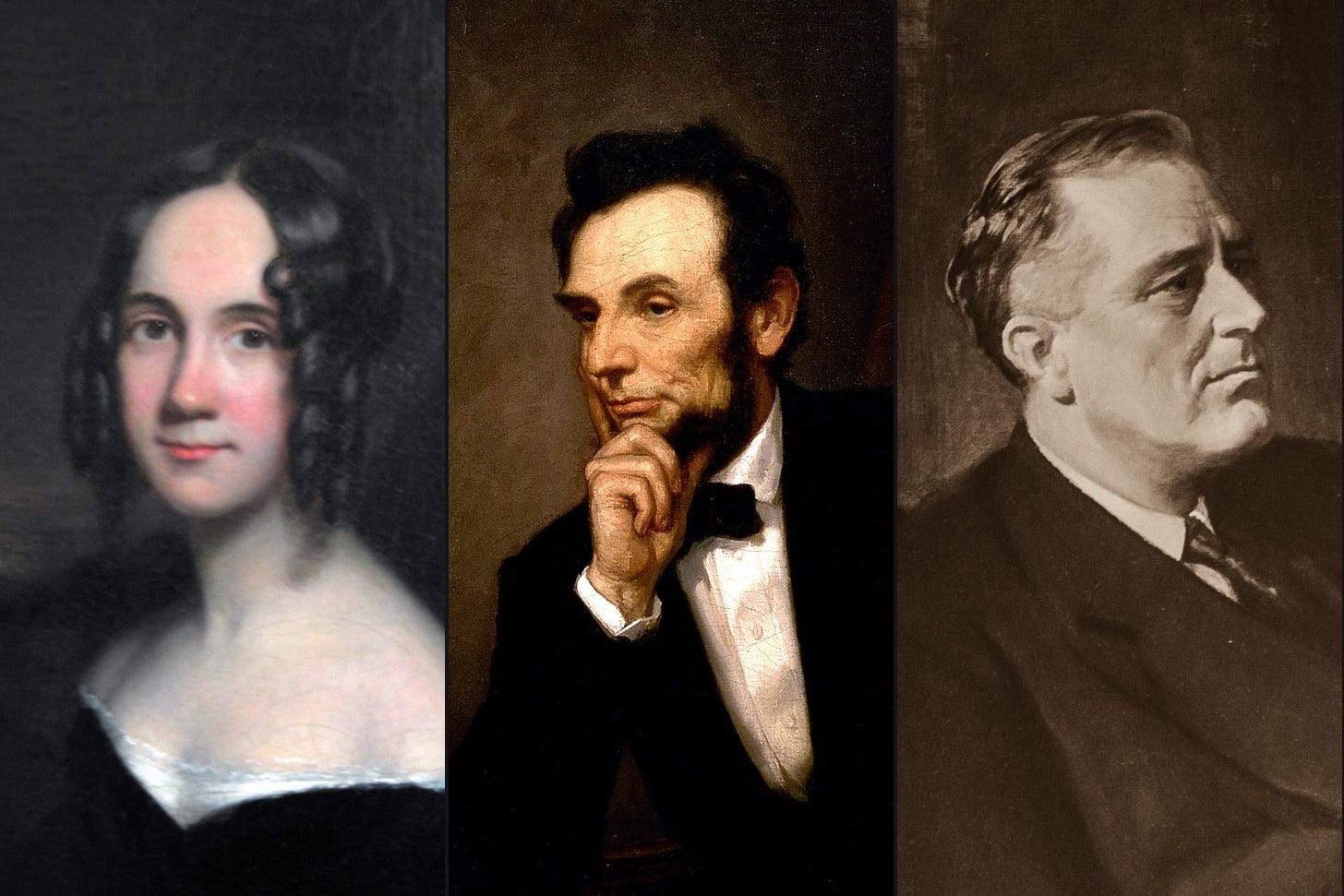
The person most responsible for changing that was Sarah Josepha Hale, best remembered today, if at all, as the author of “Mary Had a Little Lamb.” In her 1827 novel Northwood, she lovingly described a New England Thanksgiving dinner, down to the pumpkin pie, which she called “an indispensable part” of the occasion.7 After she became the editor of Godey’s Lady’s Book, a popular women’s magazine, she made a national Thanksgiving her cause, writing editorials year after year and sending letters to governors and presidents, urging that every state observe the holiday on the same day: the last Thursday in November.8
Her timing was helped by a rising interest in the Pilgrims. In 1841, a Boston minister and historian named Alexander Young republished Winslow’s long-forgotten account of the 1621 harvest celebration, and added a footnote: “This was the first Thanksgiving, the harvest festival of New England.” It’s the earliest known use of the phrase.9 A New England custom now had a founding story, and a fairly appealing one, of Englishmen and Indians sharing a meal in peace.
By the 1850s, Hale’s campaign was working. By one count, 29 states were observing a Thanksgiving, though not all on the same day.10
A Yankee holiday
Not everyone was won over. In much of the South, Thanksgiving was regarded as a New England import, and an increasingly politicized one, associated with the antislavery preaching heard in Northern pulpits. In 1856, the Richmond Whig denounced the District of Columbia’s thanksgiving proclamation as “repugnant,” and Virginia’s governor, Henry Wise, later wrote to Hale rejecting “this theatrical national claptrap of Thanksgiving.”11
The war makes it national
What finally made Thanksgiving national was the Civil War. In the summer of 1863, after the Union victories at Gettysburg and Vicksburg, Abraham Lincoln proclaimed a day of thanksgiving for Thursday, August 6.12 On September 28, Sarah Josepha Hale wrote to him, asking him to make the day of thanksgiving a national and fixed festival.13 Five days later, on October 3, Lincoln issued a proclamation, drafted by Secretary of State William Seward, inviting “my fellow-citizens in every part of the United States” to “set apart and observe the last Thursday of November next, as a day of Thanksgiving and Praise to our beneficent Father who dwelleth in the Heavens.”14
“Every part of the United States” was a pointed choice of words. In the middle of the war, Lincoln was addressing the whole country, including the states that had tried to leave it.
Lincoln’s proclamation applied only to 1863, but he issued another the next year, and his successors kept up the practice. After one detour, when Andrew Johnson chose the first Thursday of December in 1865,15 presidents settled on the last Thursday of November, year after year.16
The South comes around, slowly
The holiday spread south after the war, but not without resistance. Texas first celebrated Thanksgiving in 1868, during Reconstruction. A decade later, Gov. Oran Roberts, who had presided over the convention that took Texas out of the Union, refused to proclaim it, calling it a “damned Yankee institution.”17 Some Southern governors went along with the president’s proclamation but on a different date, and Southern cooks often swapped pumpkin pie for sweet potato.18 But eventually, Thanksgiving became what Hale had wanted, a holiday celebrated in every state on the same day.
The fourth Thursday
There was one more wrinkle. “The last Thursday” isn’t a fixed rule. November has 30 days, so it has four Thursdays in most years and five in about two years out of seven. In 1939, the last Thursday fell on November 30. The country was still climbing out of the Depression, and retailers, worried about a short Christmas shopping season, asked President Franklin Roosevelt to move the holiday up a week. He did, proclaiming Thanksgiving for November 23.19
The reaction was immediate. Critics called it “Franksgiving.”20 An early Gallup poll found 62% of Americans opposed.21 Because a president’s proclamation had no legal force on the states, each governor decided for himself, and the country split: 32 states followed Roosevelt, and 16 kept the last Thursday.22 Texas, under Gov. W. Lee O’Daniel, did both, observing the federal holiday and its own “States’ Rights Thanksgiving” a week later. The state holiday remained the traditional last-Thursday date of the Texas–Texas A&M football game.23
Congress settled the matter in 1941. The House passed a resolution fixing Thanksgiving on the last Thursday of November, but the Senate changed “last” to “fourth,” so that the holiday would never again fall as late as November 29 or 30. Roosevelt signed it on December 26, 1941, 19 days after Pearl Harbor.24 It remains federal law today: “Thanksgiving Day, the fourth Thursday in November.”25 Texas held out for years, celebrating two Thanksgivings whenever November had five Thursdays, until Gov. Price Daniel signed a law in 1957 bringing the state into line.26
Back to where it started
This year, November has four Thursdays, so the fourth Thursday is also the last one, and Thanksgiving falls on November 26, the same date as Washington’s Thanksgiving in 1789 and Lincoln’s in 1863. The holiday’s origins are older than the nation, yet its uniform national observance is younger than we tend to think. It began as an occasional New England religious observance, was given a founding legend in the 1840s, became national during a civil war, and got its fixed date in the first weeks of a world war. Sarah Josepha Hale didn’t live to see it observed in every state, but the holiday she spent decades campaigning for is, in nearly every particular, the one we’ll celebrate on Thursday.
Edward Winslow, in Mourt’s Relation (London, 1622), as reproduced in Plimoth Patuxet Museums, “Eye-Witness Account of the 1621 Harvest Celebration”.
Commonwealth Museum, Secretary of the Commonwealth of Massachusetts, “Thanksgiving Mysteries: Why is Thanksgiving on Thursday?”.
Plimoth Patuxet Museums, “Memories of Thanksgiving Across the Centuries”.
George Washington, “Thanksgiving Proclamation, 3 October 1789”, Founders Online, National Archives.
John T. Woolley, “Evolution of the Thanksgiving Proclamation”, The American Presidency Project, revised October 24, 2022.
Thomas Jefferson, “From Thomas Jefferson to Samuel Miller, 23 January 1808”, Founders Online, National Archives.
“For Decades, Southern States Considered Thanksgiving an Act of Northern Aggression”, Atlas Obscura, November 21, 2017.
National Park Service, Lincoln Home National Historic Site, “Lincoln and Thanksgiving”; Plimoth Patuxet Museums, as in note 3.
Plimoth Patuxet Museums, as in note 1; Plimoth Patuxet Museums, as in note 3.
Atlas Obscura, as in note 7.
Atlas Obscura, as in note 7, citing Melanie Kirkpatrick, Thanksgiving: The Holiday at the Heart of the American Experience (2016).
Abraham Lincoln, “Proclamation 103—Day of Thanksgiving, Praise, and Prayer, August 6, 1863”, The American Presidency Project.
Sarah J. Hale to Abraham Lincoln, September 28, 1863, Abraham Lincoln Papers, Library of Congress.
Abraham Lincoln, “Proclamation 106—Thanksgiving Day, 1863”, The American Presidency Project; National Park Service, as in note 8.
Andrew Johnson, “Proclamation 147—Thanksgiving Day, 1865”, The American Presidency Project.
Woolley, as in note 5.
Bud Kennedy, “Once, Texas had its own ‘States’ Rights Thanksgiving Day,’ to oppose FDR and Washington”, Fort Worth Star-Telegram, November 20, 2023.
Atlas Obscura, as in note 7.
G. Wallace Chessman, “Thanksgiving: Another FDR Experiment”, Prologue 23, no. 3 (Fall 1990).
“FDR’s Franksgiving Debacle”, HistoryNet.
Chessman, as in note 19.
National Archives, Center for Legislative Archives, “Congress Establishes Thanksgiving”.
Kennedy, as in note 17.
National Archives, as in note 22; Chessman, as in note 19.
Kennedy, as in note 17.