


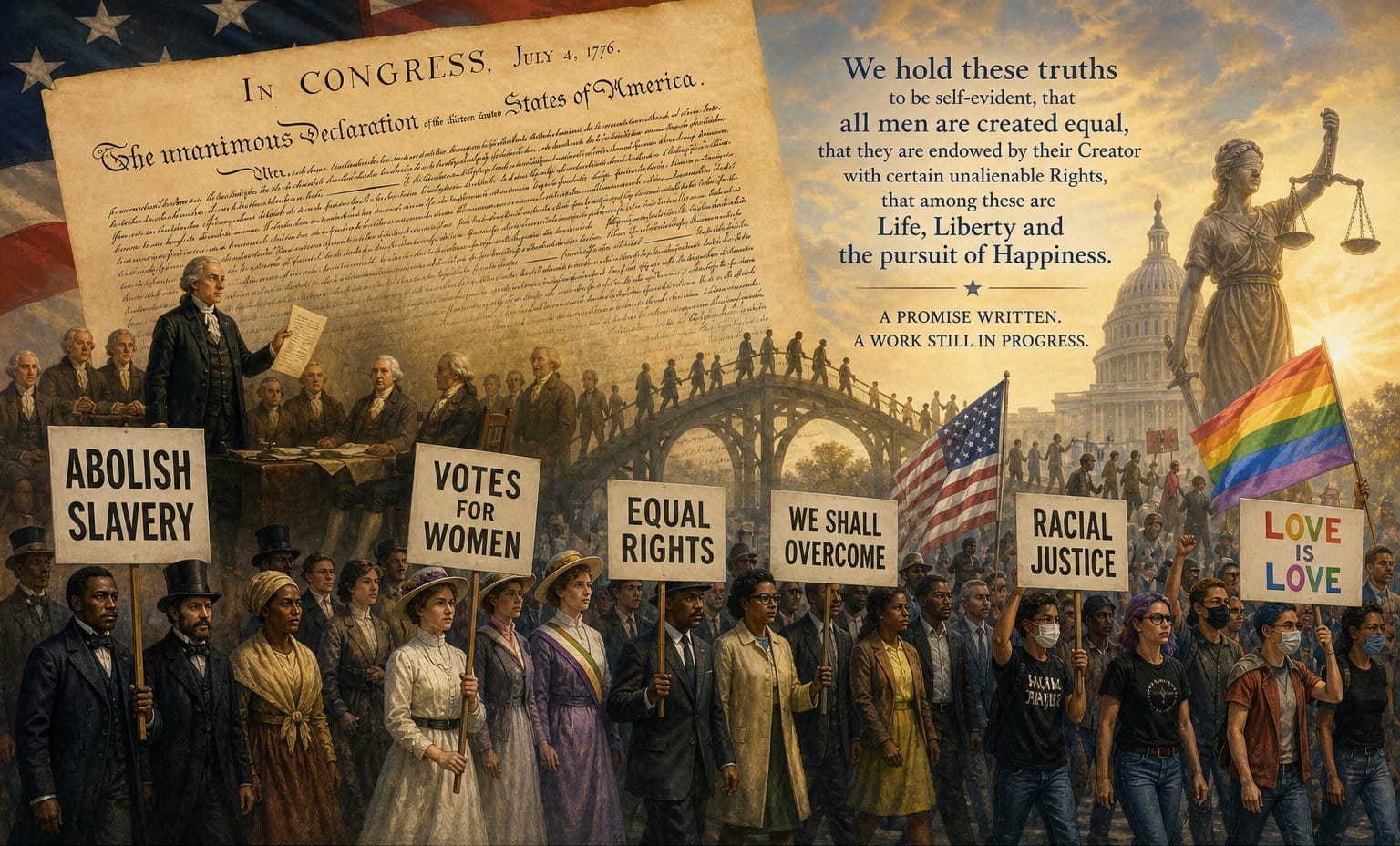
Every July 4th, Americans celebrate the birthday of their country. Fireworks, parades, cookouts, flags — the full pageantry of national pride. But what exactly are we marking the anniversary of? Not the end of the Revolutionary War, which came in 1783. Not the Constitution, which wasn’t written until 1787 and ratified in 1788. What we’re celebrating, if we’re being precise about it, is the publication of a document — a letter, really, addressed to “a candid world,” making the case that the thirteen colonies had the right to separate from the British Crown.
The preamble
Most people, if pressed, could produce a fragment or two of the Declaration of Independence. “All men are created equal” is probably the most quoted phrase in American political life. But the full second paragraph — the one that begins “We hold these truths to be self-evident” — deserves to be read slowly and carefully, because it is doing something extraordinary.
It opens with an epistemological claim: these truths are self-evident. Not proven, not argued, not derived from scripture or tradition or royal authority — self-evident. Jefferson is asserting that the principles that follow are accessible to any rational person who cares to look. It’s a deeply Enlightenment move, placing reason above revelation and making the argument available, in principle, to everyone.
Then come the truths themselves: that all men are created equal; that they are endowed with certain unalienable rights; that among these are life, liberty, and the pursuit of happiness. And then — this is the part that gets less attention — that governments are instituted among men to secure these rights, deriving their just powers from the consent of the governed. And that whenever any government becomes destructive of these ends, it is the right of the people to alter or abolish it.
This is a radical statement. It doesn’t merely assert the right of the colonists to self-governance. It asserts a universal principle: that legitimate government rests on the consent of the governed, everywhere, always — and that people have the right to overthrow governments that fail them. Jefferson wasn’t writing a legal brief for one historical grievance. He was writing a philosophy of government that would have implications far beyond 1776.
The grievances
After the preamble comes the long middle section that most people skip: the list of grievances against King George III. It is worth reading, if only because it is so different in character from the preamble. Where the preamble soars, the grievances are specific, tactical, and sometimes lawyerly. They read like a bill of particulars in a legal proceeding — which, in a sense, they are.
Some of the grievances are institutional: the King has dissolved representative legislatures, obstructed the administration of justice, kept standing armies among the colonists without their consent. Others are more visceral: he has plundered their seas, ravaged their coasts, burned their towns, destroyed the lives of their people.
And then there is one that lands with particular force in the present moment: the King, the Declaration charges, has “endeavoured to prevent the population of these States; for that purpose obstructing the Laws for Naturalization of Foreigners; refusing to pass others to encourage their migrations hither, and raising the conditions of new Appropriations of Lands.” The Founders didn’t merely tolerate immigration — they considered its obstruction an act of tyranny. They wanted more people to come. They saw the ability to attract newcomers as essential to the project they were building, and went so far as to include the King’s restriction of land grants — the homesteading mechanism by which new arrivals could establish themselves — as part of their indictment.
It is worth sitting with that for a moment, in 2026.
And then, at the very end of the list — the last grievance before the closing peroration — comes the passage that most modern readers find hardest to square with the document’s lofty opening: the King, Jefferson writes, has “endeavoured to bring on the inhabitants of our frontiers, the merciless Indian Savages, whose known rule of warfare, is an undistinguished destruction of all ages, sexes and conditions.”
There it is, in the founding document of a nation conceived in liberty: language that strikes modern readers as jarring at best. It is worth remembering, though, that frontier violence was real and often horrific — many of the signers had firsthand knowledge of settlements destroyed and families killed. The grievance itself was not invented. What the language fails to reckon with, of course, is the fuller picture: that the tribes were responding to encroachment on their own lands, and that the situation was far more complicated than a simple tale of royal incitement. But the men who signed this document were writing from inside their own experience, with all its limits. Jefferson wrote that all men are created equal, yet he owned more than six hundred people over the course of his lifetime. He wrote a philosophy of universal human dignity, and included in his list of grievances a passage that most of us today would rather not linger over.
The ideals and the distance
It would be too easy, from all of this, to conclude that the Declaration is simply hypocritical — a document whose high-minded language was always a cover for the interests of wealthy white men, and whose ideals were never meant to apply universally. That reading is understandable. But I think it misses something important.
The ideals articulated in the preamble have proven, again and again, to be larger than the men who wrote them. They have been invoked by people Jefferson would never have imagined invoking them. Frederick Douglass, in his famous 1852 speech “What to the Slave is the Fourth of July?”, didn’t reject the Declaration — he held America to it. The abolitionists, the suffragists, the civil rights movement: all of them drew on the Declaration’s language to demand that the country live up to its own founding argument. “All men are created equal” turned out to mean something the authors hadn’t fully reckoned with, and it couldn’t be put back in the bottle.
That is the strange and durable power of the document. Jefferson wrote better than he knew. The argument he made was more radical, more universal, more demanding than he or his fellow signers were themselves prepared to achieve. And 250 years later, we are still arguing about what it requires of us.
Those principles are what we’re celebrating — with our fireworks, our flags, our cookouts — on the Fourth of July. The birthday of our nation is a reminder of our ongoing struggle to fully realize its promise.
The full text of the Declaration of Independence is available from the National Archives.