

The Bicycle Driver’s Dilemma
On skill, infrastructure, and what cycling advocacy gets wrong

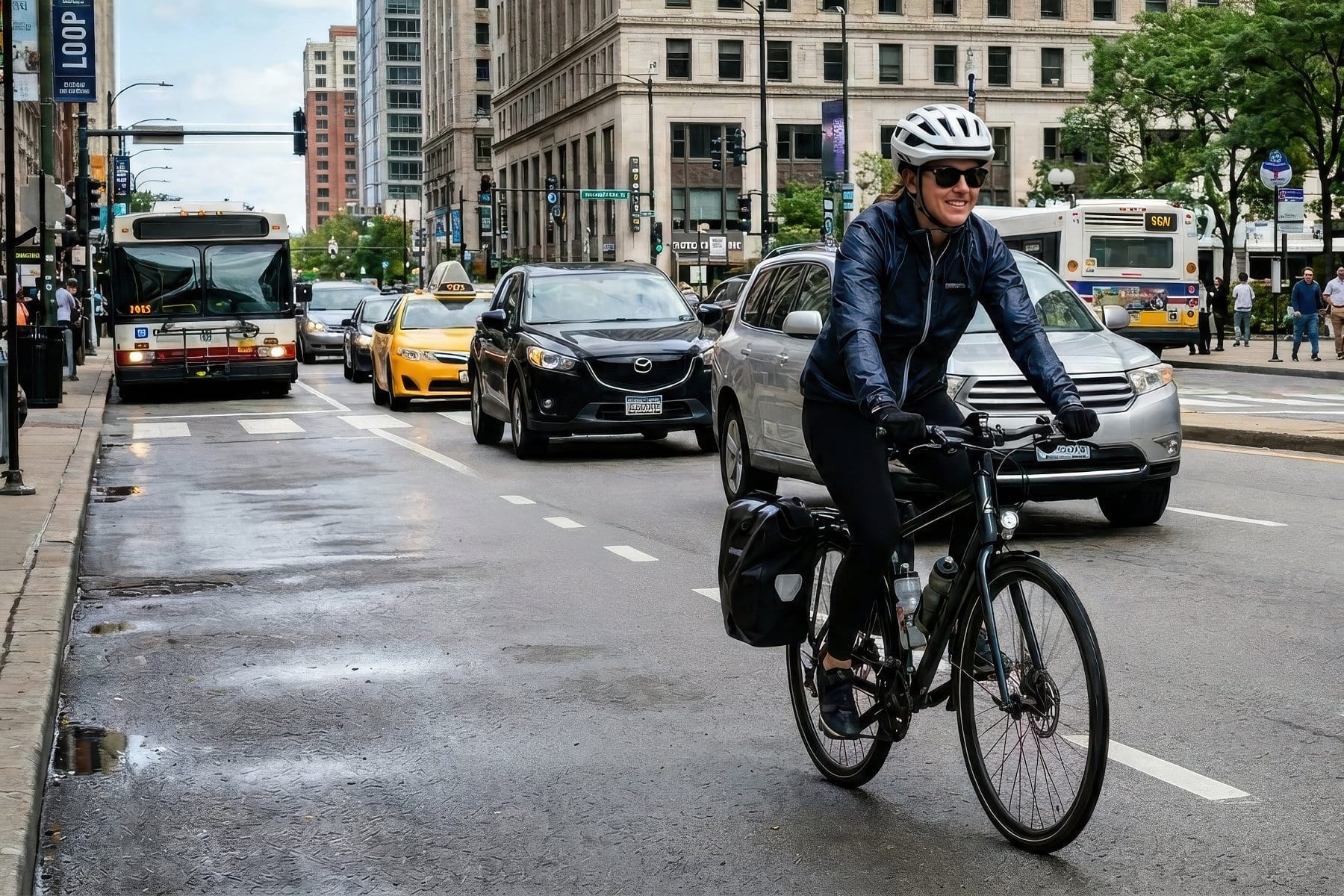
Cycling advocacy should be straightforward: you want people to ride bicycles, and you want them to do so safely and effectively. The disagreements, you might think, would be about tactics — how best to achieve those goals. But there is a deeper question lurking beneath the tactical ones, about what safety actually means and how it is best achieved. Do cyclists become safer when the infrastructure around them improves, or when their own skills and confidence improve? I have spent more than two decades thinking about that question, and this essay is about what I’ve learned.
My story
In the early 1990s I was a student at the University of Houston, and for much of that time I commuted to campus by bicycle — eight miles each way, on ordinary Houston city streets, in typical Houston traffic. The route I used most often was West Alabama Street, which begins, conveniently enough, right at the edge of the UH campus and runs westward through Third Ward, Midtown, Montrose, Upper Kirby, Greenway Plaza, and Afton Oaks.
I had virtually no problems.
That may sound surprising, even reckless, to anyone who has absorbed the prevailing narrative: that riding in traffic is inherently dangerous, that cyclists are vulnerable victims at the mercy of inattentive motorists, and that the only path to safety is physical separation from motor vehicles. But the prevailing narrative is wrong, or at least badly incomplete. What made West Alabama workable wasn’t luck or bravado. It was the fact that, at the time, it was a normal four-lane street: two 10-foot-wide lanes in each direction. In a configuration like that, a cyclist who knows what they’re doing simply occupies the right lane and rides like a vehicle. Motorists who want to pass use the left lane. Nobody has to do anything unusual. The geometry solves the problem.
I didn’t have a name for what I was doing at the time. Years later I would discover that it had one: vehicular cycling, a term coined by traffic engineer John Forester. (The preferred term nowadays is bicycle driving.) I would eventually become certified as both a League Cycling Instructor and a CyclingSavvy Instructor — part of a tradition that teaches cyclists to operate competently and confidently as drivers of vehicles, because that turns out to be the approach that actually works.
But before all that, in early 2002, I helped found BikeHouston, the city’s main bicycle advocacy organization, and became its first board chair.
I was forced to resign that same fall.
The proximate cause was a proposal to install painted bike lanes on West Alabama — the very street I had commuted on for years. These would have been standard striped bike lanes in the four-lane-wide section. To fit the bike lanes in, the road would have been reconfigured from four lanes to three: one travel lane in each direction plus a center turn lane. The bike lanes themselves would have occupied a four-foot-wide strip of the space vacated by the original right lanes, with the remainder absorbed into the new center turn lane, pushing cyclists to the edge of the roadway onto pavement that was, at the time, in notoriously poor condition and practically unrideable.
I objected, loudly. The street worked quite well for cyclists already. What was being proposed would make it worse, not better, for anyone who knew how to ride on it. A three-lane road is actually harder to navigate by bicycle than a four-lane road, because the only way a motorist can pass a cyclist is to use the center turn lane, which is designed for turning movements, not through traffic. The clean, natural geometry of the four-lane configuration — cyclist in the right lane, cars passing in the left — would be destroyed in favor of a painted stripe that forced cyclists into the gutter, while giving to some naïve observers the false impression that something helpful had been done.
The majority of the board didn’t see it that way. I was out.
Thankfully, that proposal for West Alabama was never implemented. But it serves as an example of what can happen when the people advocating for cycling infrastructure fail to understand — or refuse to acknowledge — how cycling actually works.
Understanding the problem
This is the divide I’ve been unable to bridge with mainstream cycling advocacy ever since: the difference between making cycling appear safer and making it actually safer — attempting to shelter riders, versus empowering them.
Allow me to offer an analogy: suppose society decided it would benefit from having many more people swimming in pools than currently do. One problem is that a lot of people simply aren’t interested in swimming, but another is that many who might be interested are afraid of drowning. One approach to a solution is to teach people to swim — nothing Olympic, just floating and getting from one end to the other without panic. This is not a difficult skill; millions of people already have it. The main barrier is fear, and fear responds well to competent instruction.
The other approach is to drain most of the water out of existing pools and build a great many new ones with no more than a foot of water in them, so that anyone can sit upright and feel safe. Never mind that this ruins the experience for everyone who already knows how to swim. Never mind that a person who has only ever sat in a kiddie pool is no less likely to drown when they eventually encounter deep water — which they will.
True swimming advocates favor the former approach. Swimming infrastructure advocates favor the latter. And the infrastructure advocates, it must be said, have a considerable advantage in the marketplace of ideas: they can point to the kiddie pools they’ve built, the grants they’ve secured, the ribbon-cutting ceremonies. Teaching someone to swim produces a capable swimmer. It doesn’t produce a photo-op or a press release.
The literacy version of this analogy is simpler and perhaps more cutting. If the goal is reading literacy, do you teach people to read, or do you try to produce audio editions of every major publication so that knowing how to read is supposedly unnecessary? The audio edition approach might seem compassionate — no one has to struggle, no one has to feel inadequate — but it produces a population that cannot read. The vulnerability doesn’t go away; it just becomes invisible.
The safety-in-numbers trope
Against arguments like these, the infrastructure-advocacy world has a ready reply: Safety in Numbers. The idea is that if you can make cycling appear safe enough to attract large numbers of new riders — by designing and building what their proponents call “high-comfort” facilities — those riders will become actually safer by virtue of their numbers: motorists will encounter cyclists so frequently that they’ll learn to watch for them and accommodate them.
It’s a seductive idea. It’s also completely unrealistic.
The empirical case for Safety in Numbers rests largely on correlational data: cities with high cycling rates tend to have lower rates of cycling injuries. But this confuses cause and effect. Cities with high cycling rates tend to be cities with culture, demographics, topography, climate, and urban forms that are already amenable to cycling — and to careful driving. The numbers don’t create the safety. The underlying conditions create both.
More fundamentally, Safety in Numbers inverts the normal logic of risk management. In no other domain do we reason this way. We didn’t make aviation safer by flying more people and hoping pilots and air traffic controllers would figure things out through exposure. We made it safer through rigorous training, standardized procedures, and honest analysis of what actually causes accidents. The idea that we can achieve cycling safety by persuading large numbers of unskilled, uncomfortable people to ride in conditions they’re not prepared for — and that safety will somehow emerge from the resulting chaos — is not a plausible argument.
There is also an ethical dimension that rarely gets acknowledged. Safety in Numbers, as a policy framework, treats individual cyclists as statistical inputs. Even if it were true, the person who gets hurt while the numbers are still building is an acceptable cost of the theory working itself out. That’s a strange thing for an advocacy movement to be comfortable with.
The teaching approach
None of this is an argument against bicycle infrastructure categorically. Separated paths along waterways and through parks are lovely, and generally quite safe. Sensible lane configurations on appropriate streets can be helpful. The question is whether infrastructure complements skill or attempts to substitute for it — and whether the infrastructure being built actually addresses the hazards it purports to mitigate.
On-street “protected” bicycle infrastructure mostly doesn’t. Injurious collisions between cyclists and motor vehicles happen overwhelmingly at intersections and driveways, where a motorist and a cyclist cross paths, often while the motorist is turning. Green paint, flexible posts, and “armadillos” do nothing to prevent such crashes. In many configurations, cycling in a “protected” on-street facility actually exacerbates movement conflicts like these, because it positions the cyclist at the edge of the roadway, out of motorists’ natural sightlines. The “protection” always disappears at exactly the places where it would most need to exist.
The word protected, in other words, is doing a great deal of rhetorical work that the infrastructure itself cannot do.
What genuine cycling advocacy looks like, to me, is teaching people to understand these dynamics — where the actual risks are, how to position themselves to be visible and predictable, how to communicate with motorists through eye contact, lane position, and proper signaling. It looks like producing cyclists who can ride anywhere, not just on the corridors where someone has painted a stripe. It looks like the thing I was doing on West Alabama in 1992, before anyone had decided to “improve” it.
That approach doesn’t scale into a political movement very easily. It doesn’t generate grant applications or infrastructure contracts or ribbon cuttings. It produces, instead, capable cyclists — people who have discovered, sometimes to their own surprise, that riding in traffic is not only manageable but genuinely pleasant, once you understand how it works.
That turns out to be a minority view in contemporary cycling advocacy. I found that out in 2002, and I haven’t had much reason to revise the conclusion since.
I dunno. When I was commuting 20 miles a day with a shower at each end, the “vehicular cycling” approach worked well for me. Now that I putter around town with kids on a cargo bike, or their own bikes, and need to go slow to avoid arriving sweaty. I’d like a bike lane: “bicycle driving” is less reasonable when you’re going 10mph, and no amount of “learning” is going to change those conditions.
Truth is the that both types of cyclists exist but growth in the total number of cyclists is likely achieved by appealing to those that would use bike lanes. Of course, that doesn’t mean that cities will manage to build good ones…
Just began bike commuting here in Norfolk, VA. We have the typical urban mish-mash of protected bike lines, unprotected bike lanes, sharrows, and nothing. For the most part, I have enjoyed “bicycle driving” even on those roads where there are no special designations. I try to make myself highly visible with fluorescent yellow safety “suspenders,” hi-vis tape, and blinking lights. I ride an e-bike, so it helps that I can edge up to 28 mph if I feel it it necessary to keep with the flow of traffic, but I’m usually averaging around 15-17.