


Before dawn on Wednesday, October 7, the launch field at Albuquerque’s Balloon Fiesta Park was crowded, cold, and calm. The flight status was green. At about 6:00, a handful of balloons rose into the dark, their envelopes glowing each time the pilots fired their burners. This was the Dawn Patrol, the small group that flies before sunrise, and the rest of us watched them go with the confidence of people who expected hundreds more balloons to follow within the hour.
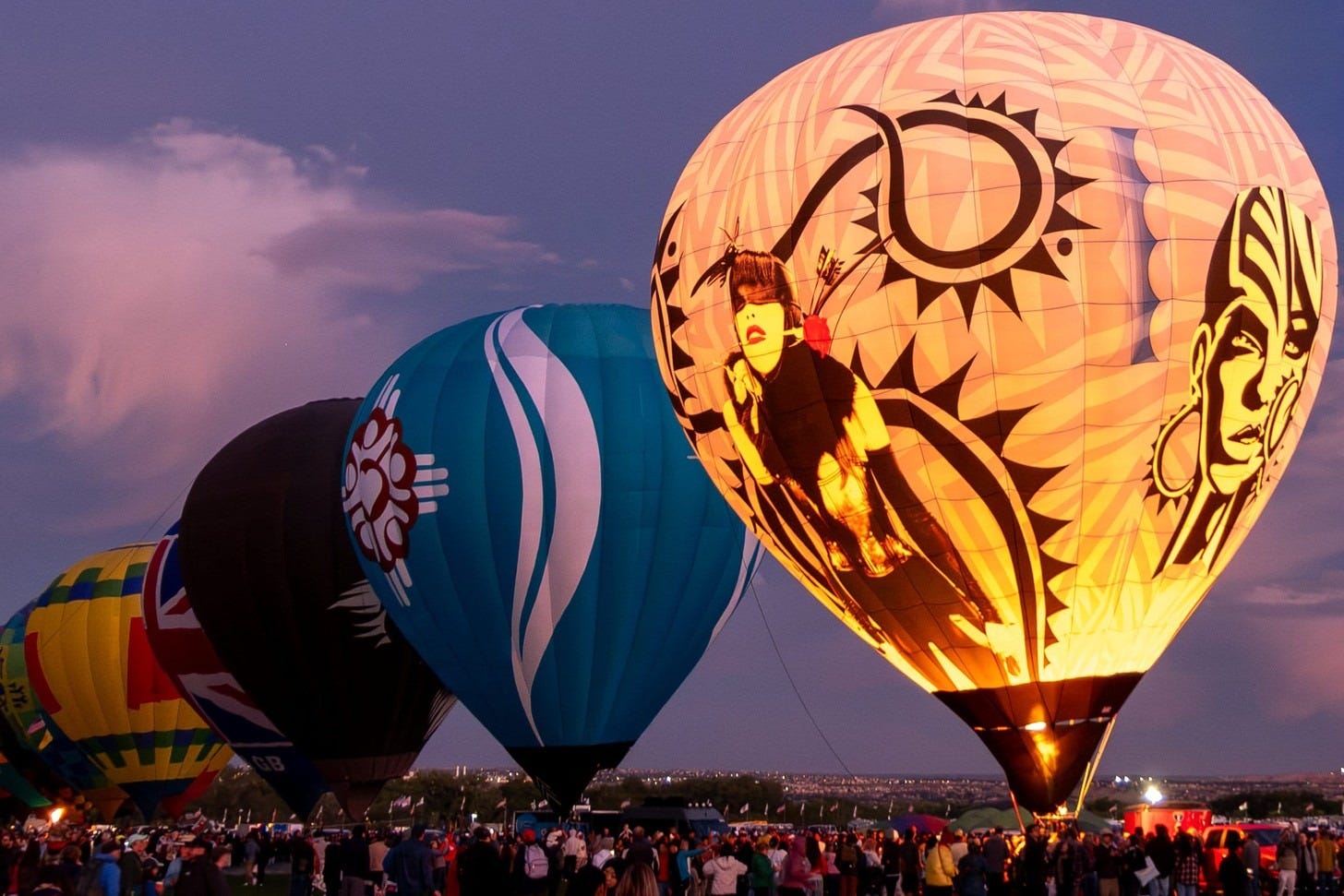
Balloon Fiesta Park, 6:45 a.m., Oct. 7, 2026. None of these balloons would leave the ground that morning. (All photos by the author.)
They didn’t. Sometime before 7:00, when the mass ascension was due to begin, the status turned yellow. Then the announcement came: the morning would be a static display. All around us, crews unrolled their envelopes, filled them with hot air, and stood them upright on the grass, and there they stayed. The air on the field still felt perfectly still. The problem, the Fiesta explained, was “developing weather patterns south of Balloon Fiesta Park.”1
Three days later, on Saturday morning, I watched from about two miles south-southeast of the park as the sky filled with balloons, hundreds of them, drifting toward me at every height from treetop to tiny dot.
The difference between those two mornings had nothing to do with the field and everything to do with the air. A balloon has no steering, so the question a pilot has to answer is not whether the air is calm here, but what the air will be doing wherever the balloon ends up an hour from now.
A balloon goes where the air goes
A hot-air balloon has a propane burner to heat the air in its envelope and a vent at the top to let hot air out. The burner makes it rise; the vent makes it sink. That is the entire control system. There is no rudder or any other control surface, no propeller, and no way to push against the wind.
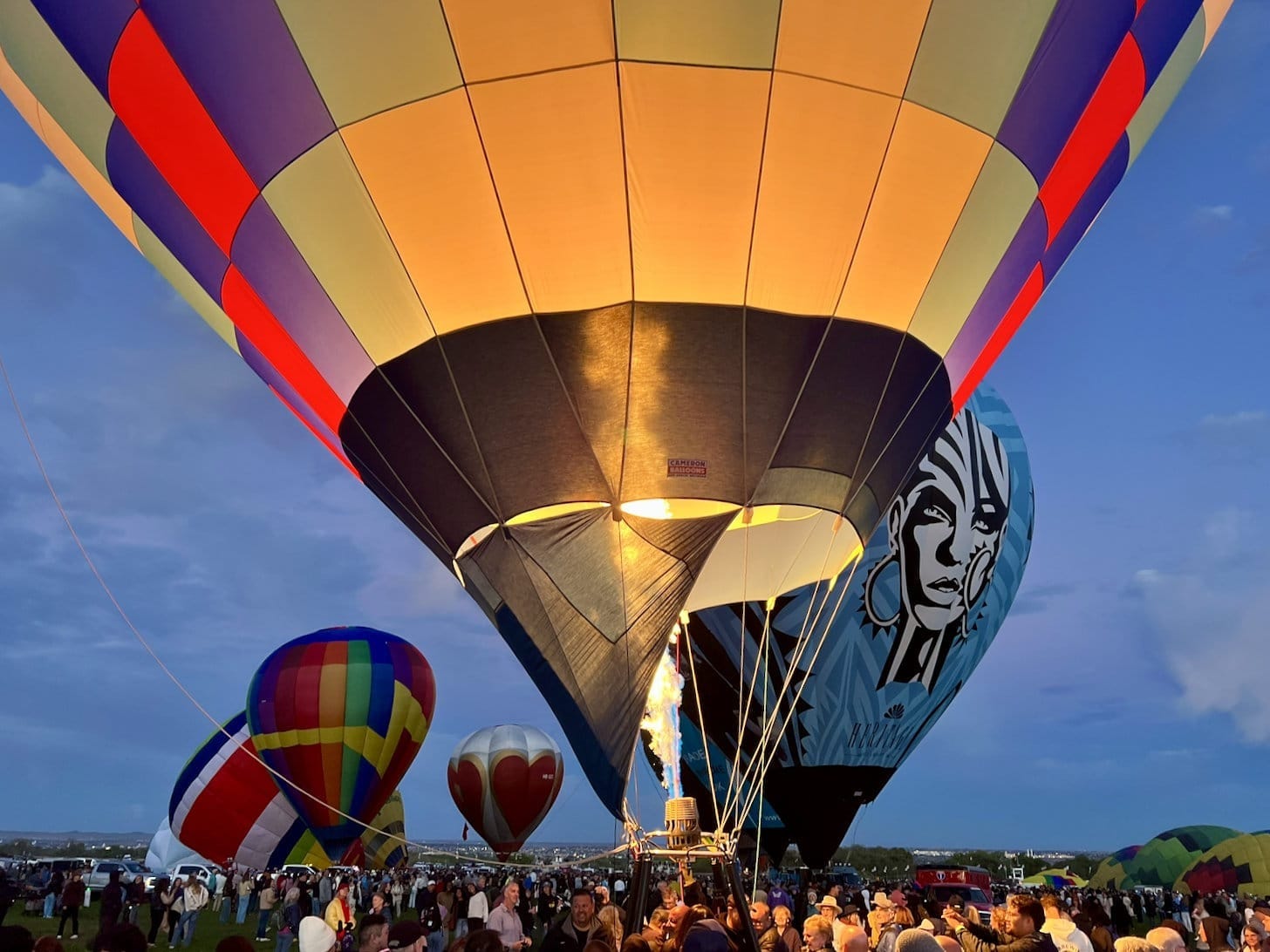
A propane burner heats the air inside an envelope at Balloon Fiesta Park, 6:52 a.m., Oct. 7, 2026.
So a balloon travels at exactly the speed of the air around it. In flight, that makes for an oddly peaceful experience: moving with the wind, a passenger feels no breeze at all. It also means the balloon lands at the speed of the wind. A breeze that would barely ruffle a flag on the launch field becomes a basket bouncing and dragging across the ground at the end of the flight.
That is why Wednesday’s decision turned on the weather to the south. On those October mornings, the low-level wind in Albuquerque usually carries balloons south. Weather building south of the park was weather the balloons would fly into, and would have to land in.
Steering by altitude
What a pilot can control is height, and that matters because the wind often blows in different directions at different altitudes. A pilot who wants to change course climbs or descends until the balloon finds a layer of air moving in the right direction.
Doing that well means knowing what each layer is doing, and the pilots learn it partly by watching each other. The Dawn Patrol serves, in the words of one local report, as a “test for the weather”: as the early balloons drift off in the dark, pilots on the ground can see which way the air is moving at the heights those balloons reach.2 The rest is local experience, and in Albuquerque the local experience includes one of the most famous wind patterns in sports.
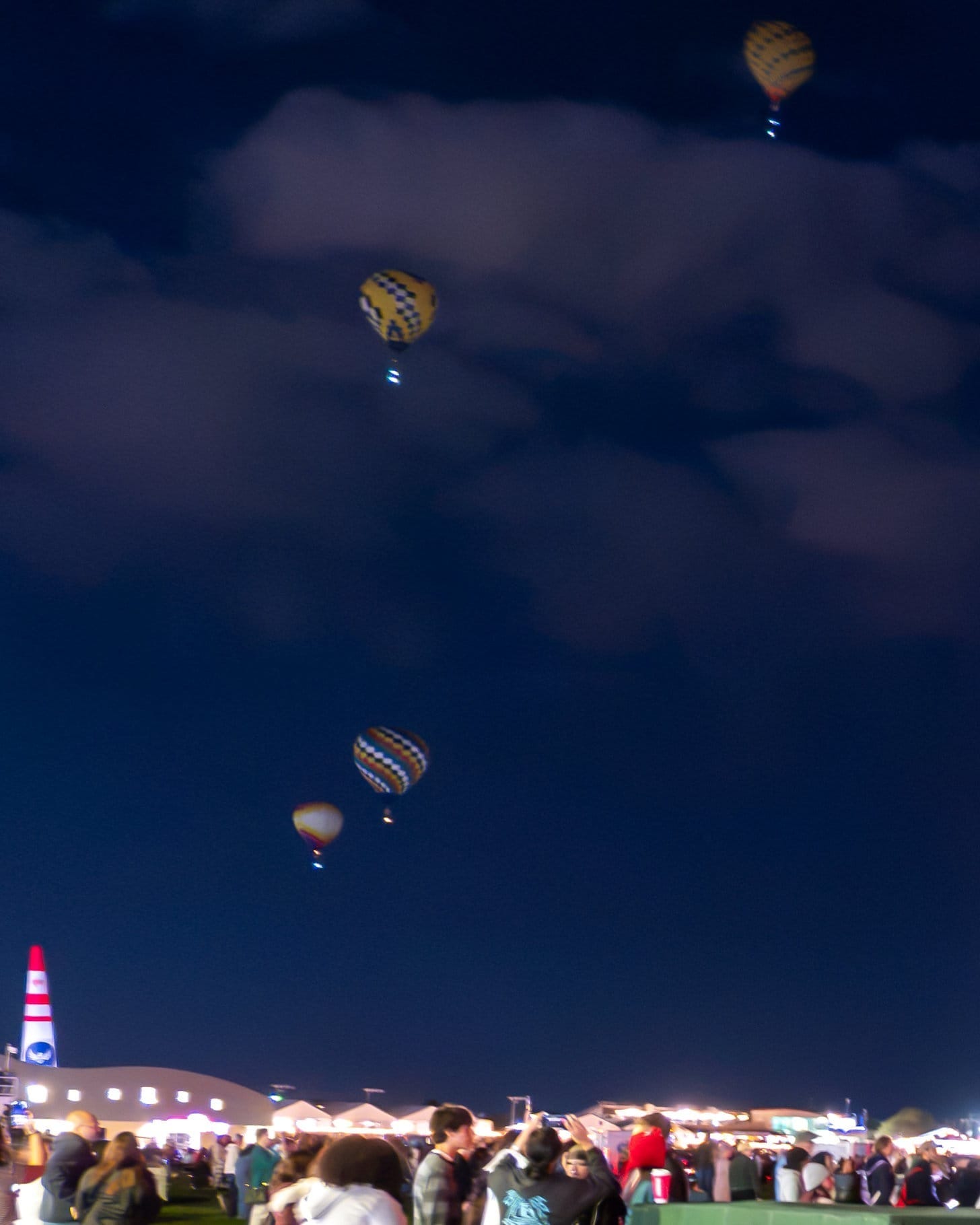
Dawn Patrol balloons rise over Balloon Fiesta Park before sunrise, 6:17 a.m., Oct. 7, 2026.
The Albuquerque Box
On clear, calm autumn nights, the ground in the high desert loses heat quickly, and it chills the air just above it. Cold air is denser than warm air, so it flows downhill, like water. Around Albuquerque, it drains off the surrounding mountains into the Rio Grande valley and then runs south along the valley floor, usually at less than 10 mph. A layer of warmer air sits on top of it like a lid. Normally air grows colder with height, so this reversal is called a temperature inversion, and it keeps the cold air in place. The cold layer is shallow, according to the National Weather Service “generally no more than a few hundred feet in depth.”3
Above that lid, the wind often blows the other way, from the south. So a pilot can launch, drift south in the cold air near the ground, then climb through the inversion into the northbound wind, ride back over the city, and descend to land near the launch field. A balloon flying that pattern traces a loop in the sky. Balloonists call it the Albuquerque Box.
The Box has made Albuquerque famous among balloonists, but it appears less often than its reputation suggests. According to a meteorologist at the Weather Service’s Albuquerque office, it occurs on about 3 of the first 15 days of October.4 On most Fiesta mornings, pilots get only half of it: the gentle southward drift near the ground, with no reliable way home. That is what I saw on Saturday, a sky full of balloons drifting south toward me, carried by the cold air from the valley.
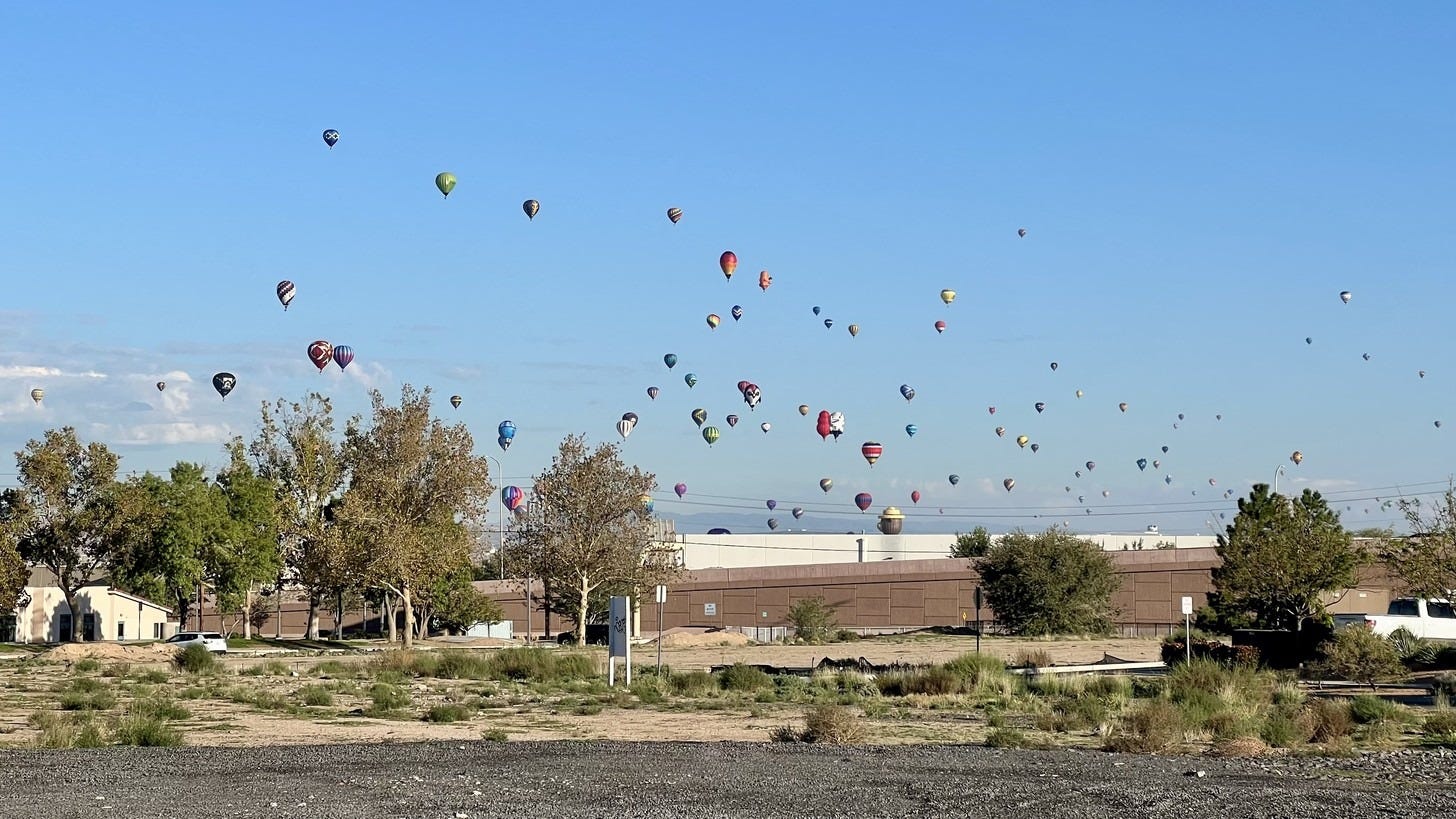
Balloons drifting south from Balloon Fiesta Park, seen from two miles away, 8:25 a.m., Oct. 10, 2026.
Why the balloons fly at dawn
The Box, and the calm that makes ballooning possible at all, are products of the night. Once the sun comes up and warms the ground, rising currents of warm air begin to stir the lower atmosphere. They break up the inversion and mix the stronger winds from higher up down to the surface. By late morning, the Box is gone.5
That gives the Fiesta a narrow window, and on October 7 the timing was tight. Sunrise that day was at about 7:06, just after the mass ascension was scheduled to begin. The Dawn Patrol had launched an hour earlier, in the most stable air of the day. Night flying became part of the Fiesta in 1978, after two California balloonists developed position lights that made it practical.6 Then the sun rose, and, as the Albuquerque Journal reported, the weather changed.7
Green, yellow, and red
Every morning, the Fiesta posts a flag that tells the pilots whether they can fly. Green means go. Yellow, in the words of a local TV station’s glossary, “usually means officials are waiting on the weather or waiting a bit longer to make an official decision.” Red means no one flies.8
Even a green flag is not an order to launch. On the field, balloons are sent up one at a time by launch directors in black-and-white striped shirts, known to everyone as “zebras.” A zebra checks that the sky overhead is clear and gives the pilot a thumbs-up, the official signal that the balloon may go. But the decision to fly belongs to the pilot.9
On October 7, the system worked the way it was designed to. Green when the Dawn Patrol launched, yellow as the forecast for the south deteriorated, and then the call to keep everyone on the ground. From the field, it looked like the most beautiful morning imaginable. From the forecast, it looked like the kind of morning that ends with hundreds of baskets coming down in rough air.
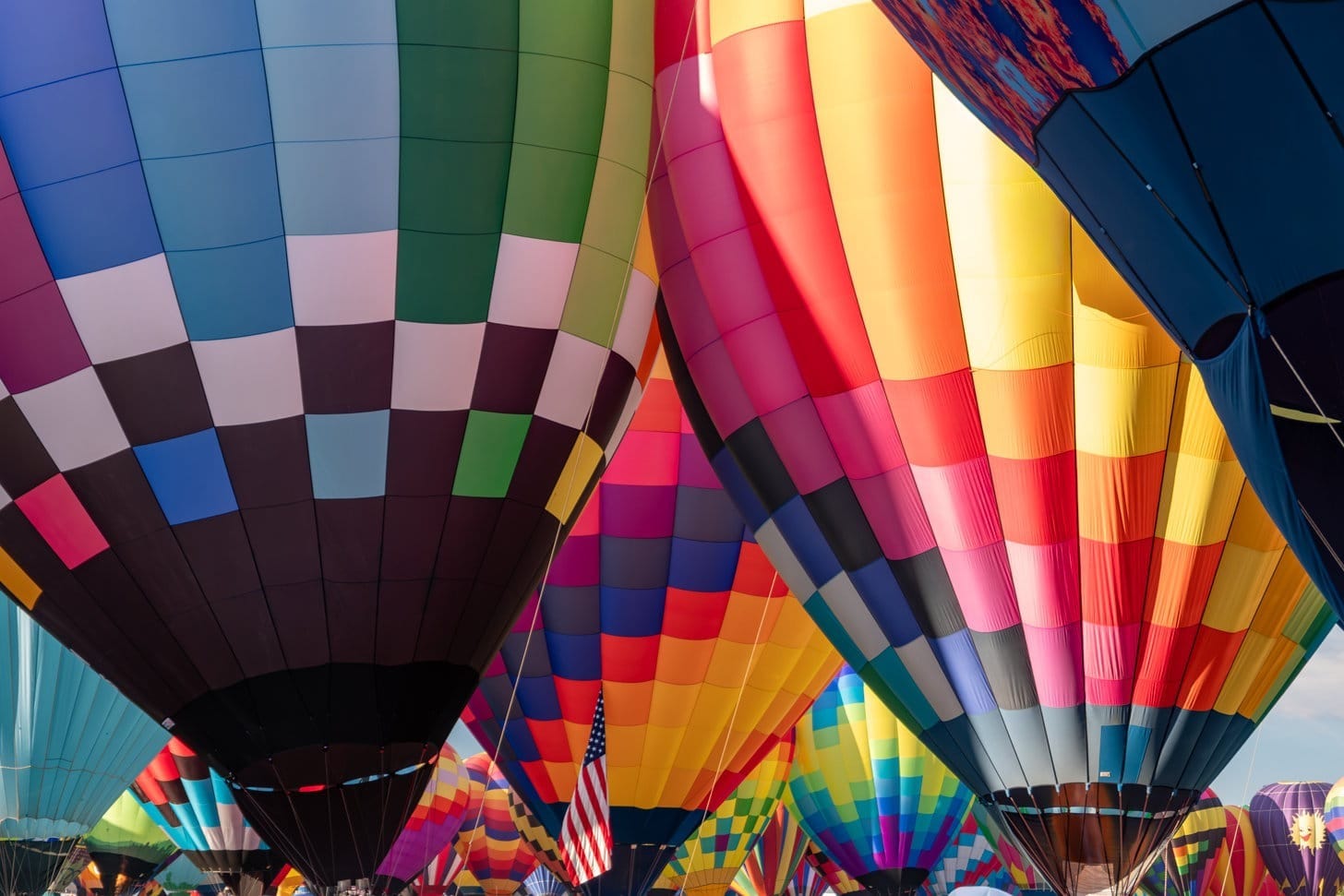
The static display at Balloon Fiesta Park, 7:54 a.m., Oct. 7, 2026.
From a mall parking lot to a city’s signature event
Hot-air ballooning is old, but the hot-air balloon as we know it is not. The Montgolfier brothers flew the first hot-air balloons in France in 1783, heated by burning straw and wool, a fire that was hard to control and dangerous to carry aloft. Within months, a rival flew the first hydrogen balloon, and for most of the next two centuries serious ballooning meant gas balloons.
The modern hot-air balloon was born on October 22, 1960, near Bruning, Nebraska, when Ed Yost of Raven Industries flew a balloon with a heat-resistant fabric envelope and an onboard propane burner. His key insight was that the balloon could carry its own fuel and reheat its air whenever it needed to. The work was paid for by the Office of Naval Research, which hoped that balloons might someday rescue downed pilots from behind enemy lines. The Navy eventually dropped the idea, but Raven sold its first balloon to a civilian about a year later, and a sport was born.10
Twelve years after Yost’s flight, Albuquerque’s KOB radio station wanted something special for its 50th anniversary. In 1972, Sid Cutter, the city’s pioneering balloonist, organized a race of 13 balloons from the parking lot of the Coronado Center shopping mall, and as many as 20,000 people came to watch.11 Today the Fiesta features about 600 balloons, and its attendance over nine days runs to hundreds of thousands.12
The Fiesta grew in Albuquerque for many reasons, from local enthusiasm to sheer momentum. But it’s hard to imagine it growing anywhere else. Few cities offer a reliable season of cold, still autumn mornings, a valley that carries balloons gently away from the field, and, on the best days, a wind above it that carries them back.
Reading the air
The pilots who stayed on the ground on Wednesday morning were not being timid. They were doing the hardest part of their job: judging the air in places they had not yet reached, at times that had not yet arrived. On Saturday, the same judgment sent hundreds of them into the sky.
When I wrote about Polynesian navigators who crossed thousands of miles of open ocean without a map, I was struck by how much of their skill lay in reading signals most of us never notice: swells, stars, the flight of birds. Balloon pilots practice a smaller version of the same art. They have instruments and forecasts that the Polynesians never had, but their aircraft has no steering, and so their skill comes down to the same thing: knowing which way the invisible currents are going, and choosing the one that will take them where they want to go.
“Weather cancels morning mass ascension launch at Balloon Fiesta”, Albuquerque Journal, October 7, 2026.
Davis Pope, “The story behind Dawn Patrol at the Balloon Fiesta”, KRQE, October 5, 2025.
National Weather Service, Albuquerque, “Balloon Fiesta Climatology”.
Michael Anand, “Ballooning in Albuquerque: What’s so special?”, Physics Today, July 2025.
National Weather Service, as in note 3; Anand, as in note 4.
Pope, as in note 2.
Albuquerque Journal, October 7, 2026, as in note 1.
Nicole Sanders, “Balloon Fiesta Lingo: Terms to know before heading to Albuquerque”, KRQE, October 6, 2025.
Gillian Barkhurst, “Meet the zebras behind Balloon Fiesta’s liftoffs”, Albuquerque Journal, October 10, 2026.
“Ed Yost, ‘father of ballooning,’ subject of new Albuquerque balloon museum exhibit”, Santa Fe New Mexican, October 2023.
“How Albuquerque Balloon Fiesta got off the ground”, KOB, October 3, 2025.