


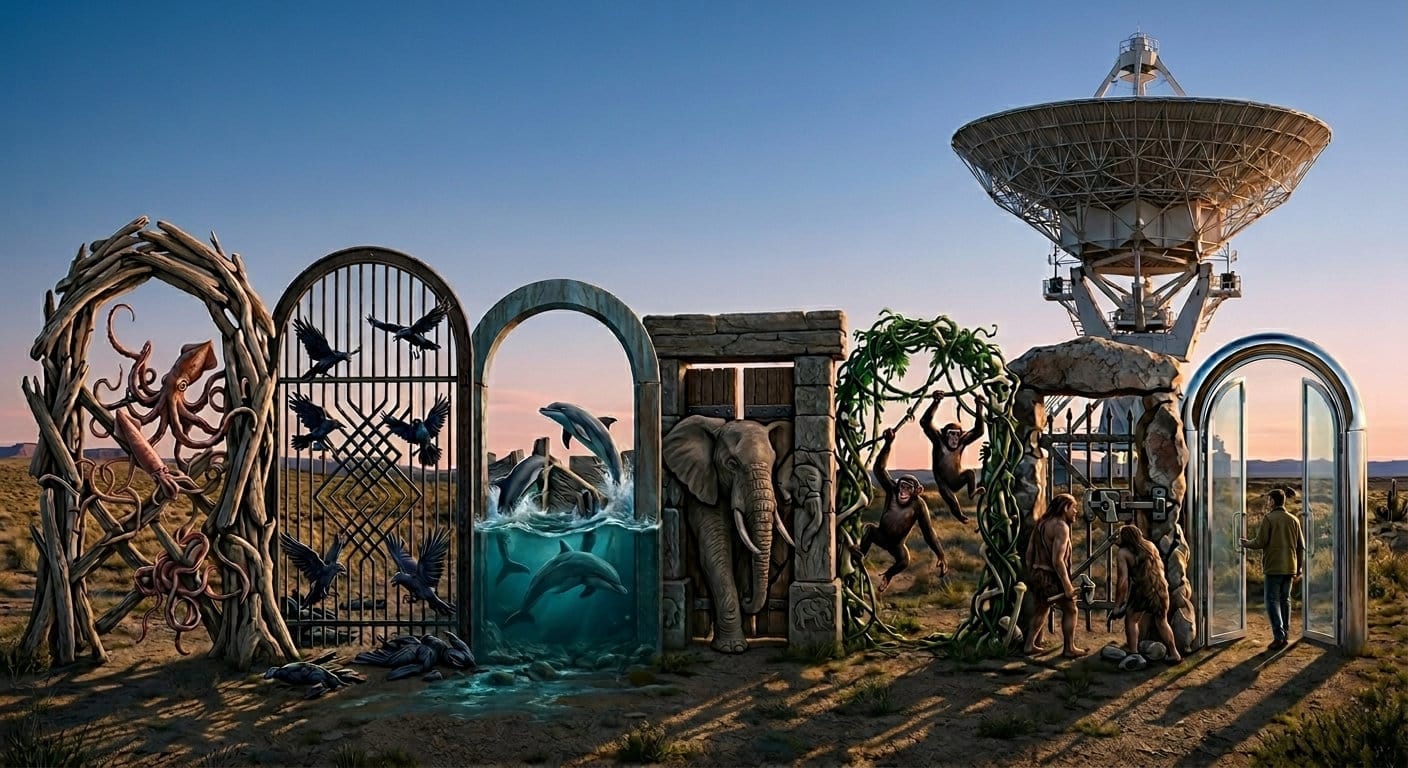
There are billions of stars in our galaxy alone, many of them older than the Sun, many of them plausibly hosting Earth-like planets. Given that much time and that many opportunities, the universe should be loud with evidence of other intelligent life. Instead, it is silent. This is the Fermi Paradox: not really a paradox in the strict logical sense, but a genuine and unsettling mismatch between expectation and observation. Where is everybody?
People have proposed a lot of answers. Stephen Webb’s well-known survey catalogs 75 of them, and that’s before counting the more exotic entries — civilizations hiding deliberately, civilizations quarantining us until we’re mature enough to join them, civilizations that have already been and gone. Many of these proposed explanations hinge on arguments about the expected difficulty and rarity of the development of intelligent life-forms.
My thesis is that intelligent life need not be rare to explain the silence we find in the cosmos: intelligence may well be common, but it is not sufficient for the development of advanced technology that would be detectable at interstellar distances. We need only survey the other intelligent species on our own planet to illustrate this point.
A parade of near-misses
Octopuses and their cephalopod relatives may be the most cognitively sophisticated invertebrates on Earth, intelligence apparently invented again, almost from scratch, by a nervous system unlike anything in the vertebrate lineage. And still, nothing resembling cumulative culture — perhaps in part because most cephalopod species live only a year or two, which alone may foreclose the possibility of any knowledge passing from one generation to the next, however clever any single individual might be.
Crows and other corvids, despite brains built on an entirely different architecture than ours, show working-memory dynamics strikingly similar to primates — a case of convergent evolution arriving at the same cognitive strategy from a completely separate starting point. And yet no corvid has ever built so much as a fire, let alone a radio telescope.
Consider dolphins: large-brained, intelligent, deeply social, and with something like culture passed between individuals. The astrophysicist Charles Lineweaver has observed (p. 10) that “dolphins have had ~20 million years to build a radio telescope and have not done so.” Why the difference between them and us?
Elephants make the case even harder to dismiss. They are larger-brained than we are, intelligent and social, with trunks capable of fine-motor dexterity, comparable to human hands in their ability to grasp and manipulate. They are remarkably long-memoried: matriarchs have led their families back to water sources unvisited for more than 35 years, and elephants have recognized the scent of a former keeper after more than a decade of separation. Elephant brains reached roughly their present relative size and complexity some 20 million years ago — about as long as dolphins have had theirs — but still: no fire, no wheel, no writing, no cumulative technology across that vast span of time.
Chimpanzees and bonobos are closer still to us than any of the above, sharing a common ancestor with humans only some six million years ago. Yet their working memory has been found comparable to that of a four-year-old human child — real, but limited. Neither species has come anywhere near building a radio telescope, and that ceiling on working memory appears to be one reason why.
If Homo sapiens hadn’t come along, would Neanderthals — who lived alongside our ancestors, made tools, may have controlled fire of their own, and showed signs of symbolic and artistic thought — have eventually built a radio telescope themselves? Nobody really knows. Some studies suggest meaningful neurological differences in capacity for recursive thought and social processing; others find no clear evidence of cognitive inferiority at all. What we can say is that even among our closest known relatives, sharing very nearly all of our genome and much of our behavioral repertoire, the outcome diverged sharply, for reasons still not fully understood — and that even this nearest of near-misses never crossed whatever threshold we eventually did.
Hard requirements
Working memory sufficient for recursive thought looks like one genuine bottleneck. A body capable of fine manipulation looks like another. A lifespan long enough to support cumulative, intergenerational culture is a third.
Then there is fire, which may be the starkest filter of all. As far as anyone can tell, exactly two species in Earth’s history have ever deliberately made and controlled fire: humans, and Neanderthals (who may have taught us how). Not dolphins, not elephants, not any of the other large-brained, social, long-lived creatures discussed above. Fire also runs into a hard physical limit that has nothing to do with intelligence: combustion requires roughly 16% atmospheric oxygen to sustain itself. A species could clear every cognitive and physiological gate already named and still be permanently unable to invent fire, simply because of the air on its planet — or because it lives in water, which blocks the atmospheric oxygen any fire needs, no matter how clever the creatures swimming there might be.
Even generative language — the capacity to combine words into genuinely novel meaning, not just a closed repertoire of calls and signals — appears to be a narrow accomplishment. Parrots can enunciate human speech with remarkable fidelity, but whether they understand what they’re saying in any deep sense remains a real and open question (not so different from the one we ask about a sufficiently fluent AI system). And language alone is not enough either: a durable recording method — some form of writing — is needed to preserve and transmit precise technical information beyond the limits of living memory. Writing solves a second problem too, one that has nothing to do with time at all: it externalizes working memory itself, letting a mind that can only hold two or three things at once perform a calculation, or follow an argument, with a hundred steps, simply by writing each step down rather than trying to hold the whole chain in mind.
And here is the part that should give anyone pause. Anatomically and cognitively modern humans have existed for some 300,000 years. Metallurgy is only a few thousand years old. Across that enormous span, there are — and have been — countless human societies that, despite having every biological capacity any other human society has, never independently developed metalworking, much less anything resembling spacefaring. Being human, per se, apparently isn’t enough either. Whatever the final gate is, it’s social and historical as much as biological, and it isn’t guaranteed even once every other requirement has been met.
A different kind of filter
Unlike the Rare Earth hypothesis, my thesis is not based on the supposition that Earth-like planets are scarce, or intelligent life uncommon. Our galaxy might be teeming with worlds not unlike our own, populated by creatures as clever as corvids, long-memoried as elephants, social as dolphins, dexterous as chimpanzees, and articulate as parrots — yet the persistent silence is still unsurprising. The bottleneck isn’t the scarcity of Earths; it’s the extraordinary difficulty of any species, on any such Earth, clearing the full sequence of narrow, mostly independent passages between “intelligent” and “radio-telescopic.”
And even a species that somehow passes through every one of those gates then faces something new and different in kind, not just in degree. The fall of any number of historical empires was never capable of erasing the gates already cleared: Babylon or Rome could fall, but writing, metalworking, and accumulated knowledge persisted elsewhere, available to be picked back up. A civilization gains the capacity for something catastrophic — for what people mean when they talk about bombing a society back to the stone age — once it has developed weapons capable of devastation on a planetary scale. That self-destruction can also arrive more slowly and just as inexorably, through large-scale environmental disturbance that a civilization sets in motion. Either way, it doesn’t exist at any earlier stage of the journey. It is created by the very same achievements that would, in principle, finally make a civilization detectable to the rest of the universe.
So perhaps the silence is best explained not by assuming intelligent life is rare, but by recognizing that very few species, anywhere, ever clear the full chain of requirements to become detectable in the first place — and that the rare exceptions which do clear that chain arrive, as their reward, at one final and uniquely dangerous test, built from the very tools that got them there.
It’s worth noticing where that leaves us. We humans cleared every earlier gate some thousands of years ago, but it’s only within the past century that we’ve stepped through the final one: being capable of quickly or slowly ending it all by making the wrong choices. Whether we’ll pass this last test is not yet known — we are, right now, somewhere in the middle of deciding.