


For years, I tuned my guitar the way it seemed like you were supposed to: using harmonics. Touch the low E string lightly at the fifth fret, pluck it, and a clear, bell-like tone rings out. Do the same at the seventh fret of the A string. If the two strings are in tune, those harmonics should ring in perfect unison — and they do, beautifully, when you get it right. One by one, I’d work my way across the six strings, chasing that pure, shimmering agreement between adjacent strings.
And then I’d play a chord, and something would be slightly off. Not badly off — not the wince-inducing clang of a badly tuned guitar — but subtly, persistently wrong, in a way I couldn’t quite explain or fix. Move to a different chord, and it might sound better. Or worse. There was no position in which everything sounded right at once.
Eventually I switched to the method that most guitarists use: fretting the fifth fret of a lower string, and tuning the adjacent open string to match. Boring, mechanical, none of the ringing beauty of harmonics. And suddenly everything worked. Every chord, every key, every position on the neck.
It took me a long time to understand why. The answer turns out to involve a mathematical problem that has occupied musicians, instrument makers, and theorists for more than two thousand years — and a solution so elegant it borders on the philosophical.
The mathematics of harmony
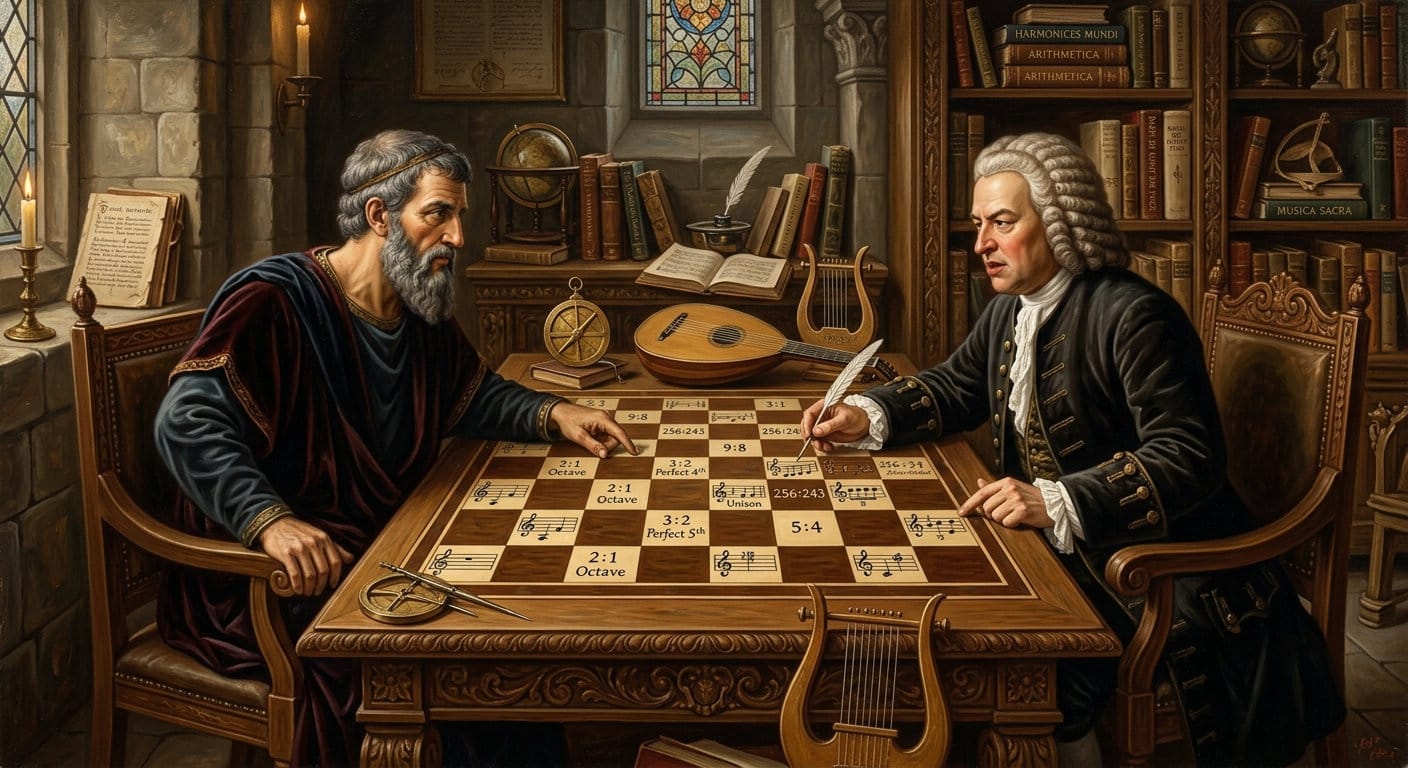
The ancient Greeks — Pythagoras and his followers, specifically — noticed something remarkable about the relationship between mathematics and musical sound. When you pluck a string, it vibrates at a particular frequency, producing a particular pitch. Pluck a string exactly half as long, and it vibrates at exactly twice the frequency, producing a pitch that sounds like the same note, only higher: an octave. The ratio is 2:1, as clean and simple as mathematics gets.
The same principle holds for other pleasing intervals. A perfect fifth — the interval between C and G, or between the first and fifth notes of a major scale — corresponds to a frequency ratio of 3:2. A perfect fourth — C to F — is 4:3. A major third — C to E — is 5:4. The most harmonious intervals in Western music are precisely those with the simplest whole-number ratios. Even the choice of twelve tones is not arbitrary: twelve is simply the smallest number of stacked perfect fifths that comes close to completing a whole number of octaves, making the twelve-tone scale a consequence of the mathematics.
This is not a cultural convention or an accident of taste. It’s physics. When two notes with a simple ratio sound together, their sound waves align in regular, repeating patterns. The ear — or rather, the brain interpreting the signals the ear sends it — finds this regularity pleasing. Complex ratios produce irregular, clashing patterns. We call them dissonant.
The harmonic series makes this even more vivid. A vibrating string or air column doesn’t just produce its fundamental pitch; it simultaneously vibrates in halves, thirds, quarters, fifths, and so on, producing a cascade of overtones at frequencies that are whole-number multiples of the fundamental. These overtones are the reason a violin and a flute sound different playing the same note: different instruments emphasize different parts of the harmonic series. And they’re also the reason simple ratios sound consonant: when played together, different notes whose frequencies form simple ratios share many of the same overtones, and those shared overtones reinforce each other rather than clashing.
So far, so elegant. Mathematics and music are, it seems, in perfect harmony.
The problem with perfection
Here is where things get complicated.
Suppose you want to build a complete musical scale — all twelve notes of the chromatic scale that Western music uses — from pure, mathematically perfect intervals. You start at C and stack perfect fifths: C, G, D, A, E, B, F#, C#, G#, D#, A#, F, and back to C. Twelve perfect fifths should bring you back to where you started, seven octaves higher.
They don’t.
Twelve perfect fifths, each at a ratio of 3:2, produce a total ratio of (3/2)¹² = 129.746…. Seven octaves, each at a ratio of 2:1, produce a total ratio of 2⁷ = 128. These are not the same number. The difference — about a quarter of a semitone — is known as the Pythagorean comma.
It’s a small discrepancy. But it’s enough to cause real problems. If you tune your instrument so that C-to-G is a perfect fifth, and G-to-D is a perfect fifth, and so on around the circle, by the time you get back to C it will be slightly sharp — close to the starting pitch, but not identical to it. And those small errors accumulate differently depending on which key you’re playing in. Some keys will sound pure and beautiful; others will contain intervals so out of tune they’re nearly unlistenable. The medieval interval known as the “wolf fifth” — the one leftover fifth that absorbs all the accumulated error — was so dissonant it was said to howl like the animal it was named for.
For most of Western music history, instruments were tuned in various “temperaments” that tried to minimize this problem by distributing the comma unevenly: making the most commonly used keys as pure as possible, at the expense of rarely-used ones. A keyboard tuned this way sounded beautiful in C major and increasingly strange as you moved toward keys with many sharps or flats.
This is why my harmonic tuning method failed. The harmonics on my guitar strings find the pure, natural intervals — the ones the physics of vibrating strings wants to produce. But the frets on a guitar are fixed at positions calculated for a different system entirely. Tune the strings to pure intervals and you’re fighting the instrument.
The brilliant compromise
The solution, fully worked out by the early eighteenth century, is called equal temperament. Instead of trying to derive the twelve notes of the chromatic scale from pure intervals, equal temperament simply divides the octave into twelve equal steps. Each step — each semitone — has a frequency ratio of the twelfth root of two, or 2^(1/12), approximately 1.05946.
The beauty of this system is that it’s perfectly symmetrical. Every semitone is identical to every other semitone. Every key is equally in tune — or, more precisely, equally out of tune. The perfect fifth in equal temperament is not 3:2; it’s 2^(7/12), approximately 1.4983 instead of 1.5000. Off by about two cents — a tiny amount, barely perceptible to most ears. The major third is further off: 2^(4/12) versus the pure 5:4, a difference of about fourteen cents, noticeable if you listen carefully. (A cent is one hundredth of a semitone; at concert A [440 Hz], one cent corresponds to a frequency difference of about 0.25 Hz.)
In exchange for these small impurities, equal temperament gives you something extraordinary: complete freedom. You can play in any key, modulate to any other key, and never encounter a wolf fifth. The entire chromatic universe is equally accessible.
Johann Sebastian Bach celebrated this liberation in The Well-Tempered Clavier, a collection of preludes and fugues in all twenty-four major and minor keys — a demonstration that a well-tempered instrument could traverse the entire tonal landscape without encountering an unplayable key. Whether Bach intended strict equal temperament or one of the various “well temperaments” of his era is still debated, but the point was the same: the old constraints were gone.
Every piano you’ve ever heard has been tuned in equal temperament. Every fretted string instrument — guitar, bass, banjo, mandolin — has frets positioned for equal temperament. The entire Western musical tradition of the past three centuries, from Bach to Beethoven to the Beatles, has been built on a tuning system in which no interval except the octave is mathematically pure.
We traded perfection for freedom. It was worth it.
Back to the guitar
The fifth-fret tuning method works because it bypasses the physics of vibrating strings entirely. When you fret the fifth fret of the low E string and tune the open A string to match, you’re not asking what ratio those two pitches form — you’re simply asking whether they sound the same. And because the fret is positioned for equal temperament, matching the fretted note to the open string tunes the open string to equal temperament as well.
The harmonic method, by contrast, goes directly to the physics. The harmonics at the fifth and seventh frets find the pure, natural overtones of the string — which are perfect intervals, not equal-tempered ones. Tune your strings to those pure intervals and you have a guitar whose open strings are in beautiful mathematical agreement with each other, but in subtle disagreement with its own frets. Play a scale or a chord and you’re mixing two incompatible systems.
I spent years fighting that incompatibility without understanding it. The pure intervals felt right — they are mathematically right — but they didn’t work on an instrument built for a different kind of rightness.
Music, it turns out, is full of this kind of compromise. The intervals we find most beautiful are rooted in simple mathematics, in the physics of sound itself. But the system we’ve built to organize those intervals — to make them navigable, transposable, endlessly recombinable — requires bending that mathematics just slightly out of true. The result is not perfect. It is, in its way, better than perfect.