


Most Houstonians have never heard of a TIRZ, but most of them live near one. The city has 27 of them, with names like Midtown, Uptown, Memorial City, and St. George Place, and together they cover more than a fifth of all the taxable real property in Houston.1 Each year, more than $200 million in city property taxes flows into these zones instead of the city’s general fund.2
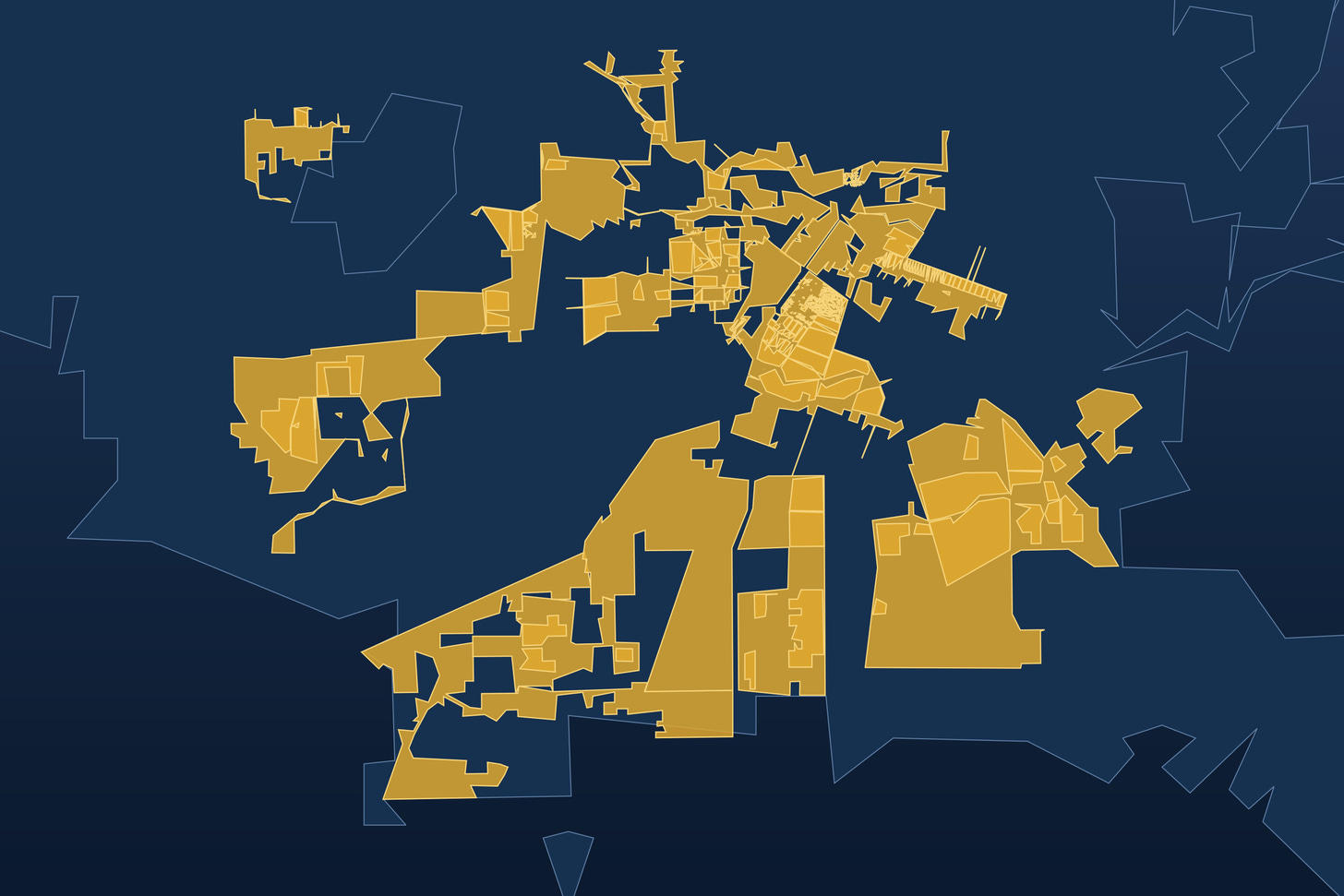
Houston’s 27 tax increment reinvestment zones. Map data: City of Houston.
TIRZ stands for tax increment reinvestment zone, and is usually pronounced terz, though I tend to say “tears,” which my wife assures me is wrong. The idea behind it is simple enough, but it’s one of the most argued-over tools in local government. Before getting to the arguments, which I’ll save for another post, it’s worth understanding what a TIRZ is, how it works, and how a financing trick invented in California in 1952 ended up shaping the streets of Houston.
How a zone works
When a city creates a TIRZ, it draws a boundary around an area and takes a snapshot of the total taxable value of the property inside it. That figure is the zone’s base. In every year that follows, the city keeps collecting taxes on the base value as usual, and that money goes to the general fund, just as it would without the zone.
The difference is what happens to growth. If property values inside the zone rise, the taxes on the increase, the increment, don’t go to the general fund. They go into a separate fund that can be spent only inside the zone, on things like streets, sidewalks, drainage, and parks.3
A simple example: suppose a neighborhood’s property is worth $100 million when the zone is created, and 10 years later it’s worth $150 million. The city still collects its usual taxes on the first $100 million. The taxes on the other $50 million go to the zone.
Each zone has its own board, which adopts a project plan, listing what it intends to build, and a financing plan, estimating how it will pay for it. The city council approves both.4 Because the increment is a predictable stream of future revenue, a zone can borrow against it, building improvements now and paying for them with tax money that hasn’t arrived yet. That is the essential bet of tax increment financing: public investment will raise property values, and the higher values will pay off the investment. In effect, a zone works like a business loan, borrowing to buy productive assets that are expected to create enough value to repay the debt. But unlike general-obligation bonds, which Texas cities can issue only with voters’ approval, a zone’s bonds can be issued without an election, because they’re repaid only from the zone’s increment rather than from the city’s general taxes.5
Supporters justify the arrangement with what’s known as the “but for” argument: but for the zone’s improvements, the new development and rising values would never have happened. If that’s true, a zone costs the city nothing, because it’s spending tax revenue that wouldn’t otherwise exist. And when the zone eventually ends, the whole, now-higher property value returns to the regular tax rolls, leaving the city better off than if it had done nothing at all.
Other taxing bodies, such as the county, a community college district, or a school district, can choose to contribute their own increment to the zone, but they aren’t required to. Only the city that creates the zone has to participate. Each taxing body that does contribute may appoint one member of the zone’s board, and the city appoints the rest, up to a total of 15. In Houston, the mayor makes the city’s appointments, subject to the city council’s approval. The bar for serving is low: a board member must be at least 18 and either live in the county or a neighboring one, or own property inside the zone. In a zone created by petition, the city can instead set up a nine-member board that includes the area’s state senator and state representative, and whose other members must own property in the zone or work for someone who does.6
An idea born in California
Tax increment financing began as a solution to a federal funding problem. The Housing Act of 1949 offered cities federal money for urban renewal, the clearing and rebuilding of neighborhoods that officials considered blighted. But there was a catch: local governments had to pay one-third of the cost themselves. Raising that share usually meant issuing bonds, and bonds required voter approval, which voters often withheld.7
California found a way around the voters. In November 1952, the state’s voters approved Proposition 18, a constitutional amendment allowing redevelopment agencies to pay for their projects with the future growth in property taxes from the areas they redeveloped. It passed with 65.9% of the vote.8 The local match for urban renewal would no longer come out of anyone’s current taxes. It would come out of taxes that didn’t exist yet.
From one state to forty-nine
For years, the idea stayed mostly in California. By 1970, only six other states had followed. Then, as federal urban-renewal money dried up in the 1970s, and as voters in many states imposed limits on property taxes, cities went looking for ways to finance development without raising taxes or asking permission. Tax increment financing fit the need. By 1984, 28 states allowed it. By 1992, 44 did. Today every state except Arizona does.9
Texas tries three times
Texas took longer than most to get it right. The Legislature first passed a tax increment financing law in 1977, but it needed a constitutional amendment, and in November 1978 voters rejected the amendment, with 48.2% in favor.10
In 1979 the Legislature tried again, this time without bothering with an amendment. The state attorney general declared that law unconstitutional, because the Texas Constitution requires taxation to be “equal and uniform,” and a law diverting some property owners’ taxes to a special fund didn’t meet that test without the Constitution’s explicit permission.11
The third attempt worked. In a 1981 special session, the Legislature passed a new Tax Increment Financing Act along with a constitutional amendment, and voters approved the amendment on November 3, 1981, with 58.3% of the vote.12 The bill’s sponsor, Rep. Steve Wolens of Dallas, later told the Houston Chronicle what he had in mind: “I wanted it to be very narrow. We didn’t want it abused; we didn’t want taxes to be given away lightly.”13
Two later changes shaped how the law works today. In 1986, the Texas Supreme Court ruled that school districts could take part in reinvestment zones.14 And in 1987, the law was moved into the state’s Tax Code as Chapter 311, where it still lives. Some sources, including the City of Houston’s own presentations, date Texas’s zones to 1987, but that year only reorganized a law that had been on the books since 1981.15
Houston’s zones
Houston created its first zone, St. George Place, near the Galleria, on December 12, 1990. It was created at the request of property owners, under a provision that lets owners of at least half the value in an area petition the city for a zone.16 Most of Houston’s zones followed in the 1990s. The newest, covering the Texas Medical Center, was created in 2022. In all, the city has created 28 zones, one of which has since expired, leaving 27.17
Houston also added a layer that most Texas cities don’t have. Nearly every Houston zone is paired with a redevelopment authority, a nonprofit local government corporation with the same board, which signs development agreements and issues debt on the zone’s behalf under a three-way agreement with the city.18 And in Harris County, a zone created by petition must spend at least one-third of its increment on affordable housing.19
State law limits how much of a big city’s taxable property can sit inside zones: no more than 25%. As of October 2024, Houston’s zones held about 22.3%.20
The state that invented it, and then ended it
California, meanwhile, had reached the end of the road. By 2011, about 400 redevelopment agencies were collecting more than $5 billion a year, roughly 12% of all the property taxes in the state. Much of that money would otherwise have gone to schools, and state law required the state to make up the difference, at a cost of more than $2 billion a year.21
In the middle of a budget crisis, Gov. Jerry Brown signed legislation on June 29, 2011, dissolving every redevelopment agency in the state.22 The agencies sued, and on December 29 the California Supreme Court unanimously upheld the dissolution. On February 1, 2012, the agencies ceased to exist.23
The state that invented tax increment financing had decided it was costing more than it was worth. Texas, and Houston in particular, made the opposite bet, and the zones have only grown since. Whether that bet has paid off is a question with more than one answer, depending on which part of Houston you live in.
Coming in December: what Houston has done with its 27 zones, and why some of them have become controversial.
City of Houston, Mayor’s Office of Economic Development, “2024 TIRZ Report”, Economic Development Committee, November 20, 2024, slide 6.
Nick Natario, “Figures show Houston contributes $200M to special tax districts while others are sending less money”, ABC13, January 15, 2026.
Texas Tax Code § 311.013 and § 311.009; Maggie Gordon, “Houston mayor to replace 4 Montrose TIRZ board members amid library funding debate”, Houston Landing, June 4, 2024.
Richard Briffault, “The Most Popular Tool: Tax Increment Financing and the Political Economy of Local Government”, University of Chicago Law Review 77 (2010), p. 69.
UC Law SF, “Community Redevelopment Projects” (Proposition 18, 1952), California Ballot Propositions Database.
Briffault, as in note 7, pp. 69–70.
Texas Legislative Council, “Amendments to the Texas Constitution Since 1876”, p. 94; Texas Comptroller of Public Accounts, Texas Economic Development Incentives, ch. 5, “Tax Increment Financing”, March 2003.
Texas Attorney General, Opinion MW-337, 1981.
Texas Legislative Council, as in note 10, p. 94.
Mike Morris and John Tedesco, “Critics tried reining in lucrative tax incentives in Houston. Nothing worked.”, Houston Chronicle, 2022.
City of El Paso v. El Paso Community College District, 729 S.W.2d 296 (Tex. 1986).
City of Houston, “FY2027 Adopted Budget”, p. XII-49; Texas Tax Code § 311.005(a)(4).
City of Houston, as in note 16; City of Houston, “2024 TIRZ Guidebook”, p. 3.
City of Houston, Mayor’s Office of Economic Development, “Tax Increment Reinvestment Zone (TIRZ) Program”, Economic Development Committee, March 19, 2025, slides 18–19.
Texas Tax Code § 311.011(f).
California Legislative Analyst’s Office, “The 2012-13 Budget: Unwinding Redevelopment”, February 17, 2012, pp. 3, 8, 12.
Office of Governor Edmund G. Brown Jr., “Governor Brown Signs Legislation”, June 29, 2011.
California Redevelopment Association v. Matosantos, 53 Cal.4th 231 (2011); Legislative Analyst’s Office, as in note 21, p. 3.