


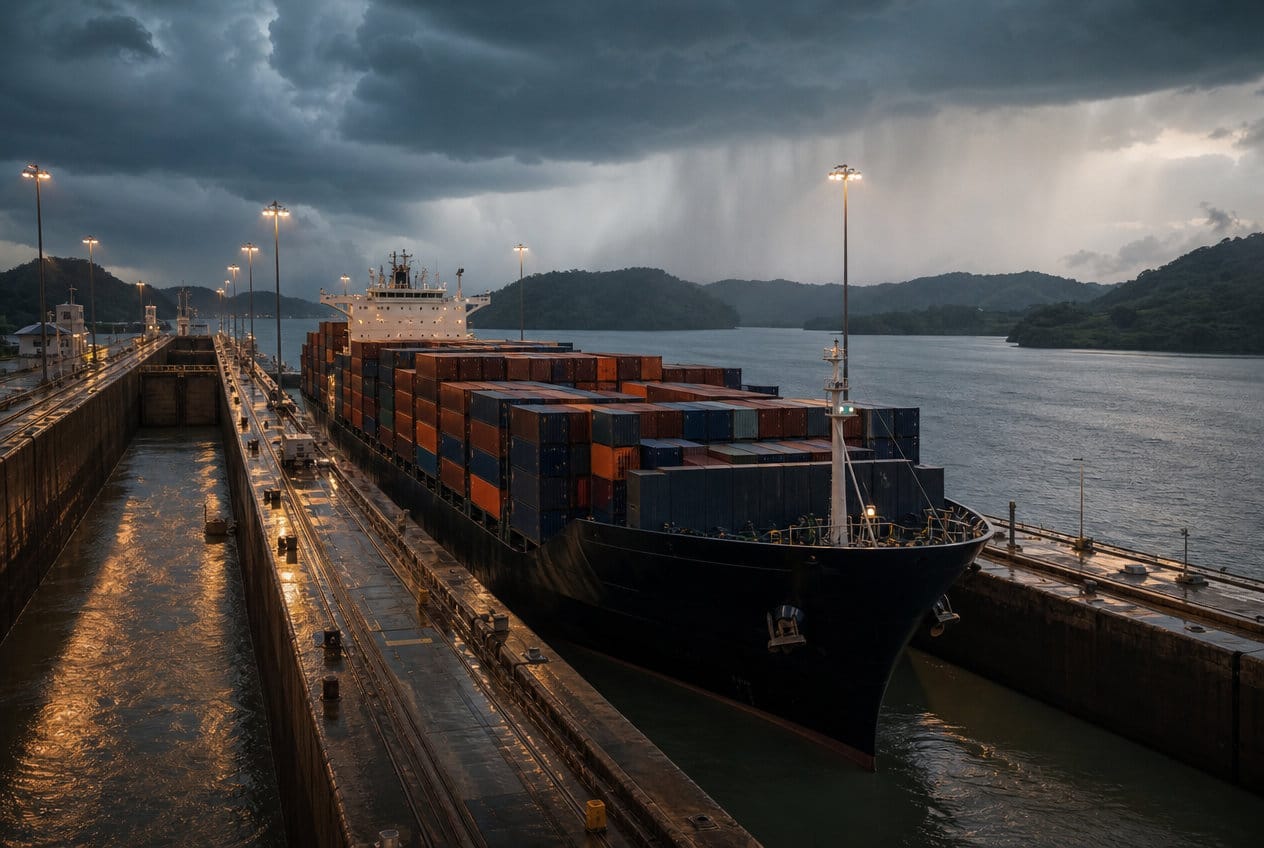
The Panama Canal is usually hailed as a heroic triumph of civil engineering: a mountain range cut through, a river made into a lake, ships lifted over a continental divide. But the people who built it, and the people who run it now, would tell you the real story is about water.
Water defeated the first people who tried to dig it. Water, put to work, is what let the second try succeed. And water, or the lack of it, is what the canal’s operators are contending with today. The canal’s story has three acts, and in each one the water behaves differently.
The obvious shortcut
In 1513, the Spanish conquistador Vasco Núñez de Balboa crossed the Isthmus of Panama and became the first European to see the Pacific from the Americas. The idea of a canal followed almost at once. On a map, the isthmus is the obvious place for one: a thin neck of land holding two oceans apart, so narrow that the canal eventually cut across it is only about 50 miles long.
In 1534, the emperor Charles V ordered the governor of Panama to survey a route along the Chagres River, which runs from the interior to the Caribbean. It was the first survey for a ship canal across the isthmus, and it followed roughly the course the canal takes today.1 The governor reported that the work was impracticable, and “beyond the resources of any sovereign.”2
So Spain built a road instead. For centuries, the silver of Peru landed at Panama City, crossed the isthmus by mule train, and often finished the trip by boat, down the Chagres to the Caribbean. The alternative — sailing around South America through the Strait of Magellan — would have taken the better part of a year, and longer still for a round-trip.
What the map didn’t show was the water. Trade winds carry moisture off the Caribbean and drop it on the mountains.3 As a result, the Caribbean coast receives 60 to 140 inches of rain a year, while the Pacific side gets 45 to 90.4 Most of it falls between May and December.5 In that season, the Chagres, a quiet river in the dry months, turns into a torrent that can rise more than 30 feet.6
For nearly four centuries, the shortcut stayed on the map. The obstacle was never really the distance. It was the rain.
How the French lost to the water
When the canal was finally attempted, it was by the most celebrated engineer-diplomat of the age. Ferdinand de Lesseps had built the Suez Canal, a sea-level channel dug through flat desert, and he meant to do the same thing in Panama.
In May 1879, de Lesseps presided over an international congress in Paris that voted, 74 to 8, for a sea-level canal across the isthmus.7 At the same congress, a French engineer named Godin de Lépinay proposed something different: dam the Chagres to make a lake, and lift ships up to it and down again with locks.8 De Lesseps rejected the idea.9
He arrived at Colón on December 30, 1879, at the start of the dry season.10 On New Year’s Day, some six hundred guests set out to watch the ceremonial first stroke of the pickaxe, but their boat was so late that it missed the tide and couldn’t get near the appointed spot. De Lesseps was “not a man to change plans.” The stroke would be symbolic anyway, he announced, so it might as well be struck right there on board, and his seven-year-old daughter, Ferdinande, would deliver it, swinging a pickaxe into a champagne box filled with dirt.11 Only weeks earlier, the rains had raised the Chagres 46 feet, the worst flood on record, and the river had swallowed the railroad bridge at Barbacoas. De Lesseps’s party crossed the gap on planks.12 It did nothing to change his mind.
Digging began in 1881, and the water fought back in two ways. Every rainy season, floods and landslides undid months of excavation. And the standing water bred mosquitoes, which carried yellow fever and malaria. The French workforce, mostly laborers recruited from the Caribbean, peaked at about 40,000 in 1888; by the end, an estimated 22,000 people had died.13
The cruel part is that the cause was already known. On August 14, 1881, in Havana, the Cuban physician Carlos Finlay presented a paper proposing that yellow fever was carried by mosquitoes. His colleagues ridiculed it, and it would be almost two decades before anyone proved him right.14
Meanwhile, the French hospitals made things worse. Their gardens were full of plants and flowers, and to protect them from ants, thousands of ring-shaped pottery dishes of water were set around them, which made perfect breeding places for mosquitoes. Inside the wards, the legs of the beds stood in shallow basins of water for the same reason. There were no screens on the windows or doors.15 Patients who came in with an injury or a minor illness often caught yellow fever or malaria after they arrived.16
By the late 1880s, the French had come around to Lépinay’s idea after all, and hired Gustave Eiffel to design locks.17 It was too late. The company went bankrupt in 1889, wiping out the savings of some 800,000 small investors.18 The scandal that followed accused more than 150 legislators of taking bribes, though only one was convicted.19 In February 1893, de Lesseps and his son were sentenced to five years in prison and Eiffel to two, though the convictions were overturned; de Lesseps, then 87, never spent a day behind bars.20 He died the following year.
The French had tried to fight the water head-on, and the water had won.
How the Americans harnessed the water
The land the Americans took over had belonged to Colombia only months earlier. When Colombia’s senate rejected a canal treaty, Panama declared independence with American backing, and fifteen days later its new envoy, a French engineer named Philippe Bunau-Varilla, who hadn’t set foot in Panama in eighteen years, signed a treaty giving the United States a ten-mile-wide zone across the isthmus, in perpetuity.212223 He had largely written it himself.24
For their first year after beginning work, the Americans made the same mistakes as the French. What turned the project around were two decisions, and neither was made by the man usually credited with building the canal.
The first was about mosquitoes. By then, Finlay’s theory had been proven: in 1900 an American army commission in Havana, led by Walter Reed, showed that mosquitoes carried yellow fever, and an army doctor named William Gorgas used that knowledge to clear the disease from Havana.25 Gorgas was sent to Panama as chief sanitary officer, but at first few people in charge believed him. He set up his headquarters at Ancon Hospital, and found it just as the French had left it: the gardens were still ringed with water-filled crockery, the beds still stood in pans of water, and the windows still had no screens.26 When yellow fever broke out in early 1905, hundreds of American workers fled, and the canal commission asked President Theodore Roosevelt to replace Gorgas for chasing mosquitoes instead of cleaning up filth. Roosevelt backed Gorgas instead.27
Gorgas’s crews drained and oiled standing water, fumigated houses, screened windows, and isolated the sick. Yellow fever cases in the Canal Zone fell from 62 in June 1905 to one in December, and there were no further outbreaks.28 Malaria was more stubborn, but hospital cases fell from 821 per 1,000 workers in 1906 to 70 per 1,000 by 1913.29
The second decision was about the river. John Frank Stevens, the chief engineer from 1905, had seen the Chagres in flood, and he concluded that a sea-level canal was “an entirely untenable proposition.”30 Instead of fighting the river, he proposed to use it: dam the Chagres at Gatún to make a lake 85 feet above sea level, and lift ships up to it with locks. Congress approved the plan in June 1906.31 It was, in all essential respects, the plan Godin de Lépinay had offered in Paris in 1879, and de Lesseps had turned down.32
Stevens resigned in 1907, and the army engineer George Goethals, appointed that February, carried the plan through to completion.33 It is Goethals whose name is most often attached to the canal, but he always acknowledged Stevens’s part in it.34 The dam created Gatún Lake, then the largest artificial lake in the world, covering 164 square miles.35
The canal opened officially on August 15, 1914, when the SS Ancon made the first official transit, passing from the Atlantic to the Pacific in about nine hours, so smoothly that, one passenger said, a stranger might have thought the canal had always been open. George Goethals, who had built it, did not ride along; he went ahead by rail to make sure each lock was ready.36 Seven months earlier, the first vessel to cross had made the trip without ceremony. It was an old French crane boat, the Alexandre La Valley, and everyone thought that fitting.37
How the locks work
The canal is a staircase of water. A ship arriving from the Caribbean enters the Gatún Locks, three chambers in a row, which lift it 85 feet to the surface of Gatún Lake. It crosses the lake and the cut through the continental divide, then descends 31 feet at Pedro Miguel and the rest of the way at Miraflores, back down to the Pacific.38
There are no pumps. Every chamber is filled by gravity, with water flowing down from the lake through tunnels in the lock walls, and emptied the same way, toward the sea.39 It’s an elegant system, and it has one cost: the water never goes back up. Each ship that passes through the original locks sends about 50 million gallons of fresh water from Gatún Lake out to the ocean, for good.40
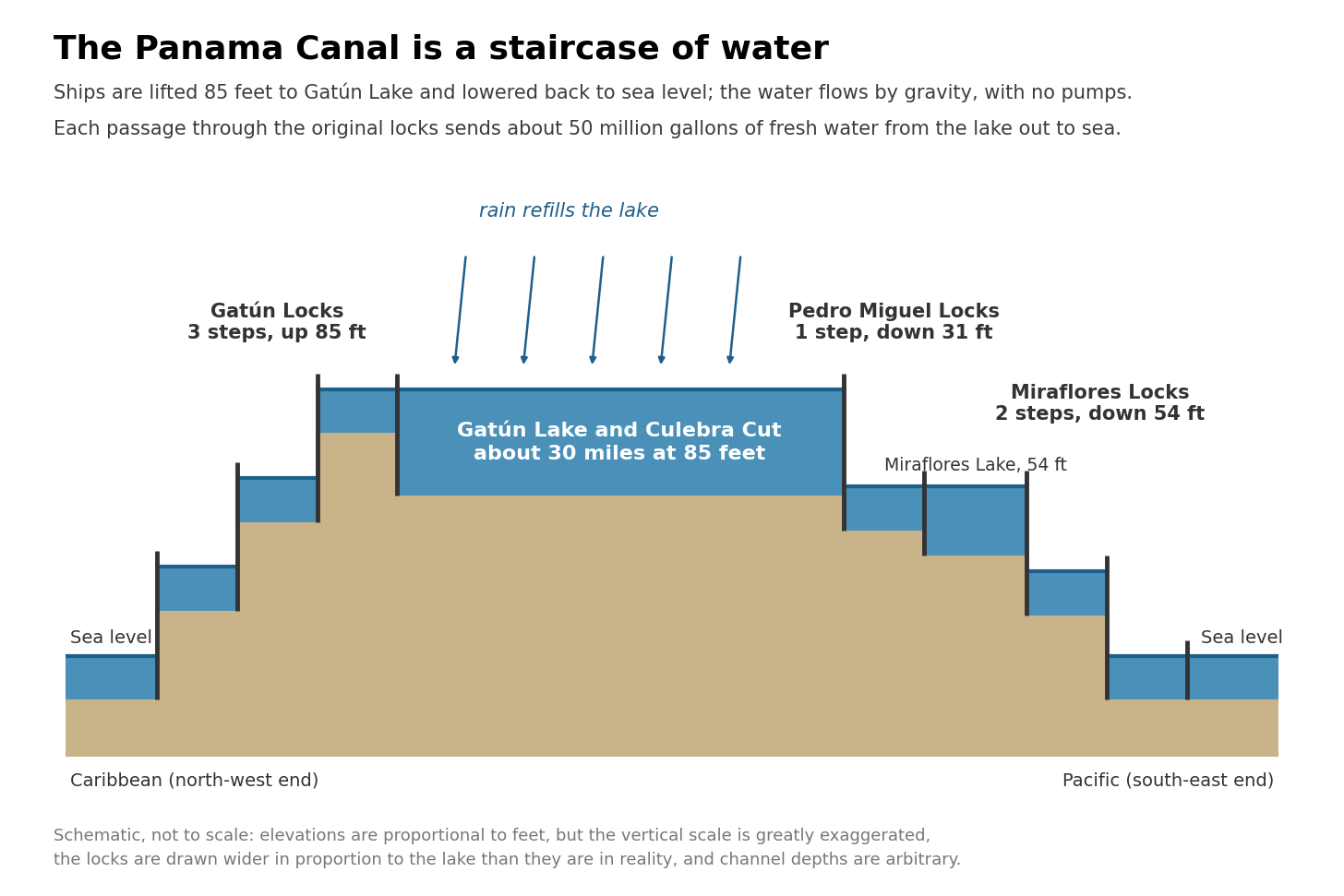
When Panama expanded the canal in 2016, the new, larger locks were built with water-saving basins beside each chamber, which catch water as a chamber empties and return it to help refill the chamber, reusing 60% of the water in each lockage.41 But the original locks still carry most of the ships, and every one of them still drains a lake that only the rain can refill.
Handing it back
For most of the twentieth century, the Canal Zone was American territory running through the middle of another country, with its own police, schools, and courts. Panamanians resented it, and on January 9, 1964, the resentment boiled over. About 200 Panamanian students marched into the Zone to raise their country’s flag at Balboa High School. In a scuffle, the Panamanian flag was torn, and rioting spread. By the time it was over, about 22 Panamanians and four American soldiers were dead.42 Panama broke off diplomatic relations the next day, and January 9 is still a national holiday there, Martyrs’ Day.43
On September 7, 1977, President Jimmy Carter and Panama’s leader, Omar Torrijos, signed two treaties in Washington that would return the canal to Panama.44 Panamanians approved them in a plebiscite that October, by about two-thirds of the vote, on a turnout above 90%.45 Americans were much less sure. The public overwhelmingly opposed the treaties, and the Senate ratified each of them in 1978 by a vote of 68 to 32 — one vote more than the two-thirds it needed, both times.46
The Canal Zone was abolished on October 1, 1979, and on December 31, 1999, the canal became entirely Panama’s.47
Too little water
For almost a century after it opened, the canal had more water than it needed. In 2023, for the first time in its history, it had to limit the number of ships it let through.48
An El Niño year had cut the rains, and Gatún Lake fell. By early August 2023, more than 150 ships were waiting to cross, nearly twice the usual backlog, with average waits of about three weeks.49 That October was the driest on record in the canal’s watershed, and by December the canal had cut its daily transits from the usual 36 to 22.50 On New Year’s Day 2024, the lake was lower than on any other January 1 on record, almost six feet below where it had been a year before.51 Late rains in November spared the canal the deeper cuts it had planned, but full capacity didn’t return until the summer of 2024.52
Now it is happening again. In August 2026, with rainfall over the watershed a third below normal and a severe El Niño in the forecast, the canal authority cut daily transits to 34, and then, from September 15, to 32. Near-average rains in September have since let it schedule a modest increase, to 33 from October 15, but it warns that the water deficit continues.53 On September 23, Panama’s president, José Raúl Mulino, went to the United Nations General Assembly to ask for help paying for a remedy: a $1.6 billion reservoir on the Río Indio, west of the canal, that would feed Gatún Lake through a tunnel more than five miles long.54 Main construction is planned for 2028 through 2031. About 2,000 people, most of them small farmers, would have to move, and many are fighting it.55
There is a complication that makes this more than a shipping story. The lakes that fill the locks are also where Panama gets its drinking water — Gatún Lake supplies both Panama City and Colón.56 In a dry year, every ship that crosses competes with the people who live there.
One design would never have had this problem. In 1970, an American commission concluded that a sea-level canal could still be dug across Panama, near the existing one — after spending years studying whether to dig it with nuclear explosives.57 A canal without locks would need no fresh water at all. It was de Lesseps’s idea, the one the rain defeated.
The canal is, in the end, a machine that runs on rain. The French lost to the water, the Americans won by putting it to work, and the Panamanians now have to ration it.
“The Panama Canal – early plans”, Construction Briefing.
“The Panama Canal”, Proceedings, U.S. Naval Institute, June 1913.
Smithsonian Tropical Research Institute, “Why Panama?”.
“Panama: Climate”, Encyclopaedia Britannica.
“Annual Precipitation in the Panama Canal Watershed, 1950–2023”, Port Economics, Management and Policy.
Linda Hall Library, “The Panama Railroad”, The Land Divided, the World United.
Panama Canal Authority, “The French Canal Construction”.
“The Americans in Panama”, chapter 5.
“Panama Canal: American intervention”, Encyclopaedia Britannica.
David McCullough, The Path Between the Seas: The Creation of the Panama Canal, 1870–1914 (1977), p. 104.
McCullough, The Path Between the Seas, pp. 103, 114; Panama Canal Authority, “The French Canal Construction”.
Linda Hall Library, “The Panama Railroad”, The Land Divided, the World United.
“Carlos Finlay (1833–1915)”, American Experience, PBS.
McCullough, The Path Between the Seas, p. 144.
Panama Canal Authority, “The French Canal Construction”.
“7 Fascinating Facts About the Panama Canal”, History.com.
“Compagnie Universelle du Canal Interocéanique de Panama”, Numistoria.
“Panama Scandal”, Encyclopaedia Britannica.
“Panama Canal – Ferdinand de Lesseps 1880–1889”, GlobalSecurity.org.
Office of the Historian, U.S. Department of State, “Building the Panama Canal, 1903–1914”.
“Hay–Bunau-Varilla Treaty”, Encyclopaedia Britannica.
“Convention for the Construction of a Ship Canal (Hay-Bunau-Varilla Treaty), November 18, 1903”, The Avalon Project, Yale Law School.
“The Strange Affair of the Taking of the Panama Canal Zone”, American Heritage.
“Carlos J. Finlay: The mosquito man”, Hektoen International.
McCullough, The Path Between the Seas, p. 416.
Linda Hall Library, “Fighting the Fever”, The Land Divided, the World United.
“Gorgas Develops Effective Methods of Mosquito Control”, EBSCO Research Starters.
“Mosquito Net”, review in Parasites & Vectors.
McCullough, The Path Between the Seas, p. 485.
Panama Canal Authority, “American canal construction”.
“Panama Canal: American intervention”, Encyclopaedia Britannica.
“Who Controls the Panama Canal?”, WorldAtlas.
“The engineering genius history forgot: John F. Stevens”, Public Works.
“Interesting Facts About the Panama Canal”, Panama and the Canal collection, University of Florida Libraries.
U.S. Army Corps of Engineers, “100th Anniversary of the Opening of the Panama Canal”.
Panama Canal Museum, “The 1914 SS San Cristobal at the Gatun Locks”; McCullough, The Path Between the Seas, p. 607.
“Interesting Facts About the Panama Canal”, University of Florida Libraries.
Panama Canal Authority, “First Panama Canal Water-Saving Basin Filled, Testing Process Begins”.
“A Tale of Two Flags”, ReVista: Harvard Review of Latin America.
“Why Today Is an Anti-American Holiday in Panama”, American Heritage.
Office of the Historian, U.S. Department of State, “The Panama Canal and the Torrijos-Carter Treaties”.
Office of the Historian, U.S. Department of State, “Memorandum From Secretary of State Vance to President Carter”, Foreign Relations of the United States, 1977–1980, vol. XXIX, document 117.
U.S. Senate, “Senate Leaders and the Panama Canal Treaties”.
Embassy of Panama, “History of the Relationship”.
Panama Canal Authority, “Panama Canal to increase daily transits to 24 starting in January”.
NASA Earth Observatory, “Panama Canal Traffic Backup”; “Panama Canal shipping pileup due to drought reaches 154 vessels”, CNBC.
Panama Canal Authority, “Panama Canal to increase daily transits to 24 starting in January”.
“Drought in Panama is disrupting global shipping. These 7 graphics show how.”, Woodwell Climate Research Center.
“Recovery of the Panama Canal”, project44.
“Panama Canal Transit Cuts 2026”, AllBestShipping; “Supply chain relief – Panama Canal to increase draught and daily transits”, Seatrade Maritime, September 29, 2026.
“Drought in Panama is disrupting global shipping. These 7 graphics show how.”, Woodwell Climate Research Center.
Office of the Historian, U.S. Department of State, “Memorandum From the President’s Assistant for National Security Affairs (Kissinger) to President Nixon”, Foreign Relations of the United States, 1969–1976, vol. E–10, document 541.